Bilingual edition: English is preserved and Chinese follows each unit. Terminology uses the confirmed v20260916 glossary; automated semantic review remains traceable.
中英双语版:英文原文完整保留,中文紧随对应单元;术语采用 v20260916 确认表,自动语义审校结果可追溯。

Vergence

会聚

The vergence of light is defined by

光的发散性由定义
Vergence = V = n/L

where n is the index of refraction of the medium and L is the distance in accordance with the Cartesian sign convention. The standard use of vergence expresses the distance L in meters, so the unit of vergence is m-1, often called "diopters".

其中,n 是介质的折射率,L 是根据笛卡尔符号约定确定的距离。标准的 vergence 使用米作为距离单位,因此 vergence 的单位是 m⁻¹,通常称为“屈光度”。
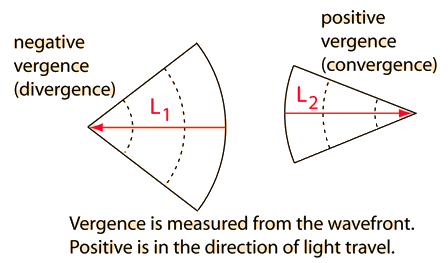
Since the distance L1 is measured from the wavefront and light is traveling left to right, it is a negative distance and the vergence is negative (divergent). L2 is positive since it is directed to the right from the wavefront (convergent).

由于L₁是从波前测量的距离,且光向左上方传播,因此它是一个负距离, vergence 为负(发散)。而L₂是正的,因为它是从波前向右测量的(汇聚)。

The change in vergence when the light encounters a refracting surface is equal to the power of the surface Ps:

当光遇到折射面时,其发散度的变化等于该表面的功率 P s :
V + Ps = V'
Vergence Example
汇聚示例
Vergence Tracing in Thick Lenses
厚透镜的光束追踪
汇聚度 = V = n/L V + P s = V'
Index

Lens concepts

Thick lens concepts

Meyer-Arendt
Ch 1.1
索引透镜概念 厚透镜概念 Meyer-Arendt 第1章1节
 
HyperPhysics***** Light and Vision
HyperPhysics ***** 光与视觉
R Nave
Go Back
返回


Vergence Example

汇聚示例

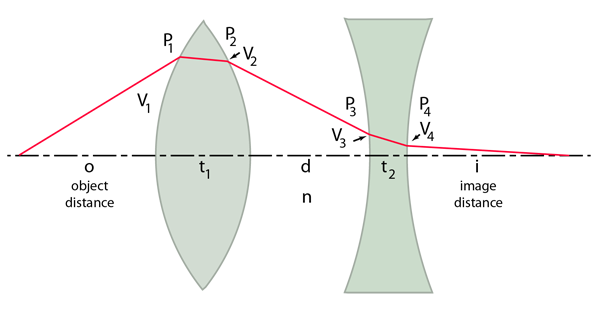
The example below shows a positive lens followed by a negative one, but the powers can be given any value, positive or negative. At each surface the relationship V + Ps = V' is applied, and the change in vergence between surfaces is calculated.

下面的例子显示了一个正透镜后跟一个负透镜,但它们的屈光力可以是任何值,正的或负的。在每个表面,关系式 V + P s = V' 都被应用,且各表面之间的发散度变化被计算。

This calculation will make use of the surface powers of the lenses, their indices of refraction and thickness, and the separation of the lenses. Note that the vertical displacements of the indicated light path are greatly exaggerated since the application of vergence tracing for thick lenses is limited to the small angles of paraxial rays.

这个计算将利用透镜的表面屈光力、折射率和厚度,以及透镜之间的间距。需要注意的是,所指示的光路的垂直位移被大大夸大了,因为厚透镜的 vergence tracing 应用仅限于近轴光线的小角度范围。

A default set of values for the parameters of this calculation is provided. You can see the default calculation by entering a 0 into one of the lens parameters, which will trigger the entry of the default parameters for the lenses. Any of them may be then changed to explore the behavior of the lens system.

Lens 1:
n1 = , P1=, P2=, thickness t1 =

透镜1:n 1 = , P 1 = , P 2 = , 厚度 t 1 =
中文译文中的待填/计算数值依次对应:1:n1 2:p1 3:p2 4:t1。实际数值以上方原输入框为准。

Lens 2:
n2 = , P3=, P4=, thickness t2 =

透镜2:n₂ = ,P₃ = ,P₄ = ,厚度t₂ =
中文译文中的待填/计算数值依次对应:1:n2 2:p3 3:p4 4:t2。实际数值以上方原输入框为准。

Lens separation d =

The vergences can be calculated from the lens parameters and the object distance.The change in vergence when the light encounters a refracting surface is equal to the power of the surface:

透镜的 vergence 可以通过透镜参数和物体距离计算得出。当光遇到折射面时,其 vergence 的变化等于该表面的 power :

Using the Cartesian sign convention, the object distance is typically a negative number since it points opposite to the direction of light travel.

根据笛卡尔符号约定,物距通常为负数,因为它方向与光的传播方向相反。

Object distance o = m.

物体距离 o = m。
中文译文中的待填/计算数值依次对应:1:o。实际数值以上方原输入框为准。

The vergences can then be calculated.

则可以计算出 vergences。

V1 = n0/o = m-1

透镜间距 d =
中文译文中的待填/计算数值依次对应:1:d 2:v1。实际数值以上方原输入框为准。

V11 = vergence inside Lens 1 = V1 + P1 = n1/i1 = m-1
where i1 = intermediate image distance if formed by P1 alone inside medium of index n1.

V₁₁ = 透镜1内的发散量 = V₁ + P₁ = n₁ / i₁ = m - 1 其中 i₁ 是若仅由 P₁ 在索引为 n₁ 的介质中单独形成时的中间像距。
中文译文中的待填/计算数值依次对应:1:v11。实际数值以上方原输入框为准。

V12 = vergence before exiting Lens 1 = n1/(i1 - t 1) = m-1

V2 = n1/(i1 - t 1) +P2 = 1/i2 =m-1
where i2 is the projected image distance upon exit from Lens 1.

V₂ = n₁/(i₁ - t₁) + P₂ = 1/i₂ = m - 1,其中i₂是从透镜1退出时的像距。
中文译文中的待填/计算数值依次对应:1:v2。实际数值以上方原输入框为准。

V3 = 1/(i2 - d) = m-1

V31 = vergence just inside Lens 2 = V3 + P3 = n2/i3 = m-1
where i3 is the projected image distance if formed within the second lens medium.

V31 是 Lens 2 内侧的会聚度,即 V31 = V3 + P3 = n2 / i3 = m - 1,其中 i3 是如果在第二透镜介质中形成像时的投影像距。
中文译文中的待填/计算数值依次对应:1:v31。实际数值以上方原输入框为准。
V₁₂ = 透镜1出口前的发散度 = n₁/(i₁ - t₁) = m - 1
中文译文中的待填/计算数值依次对应:1:v12 2:v3。实际数值以上方原输入框为准。

V32 = vergence before exiting Lens 2 = n2/(i3 - t 2) = m-1.

V4 = n2/(i3 - t 2) + P4 = 1/i =m-1
Where i is the image distance measured from the final surface.

V₄ = n₂/(i₃ - t₂) + P₄ = 1/i = m - 1 其中i是从最终表面测量的像距。
中文译文中的待填/计算数值依次对应:1:v4。实际数值以上方原输入框为准。

The values i1, i2, and i3 are calculated as intermediate values above would be the image distances inside the glass with just the most recent surface power acting. This calculation presumes that these image distances are greater than the thickness of the lenses in which they are calculated, and that may not be true for the lens parameters chosen. It is also presumed that the medium is air so that n0 = 1.

i₁、i₂ 和 i₃ 的值是如上所述的中间值,表示仅由最近一个表面的功率作用下玻璃内的像距。该计算假定这些像距大于它们所计算的透镜的厚度,但可能对于所选择的透镜参数来说并不成立。同时假定介质是空气,因此 n₀ = 1。

The exit vergence from the final surface determines the image distance with respect to that surface.

最终表面的出射发散率决定了该表面相对于像距的大小。

Image distance i = 1/V4 = m.

像距 i = 1/V 4 = m。
中文译文中的待填/计算数值依次对应:1:i。实际数值以上方原输入框为准。
V 32 = 透镜2出口处的发散度 = n 2 / (i 3 - t 2 ) = m -1 .
中文译文中的待填/计算数值依次对应:1:v32。实际数值以上方原输入框为准。
Compare to solution by matrix method
与矩阵方法求解结果比较
Vergence Tracing in Thick Lenses
厚透镜的光束追踪
该计算的参数提供了一组默认值。您可以通过将其中一个透镜参数输入0来查看默认计算,这将触发透镜的默认参数输入。之后可以更改任何参数以探索透镜系统的特性。
Index

Lens concepts

Thick lens concepts
索引透镜概念 厚透镜概念
 
HyperPhysics***** Light and Vision
HyperPhysics ***** 光与视觉
R Nave
Go Back
返回