Grand Canyon and Grand Staircase
A showcase of the history of sedimentary rock
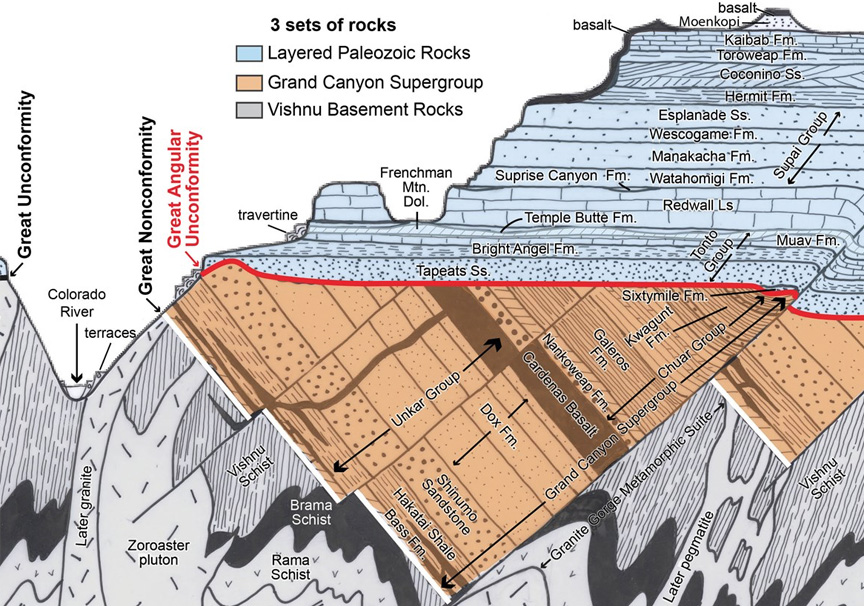
The Grand Canyon and the layered formations north of it to Zion Canyon and Bryce Canyon display the history of sedimentary rock through much of Earth's history. The formations rise in what is often called the "grand staircase". The multiple layers offer an opportunity to survey many types of sedimentary formations. The illustration below will be used as a key to the discussion of the multiple formations. This illustration is patterned after one in "The Grand Canyon", C. Hill, et al., eds, Figure 3-2 and a similar color scheme is followed for organization of the comments.
Because the Grand Canyon exposes a large fraction of the Earth's geologic history, it has been the subject of intensive study. A recent review of studies up to 2020 by Karlstrom, Crossey, Mathis and Bowman, Telling Time at Grand Canyon National Park, summarizes the efforts to accurately date the features of the Canyon. An even more recent review of this material can be found in the National Park Service's website which is beautifully illustrated and includes updates on the "Telling Time .." article.

 | Claron FormationClaron 岩层
The Claron Formation is a lake deposit (limestone) from the Cenozoic Era containing fossils of freshwater fish and an abundance of fossils of freshwater snails.(Hill,et al.,Ch3) The unique pillars of Bryce Canyon, called hoodoos, are carved into this formation. There are fossils of animals like bison and of flowering plants, but none of the extinct species such as trilobites and dinosaurs.(Hill,et al.,Ch4) 克拉伦组是一种晚太古代时期的湖泊沉积物(石灰岩),其中含有淡水鱼和大量淡水蜗牛的化石。(Hill等,第3章) Bryce Canyon独特的石柱被称为石笋,是由这种沉积物雕刻而成的。其中含有类似野牛的动物化石和开花植物的化石,但没有三叶虫和恐龙等灭绝物种的化石。(Hill等,第4章) Caanan Peak Formation卡纳安峰形成 Named for exposures of this formation around Caanan Peak, this formation is mostly a coarse clastic unit characterized by gray, tan, light-brown and pink conglomerates and conglomeratic sandstones. The material is thought to be associated with river and stream deposition and varies in thickness from about 40ft to 1000 ft. It sits atop the Kaiparowits Formation but is mostly absent in the Bryce Canyon area. It is associated with the Paleocene epoch. USGS report, Wiki Kaiparowits FormationKaiparowits Formation(矿物名)
The Kaiparowits Formation is placed in the Mesozoic Era, Cretaceous Period. The fossils found there are terrestrial fossils: frogs, lizards, turtles, crocodiles, duckbill dinosaurs, horned dinosaurs, theropod dinosaurs, and marsupial mammals. (Hill,et al.,Ch13) It is characterized by gray sandstones and mudstones, and is in the neighborhood of 100ft (30m) thick in the Bryce Canyon area. Wiki
以Caanan Peak附近暴露的沉积物命名,这一地层主要由粗粒碎屑岩组成,特征为灰色、浅黄、浅棕色和粉红色的砾岩和碎屑质砂岩。该沉积物被认为与河流和溪流沉积有关,厚度从约40英尺到1000英尺不等。它位于Kaiparowits地层之上,但在Bryce Canyon地区大多缺失。它与白垩纪时期有关。USGS报告,维基百科将Kaiparowits地层归入中生代白垩纪时期。在那里发现的化石是陆生化石:青蛙、蜥蜴、乌龟、鳄鱼、鸭嘴龙、有角恐龙、兽脚类恐龙和有袋类哺乳动物。(Hill等,第13章)其特征为灰色砂岩和泥岩,并且在Bryce Canyon地区厚度约为100英尺(30米)。维基百科 |
 | Wahweap Formation瓦赫韦普形成
The Wahweap Formation is placed in the Mesozoic Era, Cretaceous Period. It has sandstone and siltstone and is the source of a significant variety of invertebrate fossils: insect burrows in petrified logs, mollusks, crabs, gastropods. Freshwater fish fossils have been recovered: bowfin, rays, probable lungfish burrows. Several dinosaur fossils have been found: hadrosaur, ceratopsian, theropod. Wiki.
Straight Cliffs Formation直立峭壁构造
The Straight Cliffs Formation is placed in the Mesozoic Era, Cretaceous Period. The fossils found there are terrestrial fossils: frogs, lizards, turtles, crocodiles, duckbill dinosaurs, horned dinosaurs, theropod dinosaurs, and marsupial mammals. (Hill,et al.,Ch13)
Tropic Shale热带页岩
The Tropic Shale formation is placed in the Mesozoic Era, Cretaceous Period. Fossils found there include ammonites, sharks and plesiosaurs. (Hill,et al.,Ch13) 三叠纪时期的特里克 shale 地层中发现了鹦鹉螺、鲨鱼和海龙兽的化石。(Hill 等,第13章)
瓦赫普组位于中生代的白垩纪时期,由砂岩和淤岩组成,是多种无脊椎动物化石的来源:包括在化石木中的昆虫穴居、软体动物、螃蟹和双壳类。已发现的淡水鱼类化石包括弓鳍鱼、鳐鱼和可能的肺鱼穴居。已发现几种恐龙化石:鸭嘴龙、角龙类和兽脚类恐龙。维基。直崖组位于中生代的白垩纪时期。该地发现的化石为陆生化石:青蛙、蜥蜴、龟类、鳄鱼、鸭嘴恐龙、角龙类恐龙、兽脚类恐龙和有袋类哺乳动物。(Hill等,第13章) |

Dakota Formation
The Dakota Formation is placed in the Mesozoic Era, Cretaceous Period. Fossil pollen and spores have been collected here. (Hill,et al.,Ch14)
Entrada Formation
Carmel Formation
The Carmel Formation (limestone) dating to the Mesozoic Era, Jurassic Period, contains many fossil examples of marine fauna. There are many marine invertebrates including corals, crinoids, oysters and other bivalves, and the extinct cephalopods known as ammonites. (Hill,et al.,Ch13)
Temple Cap Formation
Navajo Sandstone
Kayenta Formation
Moenave Formation
Wingate Sandstone
Chinle Formation
"The Chinle Formation s placed in the Mesozoic Era, Triassic Period. It consists of colorful mudstones and siltstones that erode to form the low, rounded hills of Arizona's Painted Desert and Petrified Forest National Park."(Hill,et al.,Ch13) Fossils preserved here are many primitive conifer trees and several groups of plants that do not appear in underlying Paleozoic rocks. There are also fossils of insects and scorpions, freshwater fish and a variety of tetrapods. There are fossils of early dinosaurs. Hill, et al. lists freshwater clams, crayfish, beetles, lungfish, phytosaurs, aetosaurs, and an early bipedal dinosaur, Coelophysis. No marine organisms of any kind have been found in the Chinle Formation.
Moenkopi Formation
 | Kaibab Formation卡布 Formation
The Kaibab Formation is placed in the Paleozoic Era, Permian Period. The fossils found there are marine fossils: sponges, corals,brachiopods, bryozoans, gastropods, pelecypods, nautiloids, sharks and bony fish. Trilobites are found, but are rare.(Hill,et al.,Ch13) The projected age is 270 Myr (Hill et. al., Karlstom, et. al.).
Toroweap FormationToroweap Formation(矿物名)
The Toroweap Formation is placed in the Paleozoic Era, Permian Period. The fossils found there are marine fossils: sponges, corals,brachiopods, bryozoans, gastropods, pelecypods, nautiloids, sharks and bony fish. Trilobites are found, but are rare.(Hill,et al.,Ch13) The projected age is 275 Myr (Karlstom, et. al.).
Coconino Sandstone科科尼诺砂岩
Hermit Formation海里形成
With a projected age of about 285 Myr (Karlstom, et. al.) in Permian Period, this formation is made of soft, easily eroded shales which have formed a slope. Its softness has undermined the layers of sandstone and limestone above it and caused large blocks to fall to the lower parts of the canyon. It contains fossils of ferns, conifers and other plants, as well as fossilized tracks of reptiles and anphibians. 该地层的年龄约为285百万年(Karlstom等),属于石炭纪时期。该地层由软而易被侵蚀的页岩组成,形成了一个斜坡。其软性导致上层的砂岩和石灰岩层发生侵蚀,使大量岩块坠落到峡谷的下部。该地层中含有蕨类、裸子植物及其他植物的化石,以及爬行动物和两栖动物的化石足迹。
卡布 formation 被归入古生代的石炭纪。在那里发现的化石是海洋化石:海绵、珊瑚、双壳类、苔藓虫、软体动物、腕足类、头足类、鲨鱼和有骨鱼类。三叶虫也存在,但较少。(Hill等,第13章) 预估年龄为270百万年 (Hill等,Karlstom等)。托罗韦普 formation 被归入古生代的石炭纪。在那里发现的化石是海洋化石:海绵、珊瑚、双壳类、苔藓虫、软体动物、腕足类、头足类、鲨鱼和有骨鱼类。三叶虫也存在,但较少。(Hill等,第13章) 预估年龄为275百万年 (Karlstom等)。 |

 |
Supai Group苏帕伊组
The Supai Group is placed in the Paleozoic Era, Mississippian and Pennsylvanian Periods. The fossils there are marine fossils: brachiopods, gastropods, pelecypods,corals,bryozoans, conodonts, sharks. (Hill,et al.,Ch13) Fossil pollen from conifer-like (non-flowering) trees is found here. (Hill,et al.,Ch14) The projected age is 290-320 Myr (Karlstom, et. al.). This includes Esplanada Sandstone (290Myr), Wescogame Formation (300 Myr), Manakacha Formation (315 Myr), Watahomigi Formation 320 Myr) Supai组属于古生代的密西西比期和石炭纪时期。该地的化石为海洋生物化石:双壳类、软体动物、腕足类、珊瑚、苔藓动物、三叶虫和鲨鱼。 (Hill等,第13章) 这里发现了针叶状(非被子植物)树木的花粉。 (Hill等,第14章) 预估年龄为290-320百万年 (Karlstom等)。这包括Esplanada砂岩(290百万年)、Wescogame组(300百万年)、Manakacha组(315百万年)、Watahomigi组(320百万年)。 |
Surprise Canyon Formation
The Surprise Canyon Formation is placed in the Paleozoic Era, Mississippian and Pennsylvanian Periods. The fossils there are marine fossils: brachiopods, gastropods, pelecypods,corals,bryozoans, conodonts, sharks. (Hill,et al.,Ch13) Fossilized spores from lycopods and ferns are plentiful here and in layers above. In lower layers only the simple trilete (three-lobed) spores from now-extinct simple spore-bearing plants and algae were found.(Hill,et al.,Ch14) The projected age is 325 Myr (Karlstom, et. al.)

Redwall Limestone
The Redwall Limestone is placed in the Paleozoic Era, Mississippian and Pennsylvanian Periods. The fossils there are marine fossils: brachiopods, gastropods, pelecypods,corals,bryozoans, conodonts, sharks. (Hill,et al.,Ch13) It forms sheer cliffs 400-500 ft high which are a barrier to travel to the bottom of the canyon. There are many caves and arches in the limestone. The projected age is 340 Myr.(Hill et. al., Karlstom, et. al.) 红崖石灰岩属于古生代的密西西比期和石炭纪。其中的化石是海洋生物:双壳类、软体动物、腕足类、珊瑚、苔藓动物、三叶虫和鲨鱼。(Hill等,第13章)该石灰岩形成高400-500英尺的陡峭峭壁,成为进入峡谷底部的障碍。石灰岩中有很多洞穴和拱门。其估计年龄为3.4亿年。(Hill等,Karlstom等) |  Photo:nps.gov Photo:nps.gov(矿物名) |
Temple Butte Limestone
The Temple Butte Limestone is placed in the Paleozoic Era, Devonian Period. The fossils there are marine fossils: massive stromatoporoid sponges, rugose corals, tabulate corals, brachiopods, trilobites, placoderm fish, conodonts. (Hill,et al.,Ch13) The projected age is 385 Myr (Hill et. al., Karlstom, et. al.).
Frenchman Mountain Dolostone
Muav Limestone
The Muav Limestone is placed in the Paleozoic Era, Cambrian Period. The fossils there are marine fossils: early trilobites,brachiopods,echinoderms, sponges. (Hill,et al.,Ch13) The projected age is 504 Myr.(Karlstom, et. al.)
Bright Angel Shale
The Bright Angel Shale is placed in the Paleozoic Era, Cambrian Period. The fossils there are marine fossils: early trilobites,brachiopods,echinoderms, sponges. (Hill,et al.,Ch13)The projected age is 506 Myr. (Karlstom, et. al.)
Tapeats Sandstone
Sixtymile Formation

Great Unconformity
The term "unconformity" is used for a location where two layers of rock are in contact, but there is evidence that material is missing, i.e., the two layers were not formed at the same time. The "Great Unconformity" is perhaps the most famous unconformity. At some locations, the Tapeats Sandstone is in direct contact with the Vishnu Basement Rock where the time gap may be 1200 Myr.
Grand Canyon Supergroup
"A thick group of rocks known as the Grand Canyon Supergroup was deposited on top of the schist and granite. Though the group includes several rock types, it is considered as a single unit that experienced a similar history following deposition." 一块被称为大峡谷群的厚层岩石沉积在片麻岩和花岗岩之上。尽管该群包含几种不同的岩石类型,但被认为是一个整体单位,其形成历史在沉积后基本相似。  |
The perspective for this illustration of the Supergroup was taken from Grand Canyon Explorer. The following descriptions are excerpted from that source.
这张超群组的示意图是从Grand Canyon Explorer拍摄的。以下描述摘自该来源。 The Grand Canyon Supergroup of formations shows no animal or multicellular fossils. It is placed in the late Proterozoic Era. 大峡谷群的岩石层中没有动物或多细胞生物的化石。它被归入晚元古代时期。 |
 | Another depiction of the Grand Canyon Supergroup from the opposite direction comes from the National Park Services article on numeric ages. This article is part of a series adapted from the Natural Resources Report "Telling Time at Grand Canyon: 2020 Update". 从相反方向描绘的大峡谷群另一幅图来自国家公园管理局关于数值年龄的文章。这篇文章是改编自自然资源报告《大峡谷:2020年更新》。 |
Vishnu Schist
The precambrian rock that forms the "basement" for the grand staircase strata is generally called Vishnu Basement Rocks, which appear to be of volcanic origin and have been lifted from deeper locations in the time period between 1750 and 1660 Myr. Vishnu Schist is one component of the crystalline basement rock. Another component of basement rock is Elves Chasm Gneiss, which is thought to date to about 1840 Myr. It is in the form of igneous intrusions (called plutons) and contains iron and magnesium rich (mafic) materials. No fossils have been found in this basement rock. It is placed in the early Proterozoic Era. The projected age is 1700-1850 Myr.
Zoroaster Granite
Zoroaster Granite intruded into the Vishnu Schist at the base of the Grand Canyon. The Zoroaster Granite has a characteristic age of 1740 Myr.
A list of the Vishnu Basement Rocks with numeric ages may be found in the National Park Service publication Numeric Ages of Grand Canyon Rocks.
| Examples of sedimentary rock
沉积岩的例子 |
| Geological time scale
地质时间尺度 |
References:
Geophysics
Karlstrom, Crossey, Mathis and Bowman, Telling Time at Grand Canyon National Park
Hill, C., et al.
The Grand Canyon, Ch 3
Lutgens and Tarbuck
Ch 6
Grand Canyon Explorer
| HyperPhysics*****Geophysics
HyperPhysics ***** 地球物理学 | R Nave |