Geologic Time and the Geologic Column
This approach to the sweep of geologic time follows that in "The Grand Canyon", C.Hill, et al., eds. to organize the different periods of life since the beginning of the Cambrian period. The time data from radiometric dating is taken from that source. The times are in millions of years.
For examples that cover most of these time periods, see the outline of the Grand Canyon and Grand Staircase.
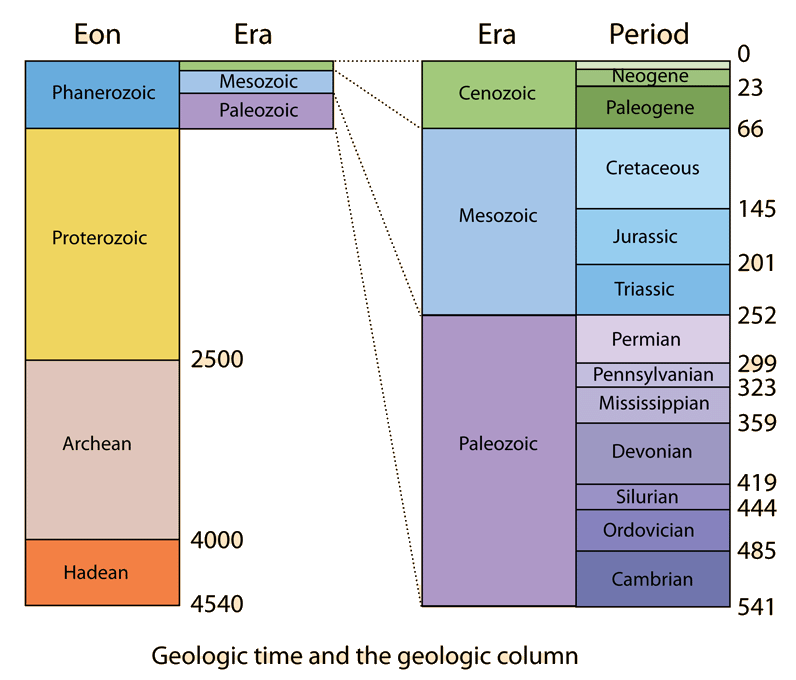
Some descriptive information about the different divisions of geologic time is given below. Lutgens & Tarbuck take on the task of surveying Earth history in one chapter, Chapter 19 of Essentials of Geology. The brief outline below draws from that material and elsewhere to provide a brief sketch of Earth history.
Note that the dates in millions of years are representative values. Research publications would give error bars for such division dates - it is not implied here that these boundaries are known to 3 or 4 significant digits. The division of the geologic column into different periods is largely based upon the varieties of fossils found, taken as indicators of a time period in Earth's history.
 | Quaternary Period, Cenozoic Era, Phanerozoic Eon [1.8 Myr - 0 ]
第四纪时期,新生代纪,显生宙 [1.8百万年 - 0] |
In the time scale of Lutgens & Tarbuck, the Quaternary Period is further divided into the Pleistocene Epoch from 1.8 to 0.01 Myr and the most recent Holocene Epoch from 0.01 Myr to the present.
By the beginning of the Quaternary Period, most of the major plate tectonic movements which formed the North American continent had taken place, and the main modifications past that were those produced by glacial action and erosion processess. Human beings emerged during this Period.
 | Neogene Period, Cenozoic Era, Phanerozoic Eon [23 Myr - 1.8 Myr ]
新生代时期,ozoic纪,Phanerozoic纪 [23百万年 - 1.8百万年 ] |
In the time scale of Lutgens & Tarbuck, the Neogene Period and the Paleogene Period below are combined and called the Tertiary Period. Calling this span from roughly 66 Myr to 1.8 Myr the Tertiary Period is fairly common in geologic literature. It is sometimes referred to as the "age of mammals". 在Lutgens & Tarbuck的时间尺度中,新生代时期和下伏的古生代时期被合并称为第三纪。在地质文献中,将从约66百万年到1.8百万年的这一时期称为第三纪是相当常见的。这一时期有时也被称为‘哺乳动物时代’。 Lutgens & Tarbuck further subdivide this Neogene Period into the Miocene Epoch from 23.8 to 5.3 Myr and the Pliocene Epoch from 5.3 to 1.8 Myr. Lutgens与Tarbuck进一步将新近纪时期划分为从23.8百万年到5.3百万年的Miocene纪,以及从5.3百万年到1.8百万年的Pliocene纪。 | 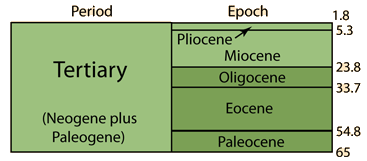 |
 | Paleogene Period, Cenozoic Era, Phanerozoic Eon [66 Myr - 23 Myr ]
古近纪时期,新生代纪,显生宙纪 [66百万年 - 23百万年 ] |
The Paleogene Period (or the early part of the Tertiary Period) represents the time period after the major extinction that wiped out the dinosaurs and about half of the known species worldwide. Lutgens & Tarbuck further subdivide this time period into the Paleocene Epoch (65-54.8Myr), the Eocene Epoch (54.8-33.7Myr), and the Oligocene Epoch (33.7-23.8 Myr).
 | Cretaceous Period, Mesozoic Era, Phanerozoic Eon [145 Myr - 66 Myr ]
白垩纪,中生代,显生宙 [145百万年 - 66百万年 ] |
The Cretaceous Period is perhaps most familiar because of the major extinction event which marks the Cretaceous-Tertiary boundary. It is typically called the K-T extinction, using the first letter of the German spelling of Cretaceous, and it marked the end of the dinosaurs. There is large body of evidence associating this extinction with the large impact crater at Chicxulub, Yucatan Peninsula, Mexico.
The Cretaceous, Jurassic and Triassic Periods are collectively referred to as the "age of reptiles".
The first flowering plants appeared near the beginning of the Cretaceous Period.
Evidence suggests that a vast shallow sea invaded much of western North America, and the Atlantic and Gulf coastal regions during the Cretaceous Period. This created great swamps and resulted in Cretaceous coal deposits in the western United States and Canada.
 | Jurassic Period, Mesozoic Era, Phanerozoic Eon [201 Myr - 145 Myr ]
侏罗纪时期,中生代,显生宙 [201百万年 - 145百万年 ] |
The distinctive fossil progression characteristic of this period was first found in the Jura Mountains of Russia.
Dinosaurs and other reptiles were the dominant species. The Jurassic Period saw the first appearance of birds.
It appears that a shallow sea again invaded North America at the beginning of the Jurassic Period. But next to that sea vast continental sediments were deposited on the Colorado plateau. This includes the Navajo Sandstone, a white quartz sandstone that appears to be windblown and reaches a thickness near 300 meters.
The early Jurassic Period at about 200 Myr saw the beginning of the breakup of Pangaea and a rift developed between what is now the United States and western Africa, giving birth to the Atlantic Ocean. The westward moving Atlantic plate began to override the Pacific plate. The continuing subduction of the Pacific plate contributed to the western mountains and to the igneous activity that resulted in the Rocky Mountains.
 | Triassic Period, Mesozoic Era, Phanerozoic Eon [252 Myr - 201 Myr ]
三叠纪时期,中生代,显生宙 [252百万年 - 201百万年 ] |
Dinosaurs became the dominant species in the Triassic Period.
In North America there is not much marine sedimentary rock of this period. Exposed Triassic strata are mostly red sandstone and mudstones which lack fossils and suggest a land environment.
 | Permian Period, Paleozoic Era, Phanerozoic Eon [299 Myr - 252 Myr ]
二叠纪,古生代,显生宙 [299百万年 - 252百万年 ] |
The Permian Period is named after the Perm region of Russia, where the types of fossils characteristic of that period were first discovered by geologist Roderick Murchison in 1841. The Permian, Pennsylvanian and Mississippian Periods are collectively referred to as the "age of amphibians". By the end of the Permian Period the once dominant trilobites are extinct along with many other marine animals. Lutgens & Tarbuck label this extinction "The Great Paleozoic Extinction" and comment that it was the greatest of at least five major extinctions over the past 600 million years.
The modeling of plate tectonics suggests that at the end of the Permian Period the continents were all together in the form called pangaea, and that the separations that have created today's alignment of continents have all occurred since that time. There is much discussion about the causes of the dramatic biological decline of that time. One suggestion is that having just one vast continent may have made seasons much more severe than today.
 | Pennsylvanian Period, Paleozoic Era, Phanerozoic Eon [323 Myr - 299 Myr ]
石炭纪,古生代,显生宙 [323百万年 - 299百万年 ] |
The Pennsylvanian Period saw the emergence of the first reptiles. This period saw the development of large tropical swamps across North America, Europe and Siberia which are the source of great coal deposits. Named after the area of fine coal deposits in Pennsylvania.
 | Mississippian Period, Paleozoic Era, Phanerozoic Eon [359 Myr - 323 Myr ]
密西西比期,古生代,显生宙 [359百万年 - 323百万年 ] |
Amphibians became abundant in this period, and toward the end of it there is evidence of large coal swamps.
 | Devonian Period, Paleozoic Era, Phanerozoic Eon [419 Myr - 359 Myr ]
泥盆纪,古生代,显生宙 [419百万年 - 359百万年 ] |
The Devonian and Silurian Periods are referred to as the "age of fishes". In the Davonian Period fishes were dominant. Primitive sharks developed. Toward the end of the Davonian there is evidence of insects with the first insect fossils. From finger-sized earlier coastal plants, land plants developed and moved away from the coasts. By the end of the Davonian, fossil evidence suggests forests with trees tens of meters high. The Devonian period is named after Devon in the west of England.
By late Devonian, two groups of bony fishes, the lung fish and the lobe-finned fish had adapted to land environments, and true air-breathing amphibians developed. The amphibians continued to diversify with abundant food and minimal competition and became more like modern reptiles.
 | Silurian Period, Paleozoic Era, Phanerozoic Eon [444 Myr - 419 Myr ]
志留纪,古生代,显生宙 [444百万年 - 419百万年 ] |
The Silurian Period marked the emergence of the first land plants.
 | Ordovician Period, Paleozoic Era, Phanerozoic Eon [485 Myr - 444 Myr ]
奥陶纪,古生代,显生宙 [485百万年 - 444百万年 ] |
The Ordovician and Cambrian Periods are referred to as the "age of invertebrates", with trilobites abundant. In this period, brachiopods became more abundant that the trilobites, but all but one species of them are extinct today. In the Ordovician, large cephalopods developed as predators of size up to 10 meters. They are considered to be the first large organisms. The later part of the Ordovician saw the appearance of the first fishes.
Data suggest that much of North America was under shallow seas during the Ordovician Period. There are large bodies of evaporite rock salt and gypsum which attest to shallow seas.
 | Cambrian Period, Paleozoic Era, Phanerozoic Eon [541 Myr - 485 Myr ]
寒武纪,古生代,显生宙 [541 百万年 - 485 百万年 ] |
The beginning of the Cambrian is the time of the first organisms with shells. Trilobites were dominant toward the end of the Cambrian Period, with over 600 genera of these mud-burrowing scavengers.
The Cambrian Period marks the time of emergence of a vast number of fossils of multicellular animals, and this proliferation of the evidence for complex life is often called the "Cambrian Explosion".
Models of plate tectonic movement suggest a very different world at the beginning of the Cambrian, with that plate which became North America largely devoid of life as a barren lowland. Shallow seas encroached and then receded.
 | Proterozoic Eon [2500 Myr - 541 Myr ]
元古代 [2500 Myr - 541 Myr ] |
Near the end of the Precambrian, there is fossil evidence of diverse and complex multicelled organisms. Most of the evidence is in the form of trace fossils, such as trails and worm holes. It is judged that most of Precambrian life forms lacked shells, making the detection of fossils more difficult. Plant fossils were found somewhat earlier than animal fossils.
There is no coal, oil or natural gas in Precambrian rock.
Rocks from the middle Precambrian, 1200 - 2500 Myr hold most of the Earth's iron ore, mainly as hematite (Fe2O3). This can be taken as evidence that the oxygen content of the atmosphere was increasing during that period, and that it was abundant enough to react with the iron dissolved in shallow lakes and seas. The process of oxidizing all that iron may have delayed the buildup of atmospheric oxygen from photosynthetic life. There is an observable end to this formation of iron ore, so the increase in atmospheric oxygen would have been expected to accelerate at that time.
Fossilized evidence for life is much less dramatic in the pre-Cambrian time frame, with amounts about 88% of Earth's history. The most common Precambrian fossils are stromatolites, which become common about 2000 Myr in the past. Stromatolites are mounds of material deposited by algae. Bacteria and blue-green algae fossils have been found in Gunflint Chert rocks at Lake Superior, dating to 1700 Myr. These are prokaryotic life. Eukaryotic life has been found at about 1000 Myr at Bitter Springs, Australia in the form of green algae.
 | Archean Eon [4000 Myr - 2500 Myr ]
阿瑞安纪元 [4000 Myr - 2500 Myr ] |
Evidence for prokaryotic life such as bacteria and blue-green algae has been found in southern Africa, dated to 3100 Myr. Banded iron formations have been dated to 3700 Myr, and presuming that this requires oxygen and that the only source of molecular oxygen in this era was photosynthesis, this makes a case for life in this time period. There are also stromatolites dated to 3500 Myr.
 | Hadean Eon [4500 Myr - 4000 Myr ]
寒武纪纪 [4500 Myr - 4000 Myr ] |
The age of the Earth is projected to be about 4500 Myr from radiometric dating of the oldest rocks and meteorites. There is evidence of a time of intense bombardment of the Earth in the time period from about 4100 to 3800 Myr in what is called the "late heavy bombardment". There is ongoing discussion about what may have caused this time of intense impacts (see Wiki). There is no evidence for life in this Eon whose name translates to "hellish".
Reference
Hill, C., Davidson, G.,Helble, T.,& Ranney, W.,eds.
The Grand Canyon, Monument to an Ancient Earth.
Lutgens & Tarbuck
Ch 18, 19
| HyperPhysics***** Geophysics
HyperPhysics ***** 地球物理学 | R Nave |