Bilingual edition: English is preserved and Chinese follows each unit. Terminology uses the confirmed v20260916 glossary; automated semantic review remains traceable.
中英双语版:英文原文完整保留,中文紧随对应单元;术语采用 v20260916 确认表,自动语义审校结果可追溯。

Clocks in the Rocks

岩石中的时钟

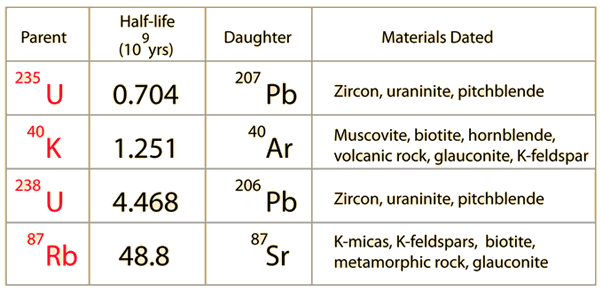
The following radioactive decay processes have proven particularly useful in radioactive dating for geologic processes:

以下放射性衰变过程在地质过程中放射性鉴年法中 proved 特别有用:

Lead isochrons are also an important radioactive dating process.

铅同位素也是一项重要的放射性鉴年法过程

Note that uranium-238 and uranium-235 give rise to two of the natural radioactive series, but rubidium-87 and potassium-40 do not give rise to series. They each stop with a single daughter product which is stable. Some of the decays which are useful for dating, with their half-lives and decay constants are:

注意,铀-238和铀-235产生两种自然存在的放射系,但铷-87和钾-40并不产生系列。它们各自停止于一个稳定的子产物。一些用于测年的衰变,其半衰期和衰变常数如下:
Parent isotope
(radioactive)
母同位素(放射性)
Daughter isotope
(stable)
子同位素(稳定)
Half-life
(Gy)
半衰期(戈瑞)
Decay constant
(10-11yr-1)
衰变常数 (10 -11 yr -1 )
40K
40Ar*
40Ar*
1.25
5.81
87Rb
87瑞利球
87Sr
87锶
48.8
1.42
147Sm
147Sm
143Nd
106
0.654
176Lu
176Hf
35.9
1.93
187Re
187Os
187Os
43
1.612
232Th
232Th
208Pb
208Pb
14
4.948
235U
207Pb
207铅
0.704
98.485
238U
206Pb
206Pb
4.47
15.5125

This data is reproduced from Dalrymple, The Age of the Earth

* Note that 40K also decays to 40Ca with a decay constant of 4.962 x 10⁻¹⁰yr-1, but that decay is not used for dating. The half-life is for the parent isotope and so includes both decays.

注意,40K也衰变成40Ca,其衰变常数为4.962×10⁻¹⁰ yr⁻¹,但这种衰变不用于测年。半衰期是指母同位素的,因此包含了所有衰变过程。

Some decays with shorter half-lives are also useful. Of these, the 14C is unique and used in carbon dating. Note that the decay constant scale in the table below was kept the same as the table above for comparison.

Parent isotope
(radioactive)
母同位素(放射性)
Daughter isotope
(stable)
子同位素(稳定)
Half-life
(y)
半衰期(年)
Decay constant
(10-11yr-1)
衰变常数 (10 -11 yr -1 )
10Be
10B
1.52 x 10⁶
456
36Cl
36Cl
36Ar
36Ar
300,000
2310
14C
14N
5715
1.21 x 10⁵
有些半衰期较短的衰变过程也具有实用性。其中,14C是唯一的,被用于碳测定。请注意,下表中的衰变常数尺度保持与上表一致,以便比较。

Dalrymple's summary of isotopes is that there are 339 isotopes of 84 elements found in nature. Of those isotopes, 269 are stable and 70 are radioactive. Eighteen of the radioactive elements have long enough half-lives to have survived since the beginning of the solar system. The table above includes the main isotopes used for age studies.

Dating of meteorites
陨石的年代测定
Moon rocks
月球岩石
Modeling the age of the Earth
地球年龄的建模
Radionuclides sorted by half-lives
按半衰期分类的放射性核素
达尔利姆佩对同位素的总结是,自然界中有84种元素共有339种同位素。其中269种是稳定的,70种是放射性的。有18种放射性元素的半衰期足够长,自太阳系形成以来一直存在。上表列出了用于年龄研究的主要同位素。
这些数据改编自 Dalrymple,《地球的年龄》
Index

References

Dalrymple
索引参考达利姆佩
 
HyperPhysics***** Nuclear
HyperPhysics ***** 核物理
R Nave
Go Back
返回


Uranium-Lead Dating

铀-铅测年法

Ages determined by radioactive decay are always subject to assumptions about original concentrations of the isotopes. The natural radioactive series which involve lead as a daughter element do offer a mechanism to test the assumptions. Common lead contains a mixture of four isotopes. Lead 204, which is not produced by radioactive decay provides a measure of what was "original" lead. It is observed that for most minerals, the proportions of the lead isotopes is very nearly constant, so the lead-204 can be used to project the original quantities of lead-206 and lead-207. (Lead-208 is the final stable product of the Thorium series, so is not used in uranium-lead dating.) The two uranium-lead dates obtained from U-235 and U-238 have different half-lives, so if the date obtained from the two decays are in agreement, this adds confidence to the date. They are not always the same, so some uncertainties arise in these processes.

由放射性衰变确定的年龄总是受到关于原始同位素浓度假设的限制。涉及铅作为子同位素的天然放射系提供了一种检验这些假设的机制。常见铅包含四种同位素的混合物。铅-204不是由放射性衰变产生的,它提供了一个衡量“原始”铅的指标。观察到对于大多数矿物,铅同位素的比例几乎保持不变,因此铅-204可以用来推断原始铅-206和铅-207的量。(铅-208是钍系的最终稳定产物,因此不用于铀铅测年。)从铀-235和铀-238获得的两个铀铅测年结果具有不同的半衰期,所以如果两种衰变得到的日期一致,这会增加日期的可信度。它们并不总是相同,因此这些过程中会有一些不确定性。

There are powerful rationales for using lead isotopes as indicative of concentrations at the point when the lead-containing mineral was in the molten state. Since the isotopes of lead are chemically identical, any processes that brought lead into the mineral would be completely indiscriminate about which isotope was brought in. The forming mineral will incorporate lead-204, lead-206 and lead-207 at the ratio at which they are found at that location at the time of formation. Any departure from the original relative concentrations of lead-206 and lead-207 relative to lead-204 could then be attributed to radioactive decay.

使用铅同位素作为矿物在熔融状态时浓度的指示物有其强有力的理由。由于铅的同位素化学性质相同,任何将铅带入矿物的过程都不会区分带入的是哪种同位素。形成矿物时,它会按照该地点在形成时所存在的同位素相对比例来吸收铅-204、铅-206和铅-207。因此,如果铅-206和铅-207相对于铅-204的原始相对比例发生偏离,就可以归因于放射性衰变。

Making use of the decay constants of both 238U and 235U, plus the fact that the consistent isotopic ratio of 238U/235U = 137.88 is found, Holmes and Houtermans developed a system to use the ratios of the lead isotopes to produce Pb-Pb isochrons for dating minerals. This approach is generally considered to be the most precise for determining the age of the Earth.

利用238U和235U的衰变常数,以及发现的238U/235U一致同位素比值为137.88这一事实,霍姆斯和霍特曼斯开发了一套系统,利用铅同位素的比例来生成Pb-Pb等时线,以测定矿物的年龄。这种方法通常被认为是最精确确定地球年龄的方法。

Uranium-Lead dating has been used in the Grand Canyon to date layers of deep formations in what is called the Grand Canyon Supergroup. In a set of layers called the Unkar Group there is a lower layer named the Bass Formation which has a layer of volcanic ash at its base. This layer has been dated at 1255 +/-2 Myr by the Uranium-Lead method.

Clocks in the Rocks
岩石中的时钟
铀-铅测年法已被用于大峡谷,以测定大峡谷群中深成岩层的年代。在被称为Unkar群的一组层中,有一个下层称为Bass层,其底部有一层火山灰。该层经铀-铅法测定为1255±2百万年。
Index

Beta decay concepts
β衰变概念索引
 
HyperPhysics***** Nuclear
HyperPhysics ***** 核物理
R Nave
Go Back
返回


Potassium-Argon Method

钾-氩法

Potassium-Argon dating has the advantage that the argon is an inert gas that does not react chemically and would not be expected to be included in the solidification of a rock, so any found inside a rock is very likely the result of radioactive decay of potassium. Since the argon will escape if the rock is melted, the dates obtained are to the last molten time for the rock. The radioactive transition which produces the argon is electron capture.

钾-氩测年法的优点在于,氩是一种惰性气体,化学性质不活泼,因此在岩石凝固时不会被包含其中。因此,若在岩石中发现氩,很可能是钾的放射性衰变产生的。由于氩在岩石熔化时会逃逸,因此测得的年代对应于岩石最后一次熔化的时刻。产生氩的放射性转变是电子捕获过程。

One thing to note about K/Ar dating is that it will never give an overestimate of the age, so it is a good tool for determining lower bounds.

需要注意的是,K/Ar测年法永远不会给出过大的年龄估计,因此它对于确定下限年龄是一个很好的工具。
More detail on Potassium-Argon dating
关于钾-氩测年法的更多细节
Clocks in the Rocks
岩石中的时钟
Index
索引
 
HyperPhysics***** Nuclear
HyperPhysics ***** 核物理
R Nave
Go Back
返回


Rubidium-Strontium Isochrons

铷-锶等时线

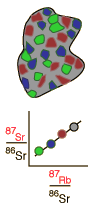
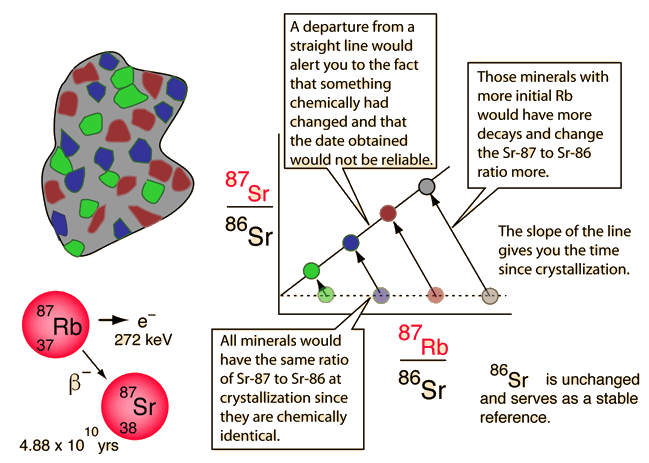
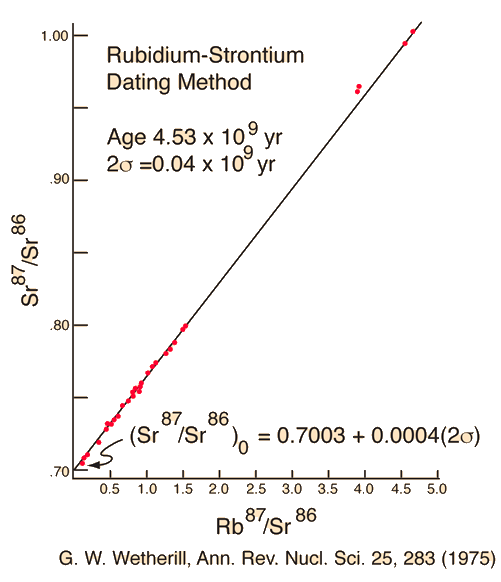
The rubidium-strontium pair is often used for dating and has a non-radiogenic isotope, strontium-86, which can be used as a check on original concentrations of the isotopes. This process is often used along with potassium-argon dating on the same rocks. The ratios of rubidium-87 and strontium-87 to the strontium-86 found in different parts of a rock sample can be plotted against each other in a graph called an isochron which should be a straight line. The slope of the line gives the measured age. The oldest ages obtained from the Rb/Sr method can be taken as one indicator of the age of the earth.

铷-锶同位素对常用于测定年龄,并且具有非放射性同位素锶-86,它可以用来检查原始同位素浓度。这一过程通常与钾-氩测年法一起应用于同一批岩石。岩石样本中不同部位的铷-87和锶-87与锶-86的比值可以在一个称为等时线的图上相互对比,该图应为一条直线。直线的斜率给出了测量的年龄。通过Rb/Sr方法获得的最古老年龄可以作为地球年龄的一个指标。

The isotope 87Rb decays into the ground state of 87Sr with a half-life of 4.88 x 10¹⁰ years and a maximum β- energy of 272 keV.

同位素⁸⁷Rb衰变成⁸⁷Sr的基态,半衰期为4.88×10¹⁰年,最大β-能为272 keV。


Steps of Rubidium-Strontium Isochron Method
铷-锶等时法步骤
Meteorite Dating Example
陨石定年示例
Rb-Sr Isochron of Moon Rock
月岩的Rb-Sr等时线
Clocks in the Rocks
岩石中的时钟
Index
索引
 
HyperPhysics***** Nuclear
HyperPhysics ***** 核物理
R Nave
Go Back
返回


Rubidium-Strontium

铷-锶

The rubidium-strontium dating method is often used in geologic studies.

铷-锶测年法常用于地质研究。

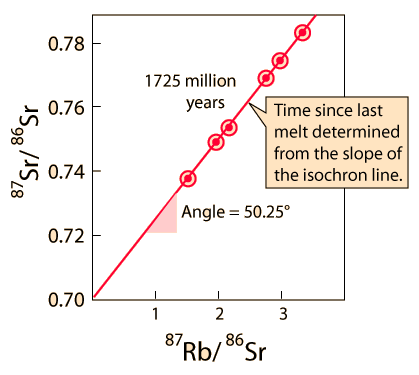
This is a rubidium-strontium isochron for a set of samples of a Precambrian granite body exposed near Sudbury, Ontario. The data is from T. E. Krogh, et al., Carnegie Institute Washington Year Book, Vol 66, 1968, p. 530.

这是来自安大略省苏德伯附近一块前寒武纪花岗岩体的样品的铷-锶等时线。数据来源于T. E. Krogh等人,《华盛顿卡内基研究所年刊》,第66卷,1968年,第530页。
Clocks in the Rocks
岩石中的时钟
Older example of Rb/Sr
Rb/Sr 的早期例子
Index
索引
 
HyperPhysics***** Nuclear
HyperPhysics ***** 核物理
R Nave
Go Back
返回


Age of the Earth

地球年龄

To the intriguing question "How old is the Earth?" we can of course only provide models and model calculations based on the best data we can get. While there are numerous natural processes that can serve as clocks, there are also many natural processes that can reset or scramble these time-dependent processes and introduce uncertainties. To try to set a reasonable bound on the age, we could presume that the Earth formed at the same time as the rest of the solar system. If the small masses that become meteorites are part of that system, then a measurement of the solidification time of those meteorites gives an estimate of the age of the Earth. The following illustration points to a scenario for developing such an age estimate.

对于引人入胜的问题“地球有多老?”我们只能基于所能获得的最佳数据提供模型和模型计算。虽然有许多自然过程可以作为钟表,但也有许多自然过程可以重置或扰乱这些时间依赖过程,并引入不确定性。为了尝试设定一个合理的上限,我们可以假设地球形成于太阳系的其他部分同时。如果成为陨石的小质量体属于该系统,那么测量这些陨石的凝固时间可以估计地球的年龄。以下示例指出了一种开发此类年龄估计的场景。
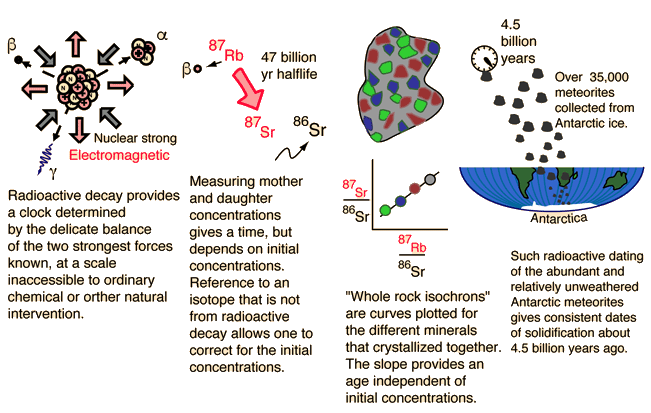
Some of the progress in finding very old samples of rock on the Earth are summarized in the following comments.

一些关于在地球上寻找非常古老的岩石样本的进展总结如下。

"The oldest rocks on earth that have been dated thus far include 3.4 billion year old granites from the Barberton Mountain Land of South Africa, 3.7 billion year old granites of southwestern Greenland, ..." Levin, 1983

目前已知的最古老的岩石包括来自南非巴伯顿山地34亿年前的花岗岩,以及西南格陵兰37亿年前的花岗岩,...。Levin,1983

But later in 1983: "Geologists working in the mountains of western Australia have discovered grains of rock that are 4.1 to 4.2 billion years old, by far the oldest ever found on the Earth" This dating was done on grains of zircon, a mineral so stable that it can retain its identity through volcanic activity, weathering, and sedimentation. It is a compound of zirconium, silicon and oxygen which in its colorless form is used to make brilliant gems. Samples more than 3.5 billion years old have been found in eight or more locations, including Wisconsin, Minnesota, South Africa, Greenland, and Labrador.

但1983年后期:“澳大利亚西部山脉的地质学家发现了一些41至42亿年前的岩石颗粒,这是地球上发现的最古老的颗粒。” 这种 dating 是通过对锆石颗粒进行测定的,锆石是一种非常稳定的矿物,能够在火山活动、风化和沉积过程中保持其身份。它由锆石、硅和氧组成,其无色形式常用于制造璀璨的宝石。在35亿年以上的颗粒已在八个或更多的地点发现,包括威斯康星州、明尼苏达州、南非、格陵兰和拉布拉多。

Older ages in the neighborhood of 4.5 billion years are obtained from meteoritic samples. The graph below follows the treatment of Krane of Rb-Sr studies of meteorite samples from Wetherill in order to show the nature of the calculation of age from isochrons.

从陨石样本中获得的较老年龄约为45亿年。下图遵循Wetherill对陨石样本中Krane的Rb-Sr研究的处理方式,以展示从等时线计算年龄的性质。
Show
calculation
展示计算

If you had 100% pure parent element when you began a dating process, then radioactive dating would be extremely reliable since the radioactive half-life of a given isotope is quite independent of any natural forces save direct collision-type interactions with the nucleus. Considering the relative scale of nuclei and atoms, nuclei are so remote from the outer edge of the atoms that no environmental factors affect them. However, there are two obvious problems with radioactive dating for geological purposes: 1) uncertainty about the composition of the original sample and 2) possible losses of material during the time span of the decay.

如果你在开始年代测定过程时拥有100%纯的母体元素,那么放射性鉴年法将非常可靠,因为某种同位素的放射性半衰期相当独立于任何自然力,除了与核的直接碰撞型相互作用。考虑到核与原子的相对尺度,核如此远离原子的外边缘,以至于没有任何环境因素会影响它们。然而,对于地质学目的而言,放射性鉴年法存在两个明显的问题:1) 对原始样品组成的不确定性,2) 在衰变时间跨度期间可能发生的物质损失。

The rubidium/strontium dating method deals with both of those difficulties by using the non-radioactive isotope strontium-86 as a comparison standard. The relative amounts of strontium-87 and -86 are determined with great precision and the fact that the data fits a straight line is a strong argument that none of the constituents was lost from the mix during the aging process.

铷/锶测年法通过使用非放射性同位素锶-86作为比较标准,解决了上述两个问题。锶-87和锶-86的相对含量可以被精确测定,而数据拟合一条直线的事实是强有力的证据,表明在老化过程中没有成分丢失。

The 4.5 billion year age for the earth is consistent with the results of the potassium/argon and uranium/lead processes. Similar results are also obtained from the study of spontaneous fission events from uranium-238 and plutonium-244.

地球45亿年的年龄与钾/氩和铀/铅过程的结果一致。类似的结果也来自对铀-238和钚-244自发裂变事件的研究。

One of the standard references for modeling the age of the Earth is G. Brent Dalrymple, The Age of the Earth, Stanford University Press, 1991.

对地球年龄建模的一个标准参考是G. Brent Dalrymple所著的《地球的年龄》,由斯坦福大学出版社于1991年出版。
Clocks in the Rocks
岩石中的时钟
Radioactive dating of meteorites
陨石的放射性鉴年法
A brief overview of time.
时间的简要概述。
Index

Reference
Krane
Sec 6.7
索引参考 Krane 第6.7节
 
HyperPhysics***** Nuclear
HyperPhysics ***** 核物理
R Nave
Go Back
返回


Meteorite Dating

陨石定年

"Meteorites, which many consider to be remnants of a disrupted planet that oriaginally formed at about the same time as the earth, have provided uranium-lead and rubidium-strontium ages of about 4.6 billion years. From such data, and from estimates of how long it would take to produce the quantities of various lead isotopes now found on the earth, geochronologists feel that the 4.6-billion-year age for the earth can be accepted with confidence." Levin

陨石,许多人都认为是原本与地球形成时间相近的破坏行星的残骸,提供了约46亿年的铀-铅和rubidium-strontium年龄。从这些数据以及估算出产生现在地球上各种铅同位素数量所需的时间,地质年代学家认为地球约46亿年的年龄可以被放心地接受。Levin
More detail on meteorite dating.
陨石测年更详细的信息。
Clocks in the Rocks
岩石中的时钟
Index
索引
 
HyperPhysics***** Nuclear
HyperPhysics ***** 核物理
R Nave
Go Back
返回


Moon Rock Dating

月岩定年

The ages of rocks returned to Earth from the Apollo missions range from 3.3 to about 4.6 billion years. The older age determinations are derived from rocks collected on the lunar highland, which may represent the original lunar crust.

从阿波罗任务返回地球的岩石年龄范围从33亿年到约46亿年。较老的年龄测定值来自月球高地采集的岩石,这些岩石可能代表原始月球地壳。
Clocks in the Rocks
岩石中的时钟
Age of the Moon
月球的年龄
Index

Reference
Dalrymple
Ch 5
索引参考 Dalrymple 第5章
 
HyperPhysics***** Nuclear
HyperPhysics ***** 核物理
R Nave
Go Back
返回


Age of the Moon

月球的年龄

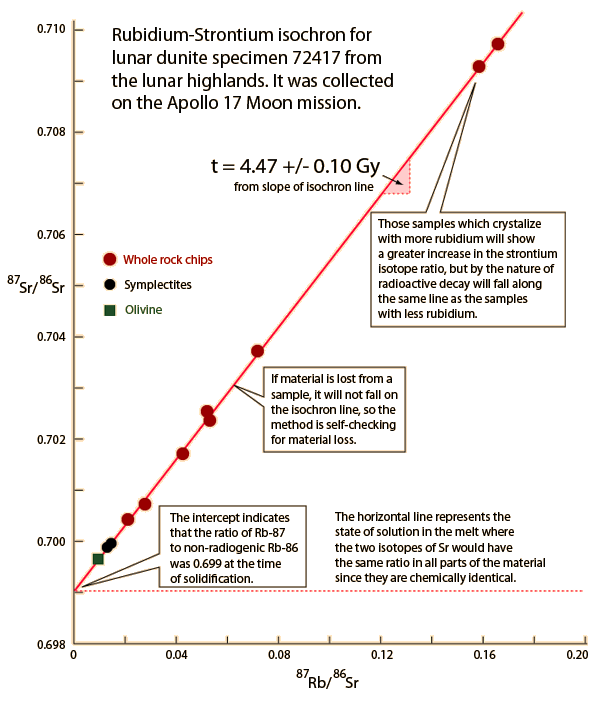
Our best clues to the age of the Moon are the radiometric dates of the oldest Moon rocks, those from the lunar highlands. Dalrymple reports that thirteen samples from the lunar highlands gave the oldest ages. These were collected by Apollo 15, 16, 17 and Luna 20. The radiometric dates range from 3.9 to 4.5 Gy. If we take the oldest ages to be the age of the Moon, then we place that age at about 4.5 Gy.

我们对月球年龄的最佳线索是来自月球高地的最古老月岩的放射性年代测定值。Dalrymple报告说,来自月球高地的13个样本给出了最古老的年龄。这些样本由阿波罗15、16、17号和Luna 20号任务收集。放射性年代测定值范围从3.9到4.5 Gy。如果我们把最古老的年龄视为月球的年龄,那么月球的年龄大约是4.5 Gy。

A sample of the kind of data that leads to such a projected age is the rubidium-strontium isochron of lunar sample 72417 which yields a time to last melting of 4.47 Gy. This isochron was discussed in Dalrymple and credited to Papanastassiou and Wassenburg, 1975.

Data from Papanastassiou, D. A. and Wasserburg, G. J., "Rb-Sr study of a lunar dunite and evidence for early lunar differentiation", Proceedings of the Sixth Lunar Science Conference, 1975, pp. 1467-1489.

Lunar sample 72417
月球样本72417

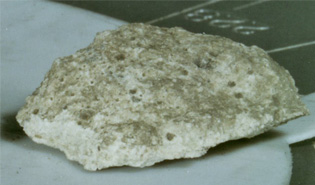
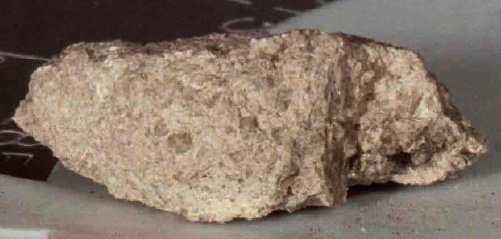
This lunar sample was collected on the Apollo 17 lunar mission. It's largest mineral constituent is olivine and the actual form is called dunite.

这块月球样本是在阿波罗17号月球任务中采集的。其主要矿物成分是橄榄石,实际的矿物名称称为辉石。

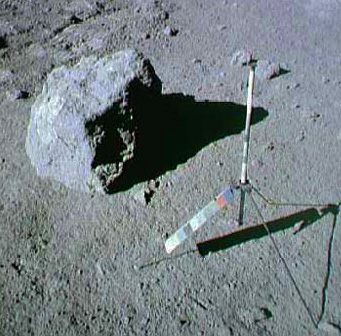
Sample 72417 was one of five chips from this half-meter boulder in found at Station 2 at the base of South Massif. The boulder is described as a metaclastic breccia, and the specific sample location was described as part of a clast of dunite. The boulder showed signs of deformation and crushing by impacts with some shock-induced melting and recrystallization. Even with all these complications, the Rb-Sr isochron is impressive evidence that the samples used for the isochron came out of the melt at about the same time.

样本72417是来自南质架底部第二站半米岩石中的一块芯片,该岩石被描述为一种metaclastic breccia,具体样本位置被描述为一块 dunite 岩石的碎片。该岩石显示出由于撞击引起的变形和破碎,伴有某些冲击熔融和再结晶现象。即使有所有这些复杂因素,Rb-Sr等时线仍是一项令人印象深刻的证据,表明用于等时线的样本大约在同一时间从熔体中形成。

Source boulder for #72417
为#72417获取源 Boulder

Lunar sample 72417
月球样本72417

The sample is about 3cm long, so this view is about 3x actual size.

样品长约3厘米,因此此视图是实际尺寸的3倍。
一种导致此类预测年龄的数据示例是月球样品72417的铷-锶等时线,其得出的最后熔融时间为4.47 Gy。该等时线在Dalrymple的讨论中被提及,并归功于Papanastassiou和Wassenburg,1975年。Papanastassiou, D. A.和Wasserburg, G. J.的数据显示于《第六次月球科学会议论文集》,1975年,第1467-1489页。

Online references:
Catalog entry for sample 72417
Lunar Sample 72417
Wiki on Dunite

Clocks in the Rocks
岩石中的时钟
在线参考:样本72417的目录条目 72417号样本的 dunite 页面
Index

Reference
Dalrymple
Ch 5
索引参考 Dalrymple 第5章
 
HyperPhysics***** Nuclear
HyperPhysics ***** 核物理
R Nave
Go Back
返回