Collisions in Two Dimensions
二维碰撞
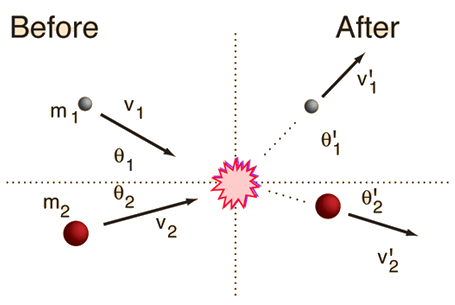
In the general case of a two-dimensional collision between two masses, one cannot anticipate how much kinetic energy will be lost in the collision. Therefore, the velocities of the two masses after the collision are not completely determined by their velocities and directions before the collision. However, conservation of momentum must be satisfied, so that if the velocity of one of the particles after the collision is specified, the other is determined.
|
|
| ||||||||||||||
| Final velocities(specify one, the other will be calculated): 最终速度(指定一个,另一个将被计算): | v'1 =m/s, | θ'1 = ° |
| Final velocities(specify one, the other will be calculated): 最终速度(指定一个,另一个将被计算): | v'2 =m/s, | θ'2 = ° |
|
Final kinetic energy =
最终动能 = | KEf = J
末态动能为焦耳 中文译文中的待填/计算数值依次对应:1:k2。实际数值以上方原输入框为准。 |  |
For ordinary objects, the final kinetic energy will be less than the initial value. The only way you can get an increase in kinetic energy is if there is some kind of energy release triggered by the impact. Was one of your objects a hand grenade?
Further discussion of concepts
进一步讨论概念
在一般情况下,两个质量的二维碰撞中,无法预知碰撞过程中损失多少动能。因此,碰撞后两个质量的 velocities 不能完全由碰撞前的 velocities 和方向确定。然而,动量必须守恒,因此如果碰撞后一个粒子的 velocity 被指定,另一个粒子的 velocity 就可以确定。由于动量必须在大小和方向上都守恒,因此必须找到初始的矢量动量。这通过将动量分解为分量,使用单位矢量符号来完成。这些分量被组合起来,以得到碰撞前系统的总动量。在上方输入质量与速度的值。然后在下方指定一个最终的 velocity。如果计算结果得到正的角度,这意味着它们的方向与图中所示一致。如果角度为负,这意味着角度的方向与图中所示相反。对于普通物体,最终的动能将小于初始值。唯一能增加动能的方式是如果碰撞触发了某种能量释放。其中一个是你的物体是手榴弹吗?
中文译文中的待填/计算数值依次对应:1:v1 2:th1 3:v2 4:th2 5:p1x 6:p2x 7:pix 8:pia 9:v1p 10:th1p 11:v2p 12:th2p。实际数值以上方原输入框为准。
Collision concepts
Elastic collisions
Elastic head-on collisions
索引 碰撞概念 弹性碰撞 弹性正面碰撞
| HyperPhysics***** Mechanics
力学 | R Nave |
返回