Bilingual edition: English is preserved and Chinese follows each unit. Terminology uses the confirmed v20260916 glossary; automated semantic review remains traceable.
中英双语版:英文原文完整保留,中文紧随对应单元;术语采用 v20260916 确认表,自动语义审校结果可追溯。

Magnetic Interactions and the
Lande' g-Factor

磁相互作用与兰德 g 因子
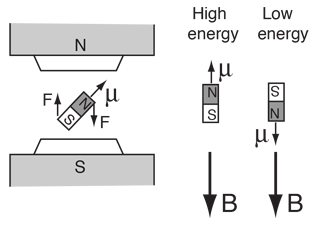
A magnetic moment experiences a torque in a magnetic field B. The energy of the interaction can be expressed as

.

Both the orbital and spin angular momenta contribute to the magnetic moment of an atomic electron.

轨道角动量和自旋角动量都对原子电子的磁矩有贡献。
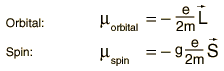
.
where g is the spin g-factor and has a value of about 2, implying that the spin angular momentum is twice as effective in producing a magnetic moment.
磁矩在磁场B中会受到力矩的作用。相互作用的能量可以表示为 。其中g是自旋g因子,其值约为2,这意味着自旋角动量在产生磁矩方面是两倍有效的。

The interaction energy of an atomic electron can then be written

原子电子的相互作用能可以写成
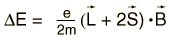
.

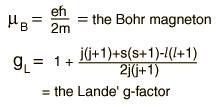
which when evaluated in terms of the relevant quantum numbers takes the form

当用相关的量子数来表示时,其形式为
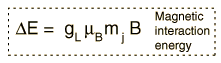
.

Show evaluation process

展示评估过程
Zeeman interaction
塞曼相互作用
Anomalous Zeeman effect
异常塞曼效应
Index

Schrodinger equation concepts

Hydrogen concepts
索引 希尔伯特方程概念 氢原子概念
 
HyperPhysics***** Quantum Physics
HyperPhysics ***** 量子物理
R Nave
Go Back
返回


Evaluating the Lande' g-Factor

计算兰德 g 因子
The Lande' g-factor is a geometric factor which arises in the evaluation of the magnetic interaction which gives the Zeeman effect. The magnetic interaction energy


which is continuous in the classical case takes on the quantum form

在经典情况下连续的,在量子情况下则呈现为量子形式

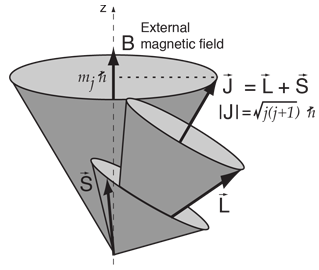
which is like a vector operation based on the vector model of angular momentum

这类似于基于角动量矢量模型的矢量运算

兰德-g因子是一个几何因子,出现在计算磁相互作用以解释塞曼效应的过程中。磁相互作用的能量
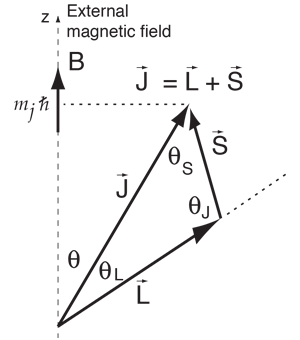
The problem with evaluating this scalar product is that L and S continually change in direction as shown in the vector model. The strategy for dealing with this problem is to use the direction of the total angular momentum J as a coordinate axis and obtain the projection of each of the vectors in that direction. This is done by taking the scalar product of each vector with a unit vector in the J direction.


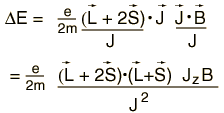
These vector relationships must be evaluated and expressed in terms of quantum numbers in order to evaluate the energy shifts. Carrying out the scalar products above leads to

这些矢量关系必须被评估并用量子数表示,以便计算能量变化。进行上述标量积运算将得到

Show reduction to standard form
化为标准形式
评估这个标量积的问题在于,L 和 S 的方向持续变化,如向量模型所示。解决这个问题的策略是将总角动量 J 的方向作为坐标轴,并获得每个向量在该方向上的投影。这是通过将每个向量与 J 方向的单位向量进行标量积来实现的。
Index

Schrodinger equation concepts
索引:薛定谔方程概念
 
HyperPhysics***** Quantum Physics
HyperPhysics ***** 量子物理
R Nave
Go Back
返回


Lande' g-Factor Evaluation

兰德 g 因数评估

In the evaluation of the Lande' g-factor by the vector model, the expression

在用矢量模型计算兰德-g因子时,表达式

must be simplified. Evaluating the remaining scalar product requires the vector model for total angular momentum.

必须进行简化。评估剩余的标量积需要向量模型来表示总角动量。

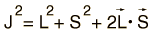
The law of cosines can be employed for evaluation of the scalar product.

余弦定律可以用于计算标量积。

Expressing this in terms of the external angle gives

用外角表示为

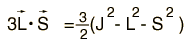
Rearranging gives the scalar product term needed

重新排列可得到所需的标量积项


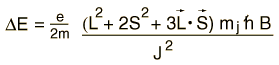
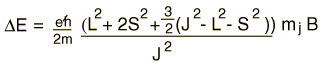
Substitution into the energy expression gives

将能量表达式代入得到

which can be reduced to


where

其中

Discussion of magnetic interaction
磁相互作用讨论
Anomalous Zeeman effect
异常塞曼效应
这可以简化为
Index

Schrodinger equation concepts
索引:薛定谔方程概念
 
HyperPhysics***** Quantum Physics
HyperPhysics ***** 量子物理
R Nave
Go Back
返回