Liquid Helium Working Range
液氦工作范围
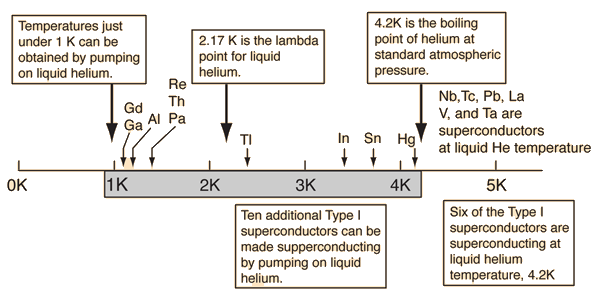
Liquid helium液氦 | Lambda pointLambda 点 | Superconductors超导体 |
Reference:
Blatt
索引参考:Blatt
| HyperPhysics***** Quantum Physics
HyperPhysics ***** 量子物理 | R Nave |
返回
Liquid Helium液氦
Kamerlingh Onnes worked for many years to liquify the element which persisted as a gas to the lowest temperature. Using liquid air to produce liquid hydrogen and then the hydrogen to jacket the liquification apparatus, he produced about 60 cubic centimeters of liquid helium on July 10, 1908. Its boiling point was found to be 4.2 K. Onnes received the Nobel Prize in 1913 for his low temperature work leading to this achievement. 卡门林·昂内斯多年来致力于液化在最低温度下仍以气体形式存在的元素。他利用液态空气产生液态氢,并用氢气作为保护层,使液化装置得以工作,于1908年7月10日产生了约60立方厘米的液氦。其沸点为4.2 K。昂内斯因低温领域的研究工作而于1913年获得诺贝尔奖。
When helium is cooled to a critical temperature of 2.17 K (called its lambda point), a remarkable discontinuity in heat capacity occurs, the liquid density drops, and a fraction of the liquid becomes a zero viscosity "superfluid". Superfluidity arises from the fraction of helium atoms which has condensed to the lowest possible energy. 当氦气冷却到2.17 K的临界温度(称为其lambda点)时,出现显著的热容量突变,液态密度下降,并且一部分液态变为零粘度的‘超流体’。超流性源于一部分氦原子凝结到最低可能的能级。
An important application of liquid helium has been in the study of superconductivity and for the applications of superconducting magnets. 液氦的重要应用在于超导性的研究以及超导磁体的应用。
Liquid helium working range液氦工作范围 |
Index
索引 | ||
|
Go Back
返回 |
Liquid Helium Working Range液氦工作范围
|
Index Reference: Blatt 索引参考:Blatt | |||
|
Go Back
返回 |
Superfluidity超流性
A remarkable transition occurs in the properties of liquid helium at the temperature 2.17K, called the "lambda point" for helium. Part of the liquid becomes a "superfluid", a zero viscosity fluid which will move rapidly through any pore in the apparatus. 在液氦温度为2.17K时,其性质发生显著变化,这一温度被称为“lambda点”。部分液氦变为“超流体”,这是一种零粘性的流体,能够迅速通过装置中的任何孔隙。
A vacuum container which seemed to be leak tight could suddenly leak helium rapidly as the superfluid moved out through a microscopic hole. A vertical tube could produce a fountain effect as the superfluid moved up the walls and out the top. 一个似乎密封良好的真空容器突然会迅速泄漏氦气,因为超流体通过微小的孔洞流出。垂直的管子可以使超流体沿壁上升并从顶部流出,产生喷泉效应。
In 1938, F. London proposed a "two-fluid" model to explain the behavior of the liquid: normal liquid and the superfluid fraction consisting of those atoms which have "condensed" to the ground state and make no contribution to the entropy or heat capacity of the liquid. This condensed fraction is the standard example of Bose-Einstein condensation. 1938年,F. London提出一个‘两流体’模型来解释液体的行为:正常流体和超流体部分,后者由那些‘凝聚’到基态的原子组成,这些原子不贡献于液体的熵或热容。这个凝聚部分是玻色-爱因斯坦凝聚的典型例子。
Another remarkable characteristic of the superfluid is its very high heat conductivity, 30 times that of copper! 超流体另一个显著的特点是其极高的热导率,是铜的30倍!
Application in IRAS Satellite在红外线卫星中的应用 |
Index Reference: Blatt 索引参考:Blatt | ||
|
Go Back
返回 |
Lambda Point for Liquid Helium氦液态的Lambda点
When helium is cooled to a critical temperature of 2.17 K , a remarkable discontinuity in heat capacity occurs, the liquid density drops, and a fraction of the liquid becomes a zero viscosity "superfluid". It is called the lambda point because the shape of the specific heat curve is like that Greek letter. Superfluidity arises from the fraction of helium atoms which has condensed to the lowest possible energy by a process called Bose-Einstein condensation.  Specific heat data from Buckingham and Fairbank, 1961, p. 138. Buckingham和Fairbank, 1961年,第138页提供的比热数据。
Liquid helium working range液氦工作范围 当氦气冷却到2.17 K的临界温度时,出现显著的热容量突变,液体密度下降,并且一部分液体变为零粘度的‘超流体’。这种现象称为lambda点,因为比热容曲线的形状类似于希腊字母λ。超流性源于一部分氦原子通过称为玻色-爱因斯坦凝聚的过程凝结到最低可能的能量状态。 |
Index Reference: Blatt 索引参考:Blatt | ||
|
Go Back
返回 |