Bilingual edition: English is preserved and Chinese follows each unit. Terminology uses the confirmed v20260916 glossary; automated semantic review remains traceable.
中英双语版:英文原文完整保留,中文紧随对应单元;术语采用 v20260916 确认表,自动语义审校结果可追溯。

Superconducting Magnets

超导磁体

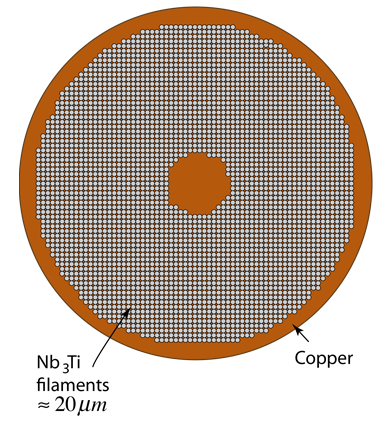
Type II superconductors such as niobium-tin and niobium-titanium are used to make the coil windings for superconducting magnets. These two materials can be fabricated into wires and can withstand high magnetic fields. Typical construction of the coils is to embed a large number of fine filaments ( 20 micrometers diameter) in a copper matrix. The solid copper gives mechanical stability and provides a path for the large currents in case the superconducting state is lost. These superconducting magnets must be cooled with liquid helium. Superconducting magnets can use solenoid geometries as do ordinary electromagnets.

类型II超导体,如铌锡和铌钛,用于制造超导磁体的线圈。这两种材料可以制成导线,并且能够承受强磁场。典型的线圈构造是将大量细丝(直径20微米)嵌入铜基体中。固体铜提供机械稳定性,并在超导状态丧失时为大电流提供路径。这些超导磁体必须用液氦冷却。超导磁体可以像普通电磁铁一样使用螺线管几何结构。

Most high energy accelerators now use superconducting magnets. The proton accelerator at Fermilab uses 774 superconducting magnets in a ring of circumference 6.2 kilometers. They have also found wide application in the construction of magnetic resonance imaging (MRI) apparatus for medical imaging.

大多数高能加速器现在都使用超导磁体。费米实验室的质子加速器使用774个超导磁体,形成一个周长为6.2公里的环。它们在医疗成像的磁共振成像(MRI)装置制造中也得到了广泛应用。

Energy-saving example
节能示例
Index

Superconductivity concepts

Reference Rohlf,Ch 15
索引 超导概念 参考 Rohlf,第15章
 
HyperPhysics***** Condensed Matter
HyperPhysics ***** 凝聚态物理
R Nave
Go Back
返回


Niobium-Titanium Superconductor

铌-钛超导体

Niobium-titanium is a Type-II superconductor with a critical temperature of 10 K and a critical magnetic field of 15 Tesla. While both of these values are lower than those for niobium-tin, this material has become the material of choice for superconducting magnets because of its mechanical properties.
To make magnet wire, the niobium-titanium is formed into filaments finer than human hair and embedded in a matrix of solid copper. The fine filaments are advantageous because current flows only within a skin-depth of the surface of a superconductor. The solid copper forms a solid mechanical structure which will also carry the current if the superconducting phase is lost.
为了制造磁线,铌钛合金被制成比人类头发更细的丝状物,并嵌入固态铜的基体中。细丝的优势在于电流仅在超导体表面的皮肤深度内流动。固态铜形成一个固态机械结构,如果超导相丧失,它也将承载电流。

铌钛合金是一种II型超导体,其临界温度为10 K,临界磁场为15特斯拉。虽然这些值低于铌锡合金,但这种材料因其机械性能成为超导磁体的首选材料。
Further detail
进一步细节
Index

Superconductivity concepts

Reference Batlogg
索引 超导概念 参考文献 Batlogg
 
HyperPhysics***** Condensed Matter
HyperPhysics ***** 凝聚态物理
R Nave
Go Back
返回


Superconducting Magnet Wire of Niobium-Titanium

铌钛超导磁线

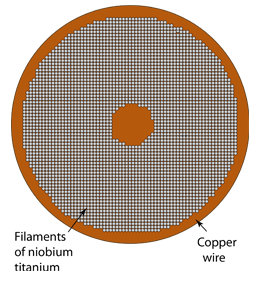
Ohanian's Physics has a photograph of a cross- section of copper wire of diameter 0.7 mm with 2100 filaments of niobium-titanium embedded in it. This is an approximate sketch of the geometry. Although copper is one of the best room- temperature conductors, it acts almost as an insulator between the strands.

Ohanian 的《物理学》中有一张铜线的横截面图,该线的直径为0.7毫米,内部嵌有2100根铌-钛合金丝。这是一张近似的几何示意图。尽管铜是室温下最好的导体之一,但在丝之间它几乎像绝缘体一样。

Index

Superconductivity concepts

Reference Ohanian
索引 超导概念 参考 Ohanian
 
HyperPhysics***** Condensed Matter
HyperPhysics ***** 凝聚态物理
R Nave
Go Back
返回


Argonne Bubble Chamber

阿贡泡室

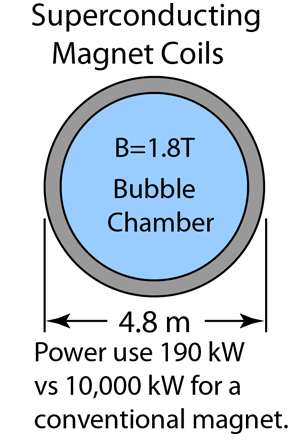
As an example of the energy savings attainable with superconducting magnets, a bubble chamber at Argonne National Laboratory has a 4.8 meter diameter magnet producing a magnetic field of 1.8 Tesla. After establishing the magnetic field, only about 190 kW is required to maintain the liquid helium refrigeration.
This magnet coil is made from niobium-titanium alloy embedded in copper. The cost of construction of this coil was about the same as for a conventional magnet, but it has a 10:1 operating cost advantage.
这种磁体线圈是由嵌入铜中的铌-钛合金制成的。这种线圈的建造成本与常规磁体大致相同,但其运行成本优势为10:1。

作为超导磁体所能实现的节能示例,阿贡国家实验室的泡室有一个直径4.8米的磁体,产生1.8特斯拉的磁场。在建立磁场之后,仅需约190千瓦的功率来维持液氦制冷。
Index

Superconductivity concepts

Reference Ohanian Interlude 8, pg VIII-8
索引 超导概念 参考 Ohanian 间章 8,第 VIII-8 页
 
HyperPhysics***** Condensed Matter
HyperPhysics ***** 凝聚态物理
R Nave
Go Back
返回


Fermilab Supermagnets

费米实验室超磁体

At Fermilab, the ultimate particle energy was increased by using superconducting magnets and the operating cost was greatly reduced. They developed 7 meter long tubular magnets which generate a field of 4.5 Tesla. Around the accelerator ring of circumference 6.2 km, there are 774 of these supermagnets with an additional 240 magnets used for focusing the particle beam.

在费米实验室,通过使用超导磁体将粒子的最高能量提高,同时运营成本大大降低。他们开发了7米长的管形磁体,产生4.5特斯拉的磁场。在周长为6.2公里的加速器环周围,有774个这样的超导磁体,此外还有240个用于聚焦粒子束的磁体。

Particles are first accelerated in a ring of conventional magnets and then injected into the superconducting magnet ring called the Tevatron for the final stage of acceleration to about a million MeV.

粒子首先在常规磁体组成的环中被加速,然后被注入称为Tevatron的超导磁体环,进行最终阶段的加速,使其能量达到约一百万MeV。
Index

Superconductivity concepts

Reference Ohanian
索引 超导概念 参考 Ohanian
 
HyperPhysics***** Condensed Matter
HyperPhysics ***** 凝聚态物理
R Nave
Go Back
返回


Superconductors in NMR Imaging

超导体在核磁共振成像中的应用

Superconducting magnets find application in magnetic resonance imaging (MRI) of the human body. Besides requiring strong magnetic fields on the order of a Tesla, magnetic resonance imaging requires extremely uniform fields across the subject and extreme stability over time. Maintaining the magnet coils in the superconducting state helps to achieve parts-per-million spacial uniformity over a space large enough to hold a person, and ppm/hour stability with time.

超导磁体在人体磁共振成像(MRI)中得到应用。除了需要强度达特斯拉量级的强磁场外,磁共振成像还需要在被检者范围内具有极高的空间均匀性,并在时间上具有极高的稳定性。保持磁体线圈处于超导状态有助于在足以容纳一个人的空间范围内实现每百万分之一级别的空间均匀性,并实现每小时百万分之一级别的稳定性。
Index

Superconductivity concepts

Reference Ohanian
索引 超导概念 参考 Ohanian
 
HyperPhysics***** Condensed Matter
HyperPhysics ***** 凝聚态物理
R Nave
Go Back
返回