Laminar Flow层流
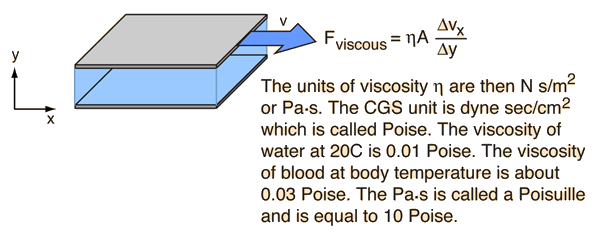
The resistance to flow in a liquid can be characterized in terms of the viscosity of the fluid if the flow is smooth. In the case of a moving plate in a liquid, it is found that there is a layer or lamina which moves with the plate, and a layer which is essentially stationary if it is next to a stationary plate. 液体中流动的阻力可以用流体的粘度来表征,如果流动是平稳的。在液体中移动的平板的情况下,发现有一层或流层与平板一起运动,而如果它靠近静止的平板,则有一层基本上是静止的。
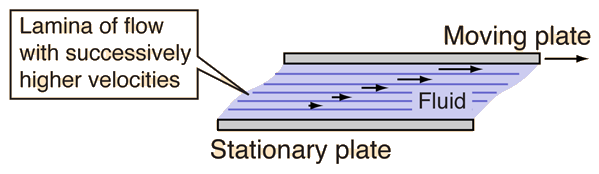
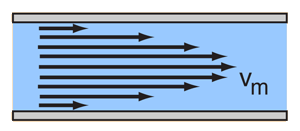
![]() There is a gradient of velocity as you move from the stationary to the moving plate, and the liquid tends to move in layers with successively higher speed. This is called laminar flow, or sometimes "streamlined" flow. Viscous resistance to flow can be modeled for laminar flow, but if the lamina break up into turbulence, it is very difficult to characterize the fluid flow. 当你从静止板移动到运动板时,速度会形成梯度,液体倾向于以依次增高的速率分层流动。这称为层流,或有时称为‘流线型’流动。可以为层流建模粘性阻力,但如果流层破裂形成湍流,则很难描述流体流动。
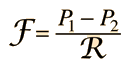
One effect of viscous forces even in laminar flow is to do negative work on the fluid and reduce its mechanical energy. Since fluid pressure is a measure of fluid mechanical energy per unit volume, this negative work can be correlated with the drop in fluid pressure along the flow path. This drop in macroscopic mechanical energy can be correlated with an increase in the internal energy of the fluid, resulting in a slight increase in temperature. 粘性力即使在层流中也会产生一种效果,即对流体做负功,从而减少其机械能。由于流体压力是单位体积流体机械能的度量,这种负功可以与流体沿流动路径的压力下降相关联。这种宏观机械能的下降可以与流体内能的增加相关联,导致温度略有上升。 |
Index Poisuille's law concepts 索引皮萨定律概念 | ||
|
Go Back
返回 |
Viscosity粘度
The resistance to flow of a fluid and the resistance to the movement of an object through a fluid are usually stated in terms of the viscosity of the fluid. Experimentally, under conditions of laminar flow, the force required to move a plate at constant speed against the resistance of a fluid is proportional to the area of the plate and to the velocity gradient perpendicular to the plate. The constant of proportionality is called the viscosity.
![]()
流体流动的阻力以及物体通过流体运动时的阻力通常用流体的粘度来表示。实验表明,在层流条件下,使板以恒定速度运动并克服流体阻力所需的力与板的面积以及垂直于板的 velocity gradient 成正比。这个比例常数称为粘度。 |
Index Poisuille's law concepts 索引皮萨定律概念 | |||
|
Go Back
返回 |
Flow Resistance for a Tube管的流动阻力
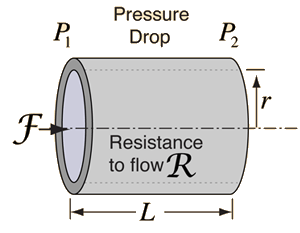
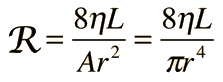
where vm is the maximum flow velocity at the center of the tube. The resistance denoted by the script R can be calculated from: 其中,v_m 是管中心的最大流速。用脚本R表示的电阻可以计算得到:
![]() Stated in terms of a viscous resistance force, 以粘性阻力力表示
![]() |
Index Poisuille's law concepts 索引皮萨定律概念 | |||||
|
Go Back
返回 |
Fluid Velocity Profile流体速度分布
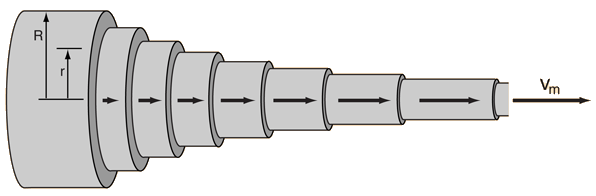
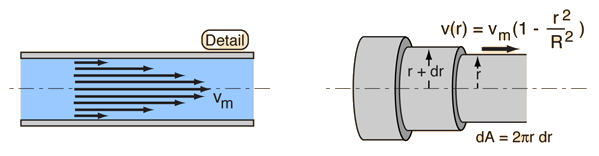
Under conditions of laminar flow in a viscous fluid, the velocity increases toward the center of a tube. 在黏性流体中的层流条件下,速度向管子中心增加。
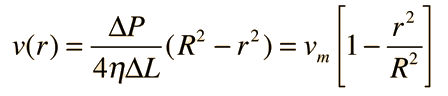
![]() The velocity profile as a function of radius is 速度随半径的函数关系是
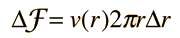
and the summing of the contributions gives flow 并累加各贡献项得到流动量
|
Index Poisuille's law concepts 索引皮萨定律概念 | ||||||||
|
Go Back
返回 |
Effective Fluid Speed in a Tube管内有效流体速度
In order to get the net resistance to flow for laminar fluid flow through a tube, one must account for the fact that different lamina of the flow travel at different speeds and encounter different resistances. 为了计算管内层流的总流动阻力,必须考虑到流体的不同层以不同的速度流动并遇到不同的电阻。
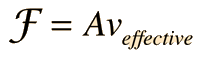
![]() The volume flowrate can be generally expressed by 体积流量通常可以表示为
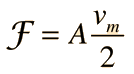
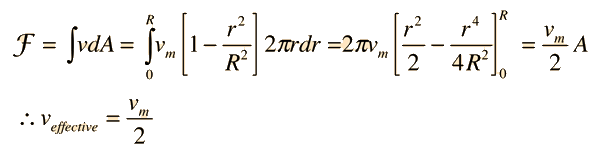
![]() but the effective velocity is not a simple average because of the nonlinear velocity profile. The total volume flowrate can be calculated by integration of the flow of the successive lamina. 但有效速度并非简单的平均值,因为存在非线性的速度分布。总体积流量可以通过对各层流的流量进行积分来计算。
![]() |
Index Poisuille's law concepts 索引皮萨定律概念 | ||
|
Go Back
返回 |