Decay of the Neutron
中子的衰变
|
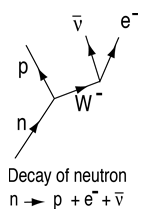
A free neutron will decay with a half-life of about 10.3 minutes but it is stable if combined into a nucleus. This decay is an example of beta decay with the emission of an electron and an electron antineutrino. The decay of the neutron involves the weak interaction as indicated in the Feynman diagram to the right.
自由中子会以约10.3分钟的半衰期衰变,但如果结合到核中则会稳定。这种衰变是β衰变的一个例子,伴随着电子和电子中微子的发射。中子的衰变涉及弱相互作用,如右图的费曼图所示。
|
|
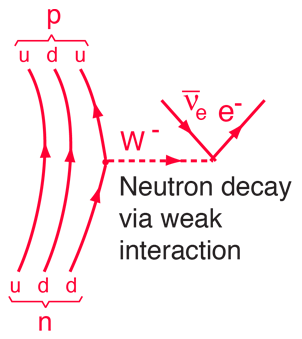 |
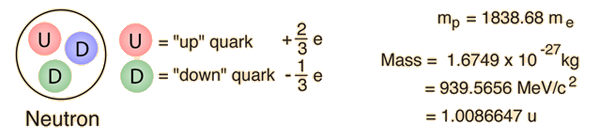
A more detailed diagram of the neutron's decay identifies it as the transformation of one of the neutron's down quarks into an up quark. It is an example of the kind of quark transformations that are involved in many nuclear processes, including beta decay.
更详细的中子衰变示意图显示,中子的衰变过程是其中的一个下夸克转变为上夸克。这是许多核过程所涉及的夸克转变的一种例子,包括β衰变。
|
The decay of the neutron is a good example of the observations which led to the discovery of the neutrino. An analysis of the energetics of the decay can be used to illustrate the dilemmas which faced early investigators of this process.
中子的衰变是导致发现中微子的观察结果的一个良好例子。对衰变能量的分析可以用来说明早期研究者在这一过程面前所面临的困境。
|
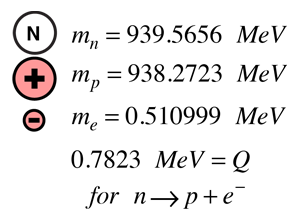
Using the concept of binding energy, and representing the masses of the particles by their rest mass energies, the energy yield from neutron decay can be calculated from the particle masses. The energy yield is traditionally represented by the symbol Q. Because energy and momentum must be conserved in the decay, it will be shown that the lighter electron will carry away most of the kinetic energy. With a kinetic energy of this magnitude, the relativistic kinetic energy expression must be used.
利用结合能的概念,并用粒子的静止质量能量来表示粒子的质量,可以从粒子质量计算出中子衰变的能量产出。能量产出通常用符号Q表示。由于能量和动量在衰变过程中必须守恒,将证明较轻的电子会带走大部分的动能。由于这种量级的动能,必须使用相对论动能表达式。
|
For the moment we presume (incorrectly) that the decay involves just the proton and electron as products. The energy yield Q would then be divided between the proton and electron. The electron will get most of the kinetic energy and will be relativistic, but the proton is non-relativistic. The energy balance is then
目前我们假设(错误地)衰变仅涉及质子和电子作为产物。此时能量释放Q将分配给质子和电子。电子将获得大部分动能,并且是相对论性的,而质子是非相对论性的。能量守恒则为

In the rest frame of the neutron, conservation of momentum requires
在中子静止参考系中,动量守恒要求
pcelectron = - pcproton
and pcelectron can be expressed in terms of the electron kinetic energy
以及电子的动能可以表示为
The energy balance then becomes
能量平衡则变为

When you substitute the numbers for this value of Q, you see that the KEe2 term is negligible, so the required kinetic energy of the electron can be calculated. The required electron kinetic energy for this two-particle decay scheme is
当你将这些数值代入这个Q值时,你会发现KE项e²可以忽略不计,因此可以计算出电子所需的动能。对于这种两粒子衰变方案,所需电子的动能为

Note that the maximum kinetic energy of the recoiling proton is only about 0.4 KeV, so the recoil energies of other nuclei which have emitted beta particles is very small compared to the electron energies.
Likewise, the momentum of the electron for this two particle decay is constrained to be
同样,对于这个双粒子衰变,电子的动量被约束为

Momentum and energy for the two-particle decay are constrained to these values, but this is not the way nature behaves. The observed momentum and energy distributions for the electron are as shown below.
两个粒子衰变的动量和能量被限制在这些值上,但这并不是自然界的行为方式。观测到的电子的动量和能量分布如下所示。
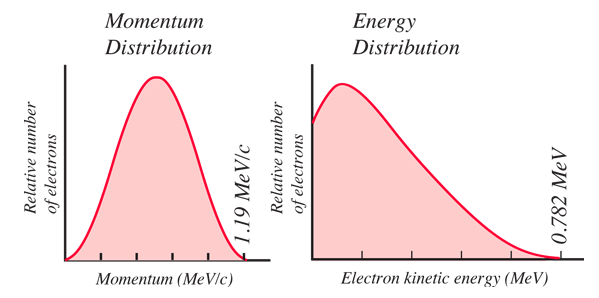
The fact that the electrons produced from the neutron decay had continuous distributions of energy and momentum was a clear indication that there was another particle emitted along with the electron and proton. It had to be a neutral particle and in certain decays carried almost all the energy and momentum of the decay. This would not have been so extraordinary except for the fact that when the electron had its maximum kinetic energy, it accounted for all the energy Q available for the decay. So there was no energy left over to account for the mass energy of the other emitted particle. The early experimenters were faced with the dilemma of a particle which could carry nearly all the energy and momentum of the decay but which had no charge and apparently no mass!
电子从中子衰变中产生时,其能量和动量呈现连续分布,这清楚地表明还有另一个粒子与电子和质子一起被释放出来。它必须是一个电中性的粒子,并在某些衰变中几乎承载了全部的衰变能量和动量。这本不应令人惊讶,因为当电子具有最大动能时,它已经占用了所有可用于衰变的能量Q。因此,就没有剩余的能量来解释另一个释放粒子的质量能量。早期的实验者面临着一个两难局面:这个粒子可以承载几乎全部的衰变能量和动量,但它却无电荷,似乎也没有质量!
The mysterious particle was called a neutrino, but it was twenty five years before unambiguous experimental observation of the neutrino was made by Cowan and Reines. The present understanding of the decay of the neutron is
那个神秘的粒子被称为中微子,但直到Cowan和Reines在25年后才有了明确的实验观测。目前对中子衰变的理解是
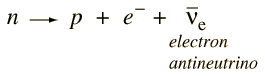
This decay illustrates some of the conservation laws which govern particle decays. The proton in the product satisfies the conservation of baryon number, but the emergence of the electron unaccompanied would violate conservation of lepton number. The third particle must be an electron antineutrino to allow the decay to satisfy lepton number conservation. The electron has lepton number 1, and the antineutrino has lepton number -1.
这种衰变说明了一些支配粒子衰变的守恒定律。产物中的质子满足重子数守恒,但电子的出现如果没有伴随中微子,则会违反轻子数守恒。第三个粒子必须是电子反中微子,以使衰变过程满足轻子数守恒。电子的轻子数为1,而反中微子的轻子数为-1。
注意,反弹质子的最大动能仅约为0.4 keV,因此其他核素在发出β粒子后产生的反弹能量远小于电子的能量。
pc 电子 = - pc 质子 |