Structure Evidence from Deep Inelastic Scattering
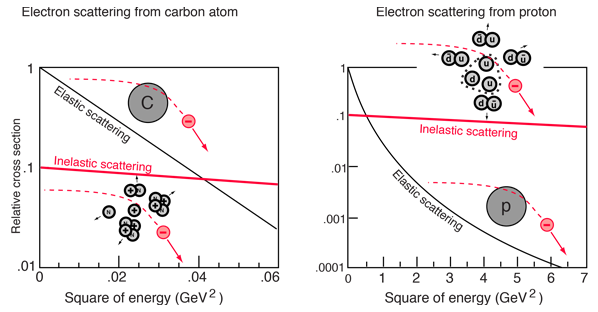
| In the energy range up to 0.06 GeV, the cross section for elastic scattering of electrons from carbon nuclei drops dramatically since it becomes more and more improbable for the carbon nucleus to remain intact under such energetic bombardment. The cross section for inelastic scattering in which the carbon nucleus breaks apart remains surprisingly near a constant value. This suggests that the electron is scattering off something within the nucleus which is structureless in this energy range. That scattering center is known to be a proton, and this scattering evidence for the existence of the proton forms a model for looking for even deeper structure.
在0.06 GeV以下的能区中,电子与碳核的弹性散射截面急剧下降,因为在这种高能轰击下,碳核保持完整变得越来越不可能。而电子与碳核的非弹性散射截面,其中碳核破裂的截面却保持相对恒定。这表明电子是在散射碳核内部的某种无结构的粒子。这种散射中心已知是质子,这种对质子存在的证据为寻找更深层次的结构提供了模型。 |
When the square of the electron energy is increased by a factor of about a hundred, then even the proton begins to show evidence of structure. The elastic scattering cross section drops precipitously while the overall scattering cross section of events which produce other particles (mostly mesons) remains almost constant. This suggests that the electron is scattering off of something within the proton which is structureless at these energies. The smaller scattering centers within the proton came to be called quarks. This kind of scattering result is one of the steps which led to the current picture of the proton as being composed of two "up" quarks and a "down" quark.
当电子的能的平方增加到大约一百倍时,连质子也开始显示出结构的迹象。弹性散射截面急剧下降,而产生其他粒子(主要是介子)的总散射截面几乎保持不变。这表明电子是在散射质子内部的某种结构less(无结构)的物体。质子内部更小的散射中心被称作夸克。这种散射结果是导致目前质子由两个“上”夸克和一个“下”夸克组成这一图像的步骤之一。 |
From early experiments in which electrons were scattered off nuclei, it could be implied that the scattering was from some charged particle within the nucleus which remained intact while the nucleus itself broke into pieces. This could in that case be verified directly by knocking out a proton and measuring its properties. The same kind of evidence in the high energy scattering of electrons off protons can be similarly interpreted: there is a smaller charged particle inside which remains intact even as the proton breaks apart. The direct verification of the existence of such a particle (a quark) is not so simple, since the nature of quark confinement is such that we cannot isolate a quark for analysis.
The illustration and comments follow the excellent discussion by Chris Quigg in a conference proceeding called "Quarks, Quasars, and Quandries". See reference.
| Survey of scattering as a nuclear probe
散射作为核探针的调查 |
Rutherford concepts
Scattering concepts
Reference
Quigg
| HyperPhysics***** Nuclear
HyperPhysics ***** 核物理 | R Nave |