Quarks夸克
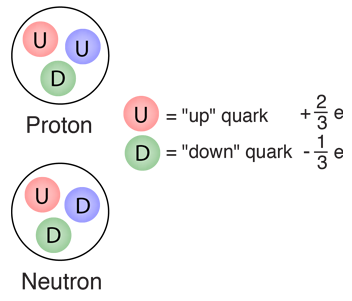
Quarks and Leptons are the building blocks which build up matter, i.e., they are seen as the "elementary particles". In the present standard model, there are six "flavors" of quarks. They can successfully account for all known mesons and baryons (over 200). The most familiar baryons are the proton and neutron, which are each constructed from up and down quarks. Quarks are observed to occur only in combinations of two quarks (mesons), three quarks (baryons). There was a recent claim of observation of particles with five quarks (pentaquark), but further experimentation has not borne it out. 夸克和轻子是构成物质的基本单元,即它们被视为“基本粒子”。在目前的标准模型中,夸克有六种“味”。它们能够成功地解释所有已知的介子和重子(超过200种)。最熟悉的重子是质子和中子,它们各自由上夸克和下夸克组成。观察发现,夸克只能以两夸克组合(介子)或三夸克组合(重子)的形式出现。最近有观测到五夸克粒子(五夸克粒子)的声称,但进一步的实验未能证实这一结果。
*The masses should not be taken too seriously, because the confinement of quarks implies that we cannot isolate them to measure their masses in a direct way. The masses must be implied indirectly from scattering experiments. The numbers in the table are very different from numbers previously quoted and are based on the July 2010 summary in Journal of Physics G, Review of Particle Physics, Particle Data Group. A summary can be found on the LBL site. These masses represent a strong departure from earlier approaches which treated the masses for the U and D as about 1/3 the mass of a proton, since in the quark model the proton has three quarks. The masses quoted are model dependent, and the mass of the bottom quark is quoted for two different models. But in other combinations they contribute different masses. In the pion, an up and an anti-down quark yield a particle of only 139.6 MeV of mass energy, while in the rho vector meson the same combination of quarks has a mass of 770 MeV! The masses of C and S are from Serway, and the T and B masses are from descriptions of the experiments in which they were discovered. *表中的夸克质量不宜作过于直接的理解:由于夸克禁闭,我们无法分离出单个夸克来直接测量其质量,只能根据散射实验间接推断。表中数值与早期引用值相差很大,依据粒子数据组2010年7月发表于《Journal of Physics G》的《Review of Particle Physics》。LBL网站提供相关摘要。早期方法曾把上夸克和下夸克的质量各视为质子质量的约三分之一,因为质子由三个夸克组成;本表数值与此明显不同。所引质量依赖于模型,底夸克的质量也列出了两种模型的结果。同样的夸克在不同组合中可对应不同的质量:π介子中,上夸克与反下夸克组成的粒子质量能量仅为139.6 MeV;ρ矢量介子中,同一夸克组合的质量则为770 MeV。粲夸克和奇异夸克的质量引自Serway,顶夸克和底夸克的质量引自发现它们的实验描述。
Each of the six "flavors" of quarks can have three different "colors". The quark forces are attractive only in "colorless" combinations of three quarks (baryons), quark-antiquark pairs (mesons) and possibly larger combinations such as the pentaquark that could also meet the colorless condition. Quarks undergo transformations by the exchange of W bosons, and those transformations determine the rate and nature of the decay of hadrons by the weak interaction. 六种味的夸克,每一种都有三种不同的“色”。夸克间的作用力只在无色组合中表现为吸引作用;这类组合包括三个夸克组成的重子、夸克—反夸克对组成的介子,以及可能满足无色条件的更大组合,如五夸克态。夸克通过交换W玻色子发生转化;这些转化决定强子经弱相互作用衰变的速率和方式。
|
Index Particle concepts References Serway Ch. 47 Rohlf Ch. 17 Griffiths Ch. 1 索引 质点概念 参考文献 Serway 第47章 Rohlf 第17章 Griffiths 第1章 | ||||||||||||||||||||||||||||||||||||||||||||||||||||||||||||||||||||||||||
|
Go Back
返回 |
Why "Quark"?为什么叫‘夸克’?
The name "quark" was taken by Murray Gell-Mann from the book "Finnegan's Wake" by James Joyce. The line "Three quarks for Muster Mark..." appears in the fanciful book. Gell-Mann received the 1969 Nobel Prize for his work in classifying elementary particles. ‘夸克’这个名称是 Murray Gell-Mann 从詹姆斯·乔伊斯的《芬尼根的守灵夜》一书中借用的。书中有一句‘三个夸克给马斯特·马克……’,这是一本富有幻想色彩的书。Gell-Mann 因在分类基本粒子方面的研究而获得了 1969 年的诺贝尔奖。 |
Index Particle concepts 索引粒子概念 | ||
|
Go Back
返回 |
Up and Down Quarks上夸克和下夸克
The up and down quarks are the most common and least massive quarks, being the constituents of protons and neutrons and thus of most ordinary matter. 上夸克和下夸克是最常见且质量最小的夸克,它们构成了质子和中子,因此也构成了大多数普通物质。
|
Index Particle concepts 索引粒子概念 | ||||
|
Go Back
返回 |
The Strange Quark奇异夸克
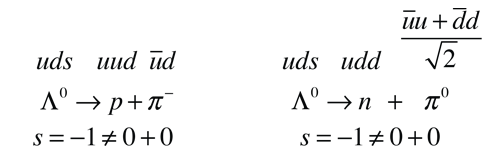
In 1947 during a study of cosmic ray interactions, a product of a proton collision with a nucleus was found to live for a much longer time than expected: 10-10 seconds instead of the expected 10-23 seconds! This particle was named the lambda particle (Λ0) and the property which caused it to live so long was dubbed "strangeness" and that name stuck to be the name of one of the quarks from which the lambda particle is constructed. The lambda is a baryon which is made up of three quarks: an up, a down and a strange quark. 1947年,在研究宇宙射线相互作用时,发现粒子碰撞核时产生的产物寿命远长于预期:10 -10秒而不是预期的10 -23秒!这个粒子被命名为lambda粒子(Λ⁰),其导致寿命较长的性质被称为“ strangeness ”,这个名字一直沿用至今,成为构成lambda粒子的其中一个夸克的名称。lambda粒子是一种重子,由三个夸克组成:一个上夸克、一个下夸克和一个奇异夸克。
The shorter lifetime of 10-23 seconds was expected because the lambda as a baryon participates in the strong interaction, and that usually leads to such very short lifetimes. The long observed lifetime helped develop a new conservation law for such decays called the "conservation of strangeness". The presence of a strange quark in a particle is denoted by a quantum number S=-1. Particle decay by the strong or electromagnetic interactions preserve the strangeness quantum number. The decay process for the lambda particle must violate that rule, since there is no lighter particle which contains a strange quark - so the strange quark must be transformed to another quark in the process. That can only occur by the weak interaction, and that leads to a much longer lifetime. The decay processes show that strangeness is not conserved: ![]() The quark transformations necessary to accomplish these decay processes can be visualized with the help of Feynman diagrams. 实现这些衰变过程所需的夸克变换可以通过费曼图来可视化。
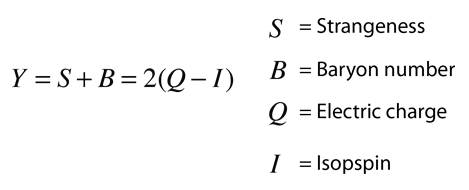
Conservation of strangeness is not in fact an independent conservation law, but can be viewed as a combination of the conservation of charge, isospin, and baryon number. It is often expressed in terms of hypercharge Y, defined by: strangeness 的守恒并不是一个独立的守恒定律,但可以视为电荷、同位旋和重子数守恒的组合。它通常以超荷 Y 表示,定义为:
![]() 寿命为10^-23秒的较短寿命是由于lambda作为重子参与强相互作用,而这种相互作用通常导致非常短的寿命。观测到的较长寿命有助于发展出一条新的守恒定律,称为‘ strangeness 的守恒 ’。粒子中存在奇异夸克的特征由量子数S=-1表示。通过强相互作用或电磁相互作用的衰变过程保持strangeness量子数。lambda粒子的衰变过程必须违反这一规则,因为不存在包含奇异夸克的更轻粒子——所以奇异夸克必须在过程中转变为另一种夸克。这只能通过弱相互作用发生,从而导致更长的寿命。衰变过程显示strangeness并不守恒: Isospin and either hypercharge or strangeness are the quantum numbers often used to draw particle diagrams for the hadrons.
同位旋和超荷或 strangeness 是常用于绘制强子粒子图的量子数。 |
Index Particle concepts 索引粒子概念 | |||
|
Go Back
返回 |
The Charm Quark粲夸克
In 1974 a meson called the J/Psi particle was discovered by experimenters at Stanford (Richter) and Brookhaven National Laboratory (Ting). With a mass of 3100 MeV, over three times that of the proton, this particle was the first example of another quark, called the charm quark. The J/Psi is made up of a charm-anticharm quark pair. Richter and Ting shared the 1976 Nobel Prize for their discovery. 1974年,斯坦福的里克特和布鲁克海文国家实验室的丁肇中分别发现了一种称为J/ψ粒子的介子。这种粒子的质量为3100 MeV,超过质子质量的三倍;它是发现粲夸克的首个实例。J/ψ粒子由一对粲夸克和反粲夸克组成。里克特和丁肇中因这一发现共同获得1976年诺贝尔物理学奖。
The lightest meson which contains a charm quark is the D meson. It provides interesting examples of decay since the charm quark must be transformed into a strange quark by the weak interaction in order for it to decay. 含粲夸克的最轻介子是D介子。它的衰变提供了一个例子:粲夸克须通过弱相互作用转变为奇异夸克,D介子才能衰变。
One baryon with a charm quark is a called a lambda with symbol Λ+c. It has a composition udc and a mass of 2281 MeV/c2. 含粲夸克的一种重子称为Λ_c⁺重子。它的夸克组成为udc,质量为2281 MeV/c²。
|
Index Particle concepts 索引粒子概念 | ||
|
Go Back
返回 |
The Top Quark顶夸克
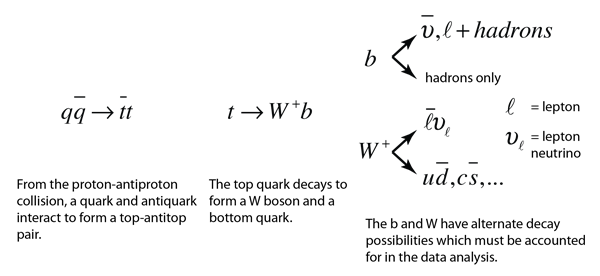
Convincing evidence for the observation of the top quark was reported by Fermilab 's Tevatron facility in April 1995. The evidence was found in the collision products of 0.9 TeV protons with equally energetic antiprotons in the proton-antiproton collider. The evidence involved analysis of trillions of 1.8 TeV proton-antiproton collisions. The Collider Detector Facility group had found 56 top candidates over a predicted background of 23 and the D0 group found 17 events over a predicted background of 3.8. The value for the top quark mass from the combined data of the two groups after the completion of the run was 174.3 +/- 5.1 GeV. This is over 180 times the mass of a proton and about twice the mass of the next heaviest fundamental particle, the Z0 vector boson at about 93 GeV. convincing evidence for the observation of the top quark was reported by Fermilab's Tevatron facility in April 1995. The evidence was found in the collision products of 0.9 TeV protons with equally energetic antiprotons in the proton-antiproton collider. The evidence involved analysis of trillions of 1.8 TeV proton-antiproton collisions. The Collider Detector Facility group had found 56 top candidates over a predicted background of 23 and the D0 group found 17 events over a predicted background of 3.8. The value for the top quark mass from the combined data of the two groups after the completion of the run was 174.3 +/- 5.1 GeV. This is over 180 times the mass of a proton and about twice the mass of the next heaviest fundamental particle, the Z0 vector boson at about 93 GeV.
The interaction is envisioned as follows: 这种相互作用被设想为如下所示:
![]()
|
Index Particle concepts Reference Ladbury Top quark Wiki ![]() D-Zero 索引 质点 概念 参考 Ladbury 顶夸克 Wiki D-Zero | ||
|
Go Back
返回 |
Confinement of Quarks夸克禁闭
How can one be so confident of the quark model when no one has ever seen an isolated quark? There are good reasons for the lack of direct observation. Apparently the color force does not drop off with distance like the other observed forces. It is postulated that it may actually increase with distance at the rate of about 1 GeV per fermi. A free quark is not observed because by the time the separation is on an observable scale, the energy is far above the pair production energy for quark-antiquark pairs. For the U and D quarks the masses are 10s of MeV so pair production would occur for distances much less than a fermi. You would expect a lot of mesons (quark-antiquark pairs) in very high energy collision experiments and that is what is observed. 如何能如此自信地接受夸克模型,当没有人曾见过孤立的夸克?缺乏直接观察有充分的理由。显然,色力不像其他已观测到的力那样随距离迅速衰减。它被假定实际上可能随距离增加而增加,速率约为每费米1 GeV。由于在可观测的尺度上,夸克之间的分离会导致能量远高于夸克-反夸克对的产生能量,因此孤立的夸克不会被观测到。对于上夸克和下夸克来说,其质量约为几十MeV,因此在远小于费米的距离内就会发生夸克-反夸克对的产生。你期望在高能碰撞实验中观察到大量的介子(夸克-反夸克对),而这正是所观测到的。
Basically, you can't see an isolated quark because the color force does not let them go, and the energy required to separate them produces quark-antiquark pairs long before they are far enough apart to observe separately. 基本上,你无法观察到孤立的夸克,因为色力不允许它们分开,而将它们分离所需的能量会在它们足够远而能被单独观测之前产生夸克-反夸克对。
One kind of visualization of quark confinement is called the "bag model". One visualizes the quarks as contained in an elastic bag which allows the quarks to move freely around, as long as you don't try to pull them further apart. But if you try to pull a quark out, the bag stretches and resists. 夸克禁闭的一种可视化方法称为“袋模型”。人们将夸克想象为被包含在一个弹性袋中,只要不试图将夸克拉得更远,夸克可以在袋内自由运动。但如果试图将一个夸克拉出袋外,袋就会伸展并产生阻力。
Another way of looking at quark confinement is expressed by Rohlf. "When we try to pull a quark out of a proton, for example by striking the quark with another energetic particle, the quark experiences a potential energy barrier from the strong interaction that increases with distance." As the example of alpha decay demonstrates, having a barrier higher than the particle energy does not prevent the escape of the particle - quantum mechanical tunneling gives a finite probability for a 6 MeV alpha particle to get through a 30 MeV high energy barrier. But the energy barrier for the alpha particle is thin enough for tunneling to be effective. In the case of the barrier facing the quark, the energy barrier does not drop off with distance, but in fact increases. 另一种看待夸克禁闭的方式,如Rohlf所表达的那样:‘当我们试图将一个夸克从质子中拉出,例如通过用一个高能粒子撞击夸克,该夸克会经历来自强相互作用的势能屏障,且该屏障随距离增加而增大。’如α衰变的例子所示,即使势能屏障高于粒子的能量,也不阻止粒子逃逸——量子力学隧穿效应给一个6 MeV的α粒子通过30 MeV的高能势能屏障提供有限的概率。但对α粒子而言,势能屏障足够薄,使得隧穿效应有效。而在夸克面临的势能屏障情况下,势能屏障不会随距离减少,反而会增加。
|
Index Particle concepts Reference Rohlf Sec 6-6 索引 质点 概念 参考 Rohlf 第6-6节 | ||
|
Go Back
返回 |
The Bottom Quark下夸克
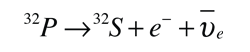
In 1977, an experimental group at Fermilab led by Leon Lederman discovered a new resonance at 9.4 GeV/c2 which was interpreted as a bottom-antibottom quark pair and called the Upsilon meson. From this experiment, the mass of the bottom quark is implied to be about 5 GeV/c2. The reaction being studied was 1977年,费米实验室的实验组在莱昂·莱德曼的领导下发现了一个新的共振态,其能量为9.4 GeV/c²,该共振态被解释为一个底夸克和反底夸克对,并被命名为Υ介子。从这一实验中,底夸克的质量被推断约为5 GeV/c²。所研究的反应为:
![]() where N was a copper or platinum nucleus. The spectrometer had a muon-pair mass resolution of about 2%, which allowed them to measure an excess of events at 9.4 GeV/c2. This resonance has been subsequently studied at other accelerators with a detailed investigation of the bound states of the bottom-antibottom meson. Studies of the B-meson have also been productive. These studied resulted in the 2008 Nobel Prize in Physics to Kobayashi and Maskawa for their explanaton of CP-violation. Further studies of CP-violation have been made in the LHCb Experiment at the LHC which studies interactions of hadrons containing the b-quark. 其中N是一个铜或铂的原子核。谱仪的μ子对质量分辨率为约2%,这使得他们能够测量出在9.4 GeV/c²处的事件过剩。这一共振现象后来在其他加速器上被进一步研究,特别关注底-反底介子的束缚态。对底介子的研究也取得了成果。这些研究最终导致了2008年诺贝尔物理学奖授予小林彰臣和益川哲哉,以表彰他们对CP破坏现象的解释。进一步的CP破坏研究在大型强子对撞机(LHC)上的LHCb实验中进行,该实验研究包含b夸克的强子相互作用。
|
Index Particle concepts Reference Rohlf Ch. 17 Bottom quark Wiki CP Violation Wiki 索引 质点 概念 参考 Rohlf 第17章 底夸克 Wiki CP 违反 Wiki | ||
|
Go Back
返回 |