Bilingual edition: English is preserved and Chinese follows each unit. Terminology uses the confirmed v20260916 glossary; automated semantic review remains traceable.
中英双语版:英文原文完整保留,中文紧随对应单元;术语采用 v20260916 确认表,自动语义审校结果可追溯。

Mesons

介子

Mesons are intermediate mass particles which are made up of a quark-antiquark pair. Three quark combinations are called baryons. Mesons are bosons, while the baryons are fermions. There was a recent claim of observation of particles with five quarks (pentaquark), but further experimentation has not borne it out.

介子是介于质子和中子之间的粒子,由一个夸克和一个反夸克组成。三种夸克组合被称为重子。介子是玻色子,而重子是费米子。有报道称观察到了五夸克的粒子(五夸克粒子),但进一步的实验尚未证实这一发现。
Meson diagram
介子图
Table of mesons
介子表
Index

Particle concepts

References
Serway
Ch. 47

Giancoli
Ch. 32

Griffiths
索引 质点 概念 参考文献 Serway 第47章 Giancoli 第32章 Griffiths
 
HyperPhysics***** Quantum Physics
HyperPhysics ***** 量子物理
R Nave
Go Back
返回


pion

介子

The pion, being the lightest meson, can be used to predict the maximum range of the strong interaction. The strong interaction properties of the three pions are identical. The connection between pions and the strong force was proposed by Hideki Yukawa. Yukawa worked out a potential for the force and predicted its mass based on the uncertainty principle from measurements of the apparent range of the strong force in nuclei. We now know that the pion is a meson, a composite particle, and the current view is that the strong interaction is an interaction between quarks, but the Yukawa theory stimulated a major advance in the understanding of the strong interaction and exchange forces in general.

介子是轻子中质量最小的粒子,可以用来预测强相互作用的最大作用范围。三种介子的强相互作用性质是相同的。介子与强相互作用之间的联系是由Hideki Yukawa提出的。Yukawa推导出了一种力的势,并基于强相互作用在核中的观测作用范围,利用不确定性原理预测了其质量。现在我们已知介子是一种复合粒子,当前观点认为强相互作用是夸克之间的相互作用,但Yukawa理论激发了对强相互作用及其交换力的深刻理解。
Particle
质点
Symbol
符号
Anti-
particle
反粒子
Makeup
组成
Rest mass
MeV/c2
静止质量 MeV/c²
SCBLifetime
寿命
Decay Modes
衰变模式
Pion
介子
π+
π-
139.6
0
0
0
2.60
x10-8
μ+νμ
Pion
介子
π0
Self
自身
135.0
0
0
0
0.83
x10-16
2γ

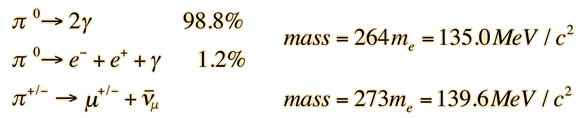
The neutral pion decays to two photons (gamma rays) 98.8% of the time. The decay is by the electromagnetic interaction on a time scale of about 10-16 seconds. The positive and negative pions have longer lifetimes of about 2.6 x 10⁻⁸ s.
中性π介子约有98.8%的时间衰变成两个光子(伽马射线)。这种衰变过程在约10 -16秒的时间尺度上发生,通过电磁相互作用。正负π介子的寿命更长,约为2.6 x 10 -8秒。

The negative pion decays into a muon and a muon antineutrino as illustrated below. This decay is puzzling upon first examination because the decay into an electron plus an electron antineutrino yields much more energy. Usually the pathway with the greatest energy yield is the preferred pathway. This suggests that some symmetry is acting to inhibit the electron decay pathway.

负π子衰变成一个μ子和一个μ子反中微子,如下面所示。这种衰变在初次观察时令人困惑,因为衰变成一个电子和一个电子反中微子会释放出更多的能量。通常,能量释放最大的路径是首选路径。这表明某种对称性在抑制电子衰变路径。

The symmetry which suppresses the electron pathway is that of angular momentum, as described by Griffiths. Since the negative pion has spin zero, the electron and antineutrino must be emitted with opposite spins to preserve net zero spin. But the antineutrino is always right-handed, so this implies that the electron must be emitted with spin in the direction of its linear momentum (i.e., also right-handed). But if the electron were massless, it would (like the neutrino) only exist as a left-handed particle, and the electron pathway would be completely prohibited. So the suppression of the electron pathway is attributed to the fact that the electron's small mass greatly favors the left-handed symmetry, thus inhibiting the decay. Weak interaction theory predicts that the fraction of muons decaying into electrons should be 1.28 x 10⁻⁴ and the measured branching ratio is 1.23 +/- 0.02 x 10⁻⁴.

抑制电子路径的对称性是角动量的对称性,如Griffiths所述。由于负π子有自旋零,电子和反中微子必须以相反的自旋发射以保持总自旋为零。但反中微子总是右旋的,所以这说明电子必须以自旋方向与它的线动量方向一致(即也是右旋的)。但如果电子是无质量的,它(像中微子一样)只会以左旋粒子存在,电子路径将被完全禁止。因此,电子路径的抑制归因于电子的小质量极大地有利于左旋对称性,从而抑制了衰变。弱相互作用理论预测μ子衰变成电子的分数应为1.28×10⁻⁴,而测量的分支比为1.23±0.02×10⁻⁴。

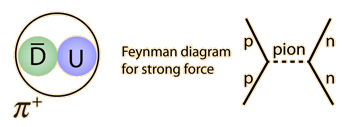
Being composed of an up and an antidown quark, the positive pion would be expected to have a mass about 2/3 that of a proton, yet its mass is only about 1/6 of that of the proton! This is an example of how hadron masses depend upon the dynamics inside the particle, and not just upon the quarks contained.

由一个上夸克和一个反下夸克组成,正π介子的预期质量应约为质子的2/3,但其实际质量仅约为质子的1/6!这说明强子的质量取决于粒子内部的动力学,而不仅仅是包含的夸克。
The pion is a meson. The π+ is considered to be made up of an up and an anti-down quark. The neutral pion is considered to be a combination of quark-antiquark pairs:
介子是一种粒子。π⁺被认为由一个上夸克和一个反下夸克组成。中性π介子被认为是由夸克-反夸克对组成的:

Pions interact with nuclei and transform a neutron to a proton or vice versa as indicated by the Feynman diagram above. Though this diagram is labeled as the diagram for the strong force, the strong force is fundamentally an interaction between quarks via gluons. Slaven terms this diagram an example of the "residual strong force" since it is depicted between colorless particles. He makes the analogy with the "residual electromagnetic force" between atoms which are electrically neutral. The interactions depicted below appear to be consistent with this picture and can be viewed as interactions between quarks which result in the production of a different distribution of quarks.

介子与核相互作用,并如上图的费曼图所示,将中子转变为质子或反之。尽管这个图被标记为强相互作用的图,但强相互作用本质上是夸克之间通过胶子的相互作用。Slaven称这个图是“残余强相互作用”的例子,因为它显示的是无色粒子之间的相互作用。他将这种相互作用与中性原子之间的“残余电磁力”作类比。下图中所描绘的相互作用似乎符合这一图景,可以视为夸克之间的相互作用,导致夸克分布发生变化。

The pions π+ and π- have spin zero and negative intrinsic parity (Rohlf Sec 17-2).

π⁺和π⁻有自旋为零和负的内禀宇称(Rohlf 第17-2节)。
Energetics of charged pion decay
带电π介子衰变的能学
Meson diagram
介子图
Table of mesons
介子表
Index

Particle concepts

References
Griffiths
Sec 10.4

Review of Particle Physics, 2010 p623

Slaven, Morningside.edu
索引 质点概念 参考文献 Griffiths 第10章第4节 Review of Particle Physics, 2010 p623 Slaven, Morningside.edu
 
HyperPhysics***** Quantum Physics
HyperPhysics ***** 量子物理
R Nave
Go Back
返回


The psi/J Particle

psi/J粒子
Particle
质点
Symbol
符号
Anti-
particle
反粒子
Makeup
组成
Rest mass
MeV/c2
静止质量 MeV/c²
SCBLifetime
寿命
Decay Modes
衰变模式
J/Psi
J/ψ
J/ψ
Self
自身
3096.9
0
0
0
0.8
x10-20
e+e-, μ+μ-...

The psi/J particle is a meson which was discovered in 1974 by experimenters at Stanford (Richter) and Brookhaven National Laboratory (Ting). Slightly more than three times as massive as the proton, this particle decayed slowly and didn't fit into the framework of the up, down, and strange quarks. It is considered to be a charm-anticharm quark pair and was the first firm experimental evidence for the fourth quark. Richter and Ting shared the 1976 Nobel Prize for their discovery.

Meson diagram
介子图
Table of mesons
介子表
ψ/J粒子是一种介子,由斯坦福的里克特和布鲁克海文国家实验室的丁肇中于1974年发现。它的质量略高于质子质量的三倍,衰变较慢,无法用上夸克、下夸克和奇异夸克的框架解释。它被认为由粲夸克和反粲夸克组成,是第四种夸克存在的首个确凿实验证据。里克特和丁肇中因这一发现共同获得1976年诺贝尔物理学奖。
Index

Particle concepts
索引粒子概念
 
HyperPhysics***** Quantum Physics
HyperPhysics ***** 量子物理
R Nave
Go Back
返回


The Upsilon Particle

Υ粒子
Particle
质点
Symbol
符号
Anti-
particle
反粒子
Makeup
组成
Rest mass
MeV/c2
静止质量 MeV/c²
SCBLifetime
寿命
Decay Modes
衰变模式
Upsilon
Υpsilon
ϒ
Self
自身
9460.4
0
0
0
1.3
x10-20
e+e-, μ+μ-..

The upsilon particle is a meson which was discovered at Fermilab in 1977. It appeared as another long-lived particle which didn't fit into the framework of the first four quarks, the up, down, strange, and charm quarks. It is taken as a bottom-antibottom quark pair and was the first experimental evidence of the fifth quark.

Υ粒子是1977年在费米实验室发现的一种介子。它的寿命较长,不能用当时已知的前四种夸克——上夸克、下夸克、奇异夸克和粲夸克——来解释。它被认为由底夸克和反底夸克组成,成为第五种夸克存在的首个实验证据。
Meson diagram
介子图
Table of mesons
介子表
Index

Particle concepts
索引粒子概念
 
HyperPhysics***** Quantum Physics
HyperPhysics ***** 量子物理
R Nave
Go Back
返回


Hadrons

强子

Particles that interact by the strong interaction are called hadrons. This general classification includes mesons and baryons but specifically excludes leptons, which do not interact by the strong force. The weak interaction acts on both hadrons and leptons.

相互作用通过强相互作用的粒子被称为强子。这种一般分类包括介子和重子,但特别排除了轻子,因为轻子不参与强相互作用。弱相互作用作用于强子和轻子。

Hadrons are viewed as being composed of quarks, either as quark-antiquark pairs (mesons) or as three quarks (baryons). There is much more to the picture than this, however, because the constituent quarks are surrounded by a cloud of gluons, the exchange particles for the color force.

介子被视作由夸克组成,要么是夸克-反夸克对(介子),要么是三个夸克(重子)。然而,情况远不止如此,因为构成夸克周围存在一片胶子云,胶子是色力的交换粒子。

There was a recent claim of observation of particles with five quarks (pentaquark), but further experimentation has not borne it out.

有报道称观察到了由五个夸克组成的粒子(五夸克粒子),但后续实验未能证实这一发现。
Index

Particle concepts
索引粒子概念
 
HyperPhysics***** Quantum Physics
HyperPhysics ***** 量子物理
R Nave
Go Back
返回


Baryons

重子

Baryons are massive particles which are made up of three quarks in the standard model. This class of particles includes the proton and neutron. Other baryons are the lambda, sigma, xi, and omega particles. Baryons are distinct from mesons in that mesons are composed of only two quarks. Baryons and mesons are included in the overall class known as hadrons, the particles which interact by the strong force. Baryons are fermions, while the mesons are bosons. Besides charge and spin (1/2 for the baryons), two other quantum numbers are assigned to these particles: baryon number (B=1) and strangeness (S), which in the chart can be seen to be equal to -1 times the number of strange quarks included.

重子是质量较大的粒子,由三个夸克组成,这在标准模型中是基本构成。这一类粒子包括质子和中子。其他重子有Λ、Σ、Ξ和Ω粒子。重子与介子的区别在于,介子仅由两个夸克组成。重子和介子都属于整体称为强子的类别,即通过强作用力相互作用的粒子。重子是费米子,而介子是玻色子。除了电荷和自旋(重子的自旋为1/2)外,这些粒子还被赋予了两个其他量子数:重子数(B=1)和 strangeness(S),在图表中可以看到,S等于-1乘以包含的奇异夸克数。

The conservation of baryon number is an important rule for interactions and decays of baryons. No known interactions violate conservation of baryon number.

重子数的守恒是重子相互作用和衰变的重要规则。已知的任何相互作用都不违反重子数的守恒。

Recent experimental evidence shows the existence of five-quark combinations which are being called pentaquarks. The pentaquark would be included in the classification of baryons, albeit an "exotic" one. The pentaquark is composed of four quarks and an antiquark, like a combination of an ordinary baryon plus a meson.

近期的实验证据显示存在由五个夸克组成的组合,这些被称作五夸克态。五夸克态应被归类为重子,尽管它是一个‘奇特’的重子。五夸克态由四个夸克和一个反夸克组成,类似于普通重子加上一个介子的组合。

Table of Baryons

重子表

Baryon diagram

重子图
Index

Particle concepts

Reference
Serway
Ch. 47
索引粒子概念参考Serway第47章
 
HyperPhysics***** Quantum Physics
HyperPhysics ***** 量子物理
R Nave
Go Back
返回


Hideki Yukawa and the Pion

Hideki Yukawa 和 π 子

Once quantum electrodyamics had produced the picture of the electromagnetic force as a process of exchanging photons, the question of whether or not the other forces were also exchange forces was a natural one. In 1935, Hideki Yukawa reasoned that the electromagnetic force was infinite in range because the exchange particle was massless. He proposed that the short range strong force came about from the exchange of a massive particle which he called a meson. By observing that the effective range of the nuclear force was on the order of a fermi, a mass for the exchange particle could be predicted using the uncertainty principle. The predicted particle mass was about 100 MeV. It did not receive immediate attention since no one knew of a particle which fit that description.

一旦量子电动力学已经将电磁力描绘为通过交换光子的过程,那么其他力是否也是交换力的问题自然地产生了。1935年,宇一宽推断电磁力的范围是无限的,因为交换粒子是无质量的。他提出强相互作用的短程性质来自于交换一个有质量的粒子,他将其称为介子。通过观察核力的有效作用范围大约为一个费米,可以利用不确定性原理预测交换粒子的质量。预测的粒子质量约为100 MeV。由于没有人知道符合这一描述的粒子,这一发现并未立即引起重视。

In 1937 a particle of mass close to Yukawa's prediction was discovered in cosmic rays by Anderson & Neddermeyer and by Street & Stevenson in independent experiments. This particle, the muon, turned out not to interact by the strong interaction. Hans Bethe and Robert Marshak predicted that the muon could be a decay product of the particle sought. In 1947, Lattes, Muirhead, Occhialini and Powell conducted a high altitude experiment, flying photographic emulsions at 3000 meters. These emulsions revealed the pion, which met all the requirements of the Yukawa particle.

1937年,安德森与内德默耶在宇宙射线中独立实验中发现了质量接近宇巴预测的粒子,该粒子即缪子,后来发现它不参与强相互作用。巴特和马什克预测缪子可能是所寻求粒子的衰变产物。1947年,拉特勒斯、穆尔黑德、奥奇亚利尼和波利在3000米高空进行实验,使用感光乳胶飞行,这些乳胶揭示了π介子,它完全符合宇巴粒子的要求。

We now know that the pion is a meson, a composite particle, and the current view is that the strong interaction is an interaction between quarks, but the Yukawa theory stimulated a major advance in the understanding of the strong interaction.

我们现在知道π介子是一种介子,是一种复合粒子,当前的观点认为强相互作用是夸克之间的相互作用,但宇巴理论促进了对强相互作用的理解的重大进展。

Index

References
Rohlf,
Ch 17.

Lattes, et al.
索引 参考 Rohlf,第17章。Lattes 等人。
 
HyperPhysics***** Quantum Physics
HyperPhysics ***** 量子物理
R Nave
Go Back
返回