Bilingual edition: English is preserved and Chinese follows each unit. Terminology uses the confirmed v20260916 glossary; automated semantic review remains traceable.
中英双语版:英文原文完整保留,中文紧随对应单元;术语采用 v20260916 确认表,自动语义审校结果可追溯。

Reflection Holograms

反射全息图

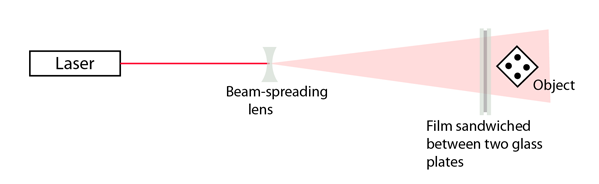
With a reflection hologram, the image is stored in a thick emulsion and can be viewed in white light. The simplest such hologram to make is the direct beam reflection hologram. In this case the direct beam through the film serves as the reference beam.

Laboratory procedure
实验室程序
使用反射全息图,图像储存在厚乳胶中,可以在白光下观看。制作最简单的这种全息图是直接光束反射全息图。在这种情况下,通过薄膜的直接光束充当参考光束。
Index

Holography concepts
索引全息概念
  HyperPhysics***** Quantum Physics ***** Optics
HyperPhysics ***** 量子物理 ***** 光学
Go Back
返回


Rainbow Holograms

彩虹全息图

Rainbow holograms are holograms which can be viewed in white light. They are made by a double holographic process where an ordinary hologram such as a transmission hologram is used as the object and a second hologram is made through a slit. A horizontal slit limits the vertical perspective of the first image so that there is no vertical parallax in the resultant rainbow hologram. This slit process removes the coherence requirement on the viewing light so that full advantage can be taken of the image brightness obtained from ordinary room light, while maintaining the three-dimensional character of the image as the viewers eye is moved horizontally. If the viewers eye is moved vertically, no parallax is seen and the image color sweeps through the rainbow spectrum from blue to red, hence "rainbow hologram".

彩虹全息图是一种可以在白光下观察的全息图。它们是通过双全息过程制作的,其中一个普通的全息图,如透射全息图,作为物体,再通过一个狭缝制作第二个全息图。水平狭缝限制了第一个图像的垂直视角,使得最终的彩虹全息图中没有垂直的视差。这种狭缝过程消除了对观察光的相干性要求,从而可以充分利用从普通室内灯光中获得的图像亮度,同时保持图像的三维特性,当观众的眼睛水平移动时。如果观众的眼睛垂直移动,则不会出现视差,图像颜色会从蓝色扫过到红色,因此称为彩虹全息图。
Index

Holography concepts
索引全息概念
  HyperPhysics***** Quantum Physics ***** Optics
HyperPhysics ***** 量子物理 ***** 光学
Go Back
返回


Denisyuk Holograms

Denisyuk Holograms(专名或术语)

Denisyuk contributed to the development of the hologram by using Lippmann's photographic process to make reflection holograms which could be viewed in color if more than one coherent source was available. In his method the beam was passed through the photographic emulsion and back reflected from the object. The emulsion could then be mounted on a reflective backing for viewing by reflected light.

Denisyuk利用Lippmann的摄影工艺开发了全息图,这种全息图如果能使用多个相干光源,就可以被观察到彩色效果。在他的方法中,光束通过摄影乳剂并从物体反射回来。然后乳剂可以安装在反射底板上,以便通过反射光观察。

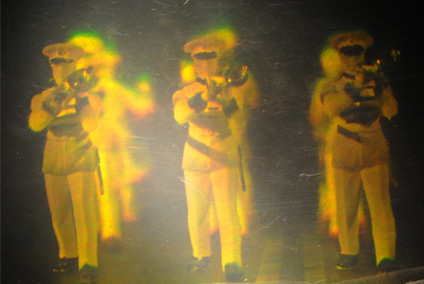
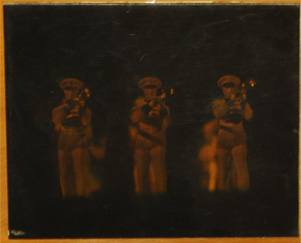
Above are two views of a Denisyuk demonstration hologram. It is composed of a very thick emulsion mounted on a reflective backing. At first glance it will look like a black, shiny piece of film. But with an overhead light, you can find a position where the image will appear, as shown above right. You can see the image with ordinary room light because of the action of the thick emulsion.
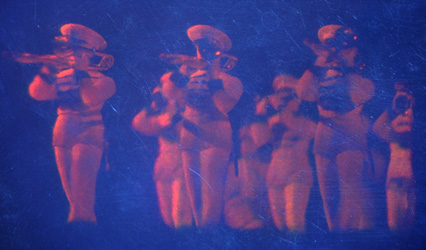
Optimum viewing of the holographic image was found with a small flashlight held back as far as practicable from the image. The photo at left was taken under those conditions. The depth of field of the image depends upon the vergence of the light from the source.

为了最佳观看全息图像,需将小手电筒尽可能远离图像持持。左图就是在这种条件下拍摄的。图像的景深取决于光源发出的光的发散角。

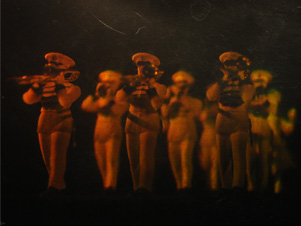
This view of the same image was photographed with the flashlight close to the hologram. Although it is brighter, there is severe loss of depth of focus. The marching band figurines are also viewed from a different angle, showing the true 3-dimensional nature of the holographic image.

同一张图像的这一视角是用手电筒接近全息图拍摄的。虽然更明亮,但景深严重损失。行进乐队的立体人像也从不同角度观看,展现了全息图像真实的三维特性。

上面是Denisyuk演示全息图的两个视图。它由一层非常厚的乳剂固定在反射底板上。乍一看,它看起来像是一块黑色的、有光泽的胶片。但使用顶光时,你可以找到一个位置,使图像显现出来,如上图右所示。由于厚乳剂的作用,你可以在普通房间灯光下看到图像。

These two images were taken with the illumination of a small penlight to more nearly approximate a point source of light. The one on the left shows the loss of depth of field when the penlight was held close to the hologram (about 40 cm). Greater depth of field was obtained at right by holding the light about 100 cm from the hologram.

这两张图像是在使用小手电筒照明的情况下拍摄的,以更接近地模拟一个点光源。左边的图像显示了当手电筒贴近全息图(约40厘米)时景深的丧失。通过将手电筒放在全息图约100厘米处,获得了更大的景深。

When you moved the light source across the hologram, you got dramatic changes in the perspective of the image, showing the true three dimensional nature of the holographic image.

当你将光源移动到 hologram 上时,图像的视角发生了显著变化,这展示了全息图像的真实三维特性。

Hecht describes this kind of hologram as a "volume hologram" because the emulsion thickness is so great that the object beam and reference beam overlap to produce a three-dimensional pattern of standing waves in the emulsion. The holographic information is stored throughout the volume of the emulsion.

References:
Holography Virtual Gallery

Hecht将这种类型的全息图称为“体全息图”,因为乳胶厚度很大,使得物束和参考束相互重叠,在乳胶中产生三维的驻波图案。全息信息存储在整个乳胶体积中。参考文献:全息术虚拟画廊
Index

Holography concepts

Reference
Hecht, Optics
Sec. 14.3
索引全息概念 参考 Hecht, Optics 第14.3节
  HyperPhysics***** Quantum Physics ***** Optics
HyperPhysics ***** 量子物理 ***** 光学
Go Back
返回


Hologram History

全息历史

Historical notes:

历史注释:

Gabor was the discoverer of the hologram and received the Nobel Prize in Physics for it in 1971. This was pre-laser holography of course, and he made holograms only of transparencies where his reference beam was the unobstructed light which went through the clear parts of the transparency.

Gabor 是全息图的发现者,并于 1971 年因这一成就获得了物理学诺贝尔奖。当然,这属于激光问世之前的全息摄影,他仅能制作出透过透明材料的全息图,其中参考光束是未被阻挡的光,通过透明材料的清晰部分传播。

Leith and Upatnieks developed the off-axis reference beam method which is most often used today. It permitted the making of holograms of solid objects by reflected light.

Leith 和 Upatnieks 开发了偏轴参考光束法,这是目前最常用的方法。它使得通过反射光制作固体物体的全息图成为可能。

Denisyuk contributed to the development by using Lippmann's photographic process to make reflection holograms which could be viewed in color if more than one coherent source was available. In his method the beam was passed through the photographic emulsion and back reflected from the object. The emulsion could then be mounted on a reflective backing for viewing by reflected light.

Denisyuk通过使用Lippmann的摄影工艺制作出能够通过反射光观察到的全息图。在他的方法中,光束通过摄影乳剂并从物体反射回来。然后该乳剂可以安装在反射底板上,通过反射光进行观察。

Benton is credited with the development of the rainbow hologram. Since it can be mass-copied and viewed with incoherent white light, it has become the most common type of hologram. Rainbow holograms have appeared on National Geographic's cover and on millions of credit cards as a deterrent to counterfeiting.

本顿被公认为是彩虹全息图的开发者。由于它可以批量复制且能使用非相干白光观看,因此成为最常见的一种全息图。彩虹全息图已出现在《国家地理》的封面上,并出现在数以百万计的信用卡上,以防止伪造。

Composite holograms are made as multiple strips so that you get a different image from different angles. They can be viewed in white light.

复合全息图是由多条条带构成的,使得从不同角度观看时会得到不同的图像。它们可以在白光下观看。
Index

Holography concepts
索引全息概念
  HyperPhysics***** Quantum Physics ***** Optics
HyperPhysics ***** 量子物理 ***** 光学
Go Back
返回