Bilingual edition: English is preserved and Chinese follows each unit. Terminology uses the confirmed v20260916 glossary; automated semantic review remains traceable.
中英双语版:英文原文完整保留,中文紧随对应单元;术语采用 v20260916 确认表,自动语义审校结果可追溯。

Cockroft-Walton Accelerators

Cockroft-Walton 加速器

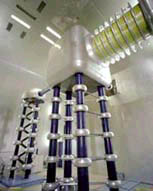
The major accelerator facilities make use of several types of devices to build up the energy of the particles. The Cockroft-Walton accelerator is used as the first stage of acceleration at Fermilab. "Inside this device, hydrogen gas is ionized to create negative ions, each consisting of two electrons and one proton. The ions are accelerated by a positive voltage and reach an energy of 750,000 electron volts (750 keV). This is about 30 times the energy of the electron beam in a television's picture tube." (Fermilab)

主要加速器设施利用几种类型的装置来增加粒子的能量。Cockroft-Walton加速器用于费米实验室中粒子加速的首阶段。“在该装置内,氢气被电离以生成负离子,每个离子由两个电子和一个质子组成。这些离子在正电压作用下被加速,达到750,000电子伏特(750 keV)的能量。这大约是电视机显像管中电子束能量的30倍。”(费米实验室)

Image courtesy Fermilab
图片 courtesy Fermilab

Developed by John D. Cockroft and Earnest T. S. Walton at the Cavendish Laboratory in England, this type of accelerator consists of a multi-step voltage divider which accelerates ions linearly through constant voltage steps. Their device had the distinction of being the first to produce an artificial nuclear disintegration by bombarding lithium with accelerated protons (published 1932).
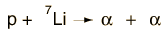
由约翰·D·柯克罗夫特和埃纳斯特·T·S·沃尔顿在英国卡文迪许实验室开发的这种加速器,由一个多级电压分压器组成,可使离子线性地通过恒定的电压步骤加速。他们的装置具有独特之处,是首次通过用加速的质子轰击锂来实现人工核分解的装置(1932年发表)。

Cockroft and Walton were able to get energies of several hundred kilo-electronvolts from the accelerator, and its upper limit is about 1 MeV. The upper limit is imposed by electical breakdown. To approach that limit, large and carefully designed insulators must be used, making this accelerator very bulky.

Cockroft 和 Walton 用加速器获得了几百千电子伏的能量,其上限约为 1 MeV。这个上限是由电气击穿造成的。要接近这个极限,必须使用大型且精心设计的绝缘体,使得这个加速器变得非常笨重。

The high-energy limit was raised by replacing the ladder of rectified voltages with an insulating belt to transport charge in the van de Graaf accelerator.

为提高高能极限,通过将整流电压阶梯替换为绝缘带,以在范德格拉夫加速器中传输电荷。
Types of Accelerators
加速器类型
Index

Particle concepts

Search for elementary particles
索引 质点概念 搜索基本粒子
 
HyperPhysics***** Quantum Physics
HyperPhysics ***** 量子物理
R Nave
Go Back
返回


van de Graaf Accelerators

范德格拉夫加速器

The high energy limit for DC high voltages was extended with the development of the van de Graaf accelerator. It used an insulating belt to transport charge to a conducting region, similar in principle to the demonstration van de Graaf generators used to demonstrate high voltages. The acceleration tubes for the particles were insulated with compressed gases. This achieved a higher voltage than the high-voltage rectifiers of the Cockroft-Walton accelerator, which were limited by spark discharges.

直流高压的高能极限随着范德格拉夫加速器的发展而得以扩展。它使用绝缘带将电荷运输到导电区域,其原理类似于用于演示高压的范德格拉夫发电机。粒子的加速管用压缩气体绝缘。这实现了比柯克霍夫-沃尔顿加速器的高压整流器更高的电压,后者受到火花放电的限制。

The high-energy limit was raised by replacing the ladder of rectified voltages with an insulating belt to transport charge in the van de Graaf accelerator.

为提升高能极限,通过将整流电压阶梯替换为绝缘带,以在范德格拉夫加速器中传输电荷。

Van de Graaf accelerators have achieved energies of about 10 MeV, and are thus capable of producing particles of higher energy than the energies of radioactive decay.

Van de Graaf加速器已达到约10 MeV的能量,因此能够产生比放射性衰变的能量更高的粒子。
Types of Accelerators
加速器类型
Index

Particle concepts

Search for elementary particles
索引 质点概念 搜索基本粒子
 
HyperPhysics***** Quantum Physics
HyperPhysics ***** 量子物理
R Nave
Go Back
返回