Bilingual edition: English is preserved and Chinese follows each unit. Terminology uses the confirmed v20260916 glossary; automated semantic review remains traceable.
中英双语版:英文原文完整保留,中文紧随对应单元;术语采用 v20260916 确认表,自动语义审校结果可追溯。

Accelerators

加速器

The search for the very small requires very high energies. The discoveries necessary for the electroweak unification were near the upper end of available energies in the current generation of particle accelerators. High energy particle physics experimental research is now concentrated in a relatively small number of places.

寻找极小的粒子需要极高的能量。为实现电磁统一所需的发现,接近当前粒子加速器可用能量的上限。目前,高能粒子物理实验研究主要集中在少数几个地方。

Fermilab

费米实验室

SLAC

KEK

CERN

欧洲核子研究中心

Brookhaven

布罗克豪森

LBL

These large accelerator facilities employ a variety of acceleration devices and have sophisticated arrays of detectors to permit analysis of the results of the high energy scattering events.

这些大型加速器设施采用多种加速装置,并配备复杂的探测器阵列,以分析高能散射事件的结果。
Index

Particle concepts

Search for elementary particles
索引 质点概念 搜索基本粒子
 
HyperPhysics***** Quantum Physics
HyperPhysics ***** 量子物理
R Nave
Go Back
返回


Fermilab

费米实验室

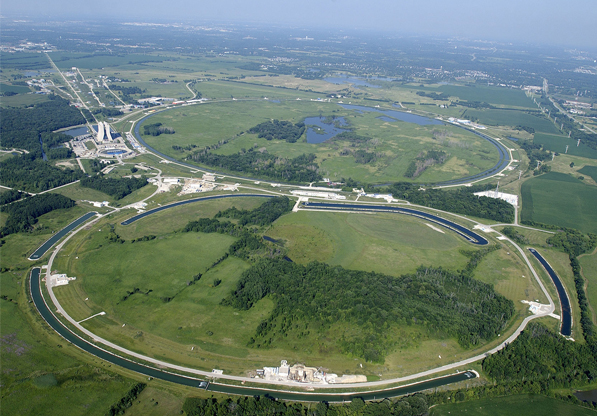
The Fermi National Accelerator Laboratory near Chicago had the Tevatron, the world's most powerful proton-antiproton collider until the startup in 2008 of the Large Hadron Collider (LHC). It was designed to reach 1 TeV. It played a major role in the search for evidence for the last of the quarks, the top quark.
位于芝加哥附近的费米国家加速器实验室拥有Tevatron,这是直到2008年大型强子对撞机(LHC)启动之前世界上最强的质子-反质子对撞机。它设计用于达到1 TeV。它在寻找最后一种夸克——顶夸克的证据的搜索中发挥了重要作用。

Fermilab facility. Image courtesy Wikipedia. The main injector is in the foreground, and the antiproton ring and Tevatron (inactive since 2011) are in the background. Author Fermilab, Reidar Hahn, 2003.
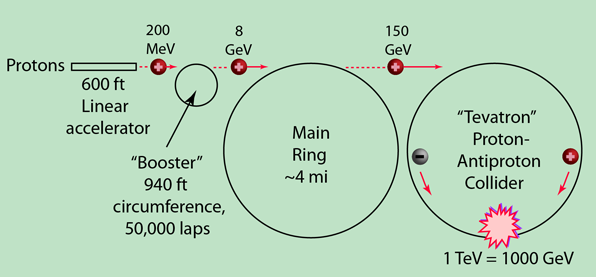
Protons from the Main Ring in bunches of a quadrillion are smashed into a metal target to make antiprotons. About 10 billion are made and extracted into a triangular magnet array called an accumulator. Once a sufficient "stack" of antiprotons is accumulated, they were injected into the Tevatron. Six bunches of each type of particle, each bunch 2 ft long and thinner than a pencil, were accelerated in opposite directions around the ring to collide in a "shot" in the collider detector (Trefil, Discover Dec89, p56).

来自主环的粒子以每群一千万亿的数量被撞向金属靶,以产生反质子。大约有100亿个反质子被提取并放入称为积累器的三角形磁体阵列中。一旦积累器中积累出足够数量的反质子,它们就被注入到Tevatron中。每种类型的粒子各六群,每群长2英尺,比铅笔还细,被加速并以相反方向绕环运动,以便在对撞机探测器中的“一发”中发生碰撞(Trefil,Discover Dec89,p56)。

The Fermilab facility houses the Main Injector, a proton synchrotron accelerator. Beneath it in the same tunnel is another synchrotron, a superconducting magnetic ring called the Tevatron which boosts the energy to 1 TeV. There is an antiproton storage ring which achieves collision energies of about 1.8 TeV.

费米实验室设有主注入器,这是一个质子回旋加速器。在同一个隧道下方还有一个回旋加速器,即超导磁环称为Tevatron,它将能量提升到1 TeV。还有一个反质子存储环,可实现约1.8 TeV的碰撞能量。

Before entering the Main Injector, protons are accelerated to about 750 keV by a Cockroft-Walton accelerator, then to about 400 MeV by a linear accelerator. They are raised to 8 GeV by a comparatively small booster accelerator and then up to 150 GeV by the Main Injector.

在进入主加速器之前,质子首先由一个Cockroft-Walton加速器加速到约750 keV,然后由一个直线加速器加速到约400 MeV。接着,它们通过一个相对较小的回旋加速器被提升到8 GeV,最后由主加速器加速到150 GeV。

Associated with the Tevatron were two large detector facilities, the Collider Detector Facility and the D0 detector facility. Until the startup in 2008 of the Large Hadron Collider (LHC), it was the most powerful particle accelerator in the world. The Tevatron startup was in 1983 and it was decommissioned in 2011.

与Tevatron相关的是两个大型探测器设施,即Collider Detector Facility和D0探测器设施。在大型强子对撞机(LHC)于2008年启动之前,它是世界上最大的粒子加速器。Tevatron于1983年启动,并于2011年停用。
Some discoveries at Fermilab
费米实验室的一些发现
Upsilon meson
Υ介子
Charm quark
粲夸克
Top quark
顶夸克
Accelerators
加速器
费米实验室设施。图片 courtesy Wikipedia。前景是主注入器,背景是反质子环和Tevatron(自2011年以来已停用)。作者 Fermilab,Reidar Hahn,2003。
Index

Particle concepts

Search for elementary particles


Fermilab


Fermilab Wiki
索引粒子概念 搜索基本粒子 费米实验室 费米实验室维基
 
HyperPhysics***** Quantum Physics
HyperPhysics ***** 量子物理
R Nave
Go Back
返回


Fermilab's Booster and Main Injector

费米实验室的加速器

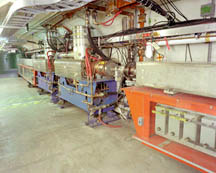
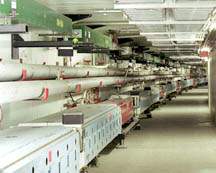
As part of Fermilab's chain of accelerators, the booster and main injector increase the energy of particles before injection into the Tevatron.

After being accelerated by Cockroft-Walton and linear accelerators, protons enter the third stage, the Booster, which is located about 20 feet below ground. The Booster is a circular accelerator (synchrotron) that uses magnets to bend the beam of protons in a circular path. The protons travel around the Booster about 20,000 times so that they repeatedly experience electric fields. With each revolution the protons pick up more energy, leaving the Booster with 8 billion electron volts (8 GeV).

在被Cockroft-Walton加速器和线性加速器加速后,质子进入第三阶段,即 Booster,它位于地面以下约20英尺。Booster是一种环形加速器(回旋加速器),它利用磁铁使质子束在环形路径中弯曲。质子在Booster中绕行约20,000次,从而使它们反复经历电场。每次绕行,质子都会获得更多的能量,最终离开Booster时具有80亿电子伏特(8 GeV)的能量。

The Main Injector, completed in 1999, accelerates particles and transfers beams. It has four functions: (1) It accelerates protons from 8 GeV to 150 GeV. (2) It produces 120 GeV protons, which are used for antiproton production. (3) It receives antiprotons from the Antiproton Source and increases their energy to 150 GeV. (4) It injects protons and antiprotons into the Tevatron.

主要加速器于1999年建成,用于加速粒子并转移束流。它有四个功能:(1) 它将质子从8 GeV加速到150 GeV。(2) 它产生120 GeV质子,用于反质子的生产。(3) 它从反质子源接收反质子并将其能量提高到150 GeV。(4) 它将质子和反质子注入到Tevatron中。

Inside the Main Injector tunnel, physicists have also installed an Antiproton Recycler (green ring). It stores antiprotons that return from a trip through the Tevatron, waiting to be re-injected.

在主加速器隧道内,物理学家还安装了一个反质子回旋器(绿色环)。它储存从Tevatron返回的反质子,等待再次注入。

The Tevatron receives 150 GeV protons and antiprotons from the Main Injector and accelerates them to almost 1000 GeV, or one tera electron volt (1 TeV). Traveling only 200 miles per hour slower than the speed of light, the protons and antiprotons circle the Tevatron in opposite directions. The beams cross each other at the centers of the 5000-ton CDF and DZero detectors located inside the Tevatron tunnel, creating bursts of new particles. (Fermilab)

Tevatron 从Main Injector获得150 GeV的质子和反质子,将其加速至接近1000 GeV,即1 tera电子伏(1 TeV)。这些质子和反质子以仅比光速慢200英里/小时的速度在Tevatron内环行,方向相反。两束粒子在Tevatron隧道内位于中心的5000吨重的CDF和DZero探测器处交汇,产生新的粒子爆发。(Fermilab)

Images courtesy Fermilab
图片 courtesy Fermilab

Accelerators
加速器
作为费米实验室加速器链的一部分, booster 和 main injector 在粒子注入到 Tevatron 前增加其能量。
Index

Particle concepts

Search for elementary particles
索引 质点概念 搜索基本粒子
 
HyperPhysics***** Quantum Physics
HyperPhysics ***** 量子物理
R Nave
Go Back
返回


Fermilab's Tevatron

费米实验室的超导粒子加速器

Beneath the Main Ring at Fermilab in the same tunnel is another synchrotron, a superconducting magnetic ring called the Tevatron which boosts the energy to 1 TeV. There is an antiproton storage ring which achieves collision energies of about 1.8 TeV.

在费米实验室主环下方的同一隧道中,还有一个同步回旋加速器,这是一个称为Tevatron的超导磁环,它将能量提升到1 TeV。还有一个反质子存储环,其碰撞能量可达约1.8 TeV。

The Tevatron makes use of superconducting magnets to achieve the high energies and reduce operating costs.

Tevatron利用超导磁体来实现高能束流并降低运行成本。

The Tevatron received 150 GeV protons and antiprotons from the Main Injector and accelerated them to almost 1000 GeV, or one tera electron volt (1 TeV). Traveling only 200 miles per hour slower than the speed of light, the protons and antiprotons circle the Tevatron in opposite directions. The beams cross each other at the centers of the 5000-ton CDF and DZero detectors located inside the Tevatron tunnel, creating bursts of new particles. (Fermilab)

Tevatron 从Main Injector获得150 GeV的质子和反质子,将其加速至接近1000 GeV,即1 tera电子伏(1 TeV)。这些质子和反质子以仅比光速慢200英里/小时的速度在Tevatron内环行,方向相反。两束粒子在Tevatron隧道内5000吨重的CDF和DZero探测器中心交汇,产生新的粒子爆发。(Fermilab)

The Tevatron was the premiere proton-antiproton collider from 1986 to 2011 when it was decommissioned. The Large Hadron Collider (LHC) was started on 10 September 2008 with proton-proton collision energies reaching 13 TeV in LHC Run 2 ending in 2018.

Accelerators
加速器
Tevatron 是从 1986 年到 2011 年为止的首个质子-反质子对撞机。大型强子对撞机(LHC)于 2008 年 9 月 10 日开始运行,其质子-质子碰撞能量在 LHC 运行二期达到 13 TeV,于 2018 年结束。
Index

Particle concepts

Search for elementary particles
索引 质点概念 搜索基本粒子
 
HyperPhysics***** Quantum Physics
HyperPhysics ***** 量子物理
R Nave
Go Back
返回