Allowed and Forbidden Particle Decays
Discrete particles tend to be unstable and to decay into two or more particles of lesser mass unless they are forbidden to do so by some principle or conservation law. This tendency is sometimes referred to as the totalitarian principle. It is instructive to look at some allowed and forbidden decays and to develop patterns which would allow us to predict whether a given decay will occur.
One way to examine a decay is to list the quark content of each of the particles. For this purpose, it is convenient to refer to the meson table and baryon table.
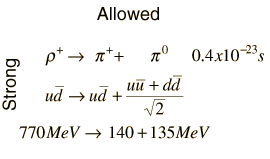 If the quark content on the two sides matches and the decay conserves energy, baryon number, and charge, then it will tend to decay very rapidly, on the order of 10-22 seconds. Note that the quark-antiquark pairs which constitute the π0 can be created if there is sufficient energy available in the decay. 如果两边的夸克内容一致,并且衰变过程守恒能量、重子数和电荷,那么它会倾向于迅速衰变,时间尺度约为10 -22秒。注意,如果衰变过程中有足够的能量,可以产生构成π⁰的夸克-反夸克对。 | 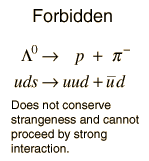 The weak interaction can transform the flavor of the quarks, and this decay can proceed by the weak interaction. 弱相互作用可以改变夸克的风味,这种衰变可以通过弱相互作用进行。 |
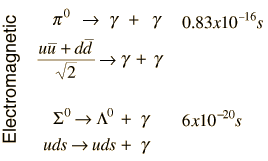 Since the π0 is composed of quark-antiquark pairs, it can decay electromagnetically into photons. It requires two photons to conserve momentum. 由于π⁰粒子由夸克-反夸克对组成,它可以通过电磁衰变产生光子。为了守恒动量,它必须衰变成两个光子。 | 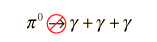 The decay of the pion into three photons could conserve energy and momentum. But it violates charge conjugation symmetry, and it is found that strong and electromagnetic decays are invariant under charge conjugation. 介子衰变成三个光子时,可能守恒能量和动量。但这种衰变违反了宇称对称性,发现强相互作用和电磁衰变在宇称对称性下是不变的。 |
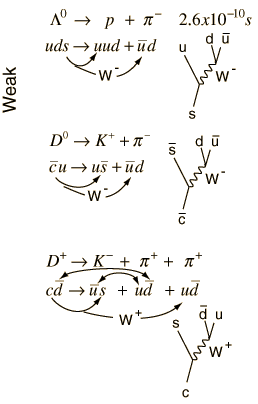 The weak interaction decays are more complex and have more possibilities. They involve quark transformations involving the W particles to change quark flavors. Besides tracking the quark content of the particles, it is helpful to examine the Feynmann diagrams for W decay to see what the usual decay products are. With those tools, the first two decays above are fairly straightforward. The third requires a bit more gymnastics with the quarks. It requires the production of a quark-antiquark pair to proceed as indicated. 弱相互作用衰变更为复杂,可能性更多。它们涉及通过W粒子转变夸克风味的过程。除了追踪粒子的夸克内容外,还应检查W衰变的费曼图,以确定常见的衰变产物。借助这些工具,上述前两个衰变相对较为直接。第三个则需要一些夸克的技巧操作。它需要产生一个夸克-反夸克对才能继续进行。 | 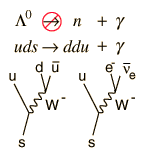 Since the interaction shown does not conserve strangeness, it will not proceed by the strong or electromagnetic interactions. It might be presumed that it ought to go by weak interaction, but the Feynmann diagrams above show the decays of the strange quark, and the decay shown is not included as a possibility. In order to get the extra down quark to form the neutron, you would need to create an up and anti-up as well. That would usually pair with a down-antidown to form a π0 meson, not a photon. 由于上述相互作用不守恒 strangeness,它不会通过强相互作用或电磁相互作用进行。或许可以认为它应当通过弱相互作用进行,但上面的 Feynmann 图显示的是奇异夸克的衰变,而所展示的衰变并未被列为可能的情况。为了得到额外的下夸克以形成中子,你还需要创造一个上夸克和反上夸克。这通常会与一个下夸克和反下夸克配对形成一个 π⁰ 介子,而不是光子。 |
Particle concepts
References
Das & Ferbel
Ch. 11
| HyperPhysics***** Quantum Physics
HyperPhysics ***** 量子物理 | R Nave |