Particle Interactions and Conservation Laws粒子相互作用与守恒定律
In developing the standard model for particles, certain types of interactions and decays are observed to be common and others seem to be forbidden. The study of interactions has led to a number of conservation laws which govern them. These conservation laws are in addition to the classical conservation laws such as conservation of energy, charge, etc., which still apply in the realm of particle interactions. Strong overall conservation laws are the conservation of baryon number and the conservation of lepton number. Specific quantum numbers have been assigned to the different fundamental particles, and other conservation laws are associated with those quantum numbers. 在发展粒子标准模型时,某些类型的相互作用和衰变被观察到是常见的,而另一些则似乎被禁止。对相互作用的研究导致了一系列守恒定律,这些定律支配着这些相互作用。这些守恒定律除了仍然适用于粒子相互作用的经典守恒定律,如能量、电荷等之外,还包括重子数和轻子数的守恒。不同的基本粒子已被赋予特定的量子数,其他守恒定律则与这些量子数相关联。
From another point of view, it would seem that any localized particle of finite mass should be unstable, since the decay into several smaller particles provides many more ways to distribute the energy, and thus would have higher entropy. This idea is even stated as a principle called the "totalitarian principle" which might be stated as "every process that is not forbidden must occur". From this point of view, any decay process which is expected but not observed must be prevented from occurring by some conservation law. This approach has been fruitful in helping to determine the rules for particle decay. 从另一个角度来看,任何具有有限质量的局域粒子都应是不稳定的,因为衰变成多个较小粒子的过程提供了更多的能量分布方式,因此熵会更高。这个想法甚至被表述为一个称为‘绝对原则’的原理,可以表述为‘所有未被禁止的过程都必须发生’。从这个角度来看,任何预期但未被观测到的衰变过程都必须通过某种守恒定律来阻止发生。这种方法在帮助确定粒子衰变规则方面取得了成果。
Conservation laws for parity, isospin, and strangeness have been developed by detailed observation of particle interactions. The combination of charge conjugation (C), parity (P) and time reversal (T) is considered to be a fundamental symmetry operation - all physical particles and interactions appear to be invariant under this combination. Called CPT invariance, this symmetry plumbs the depths of our understanding of nature. 宇称、同位旋和 strangeness 的守恒定律已通过粒子相互作用的详细观察得以发展。电荷共轭(C)、宇称(P)和时间反演(T)的组合被认为是一种基本的对称操作——所有物理粒子和相互作用似乎都对这种组合保持不变。这种对称性称为 CPT 不变性,它深入揭示了我们对自然的理解。
Another part of the high energy physicist's toolkit in anticipating what interactions can be expected is "crossing symmetry". Any interaction which is observed can be used to predict other related interactions by "crossing" any particle across the reaction symbol and turning it into its antiparticle. 高能物理学家在预测可能的相互作用时,另一件有用的工具是“交叉对称性”。任何被观测到的相互作用都可以通过将反应符号中的任何粒子交叉转换为其反粒子,来预测其他相关的相互作用。
|
Index Particle concepts References Blatt Ch. 17 索引 质点 概念 参考文献 Blatt 第17章 | ||
|
Go Back
返回 |
Conservation of Baryon Number重子数守恒
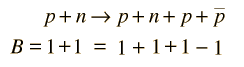
Nature has specific rules for particle interactions and decays, and these rules have been summarized in terms of conservation laws. One of the most important of these is the conservation of baryon number. Each of the baryons is assigned a baryon number B=1. This can be considered to be equivalent to assigning each quark a baryon number of 1/3. This implies that the mesons, with one quark and one antiquark, have a baryon number B=0. No known decay process or interaction in nature changes the net baryon number. 自然界对粒子相互作用和衰变有特定的规则,这些规则可以总结为守恒定律。其中最重要的一条是重子数的守恒。每个重子都被赋予一个重子数B=1。这可以视为等同于给每个夸克赋予一个重子数1/3。这表明,介子(由一个夸克和一个反夸克组成)的重子数B=0。目前尚未发现任何自然中的衰变过程或相互作用会改变净重子数。
The neutron and all heavier baryons decay directly to protons or eventually form protons, the proton being the least massive baryon. This implies that the proton has nowhere to go without violating the conservation of baryon number, so if the conservation of baryon number holds exactly, the proton is completely stable against decay. One prediction of grand unification of forces is that the proton would have the possibility of decay, so that possibility is being investigated experimentally. 中子和所有更重的重子直接衰变成质子或最终形成质子,质子是质量最小的重子。这表明,如果质子数守恒严格成立,质子将无法衰变,因此质子对衰变具有完全的稳定性。大统一理论的一个预测是质子有可能衰变,因此这一可能性正在被实验研究。
Conservation of baryon number prohibits a decay of the type 重子数守恒禁止以下类型的衰变
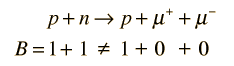
![]() but with sufficient energy permits pair production in the reaction 但只要有足够的能量就允许在反应中产生粒子对
![]() The fact that the decay 衰变的事实
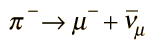
![]() is observed implied that there is no corresponding principle of conservation of meson number. The pion is a meson composed of a quark and an antiquark, and on the right side of the equation there are only leptons. (Equivalently, you could assign a baryon number of 0 to the meson.) 观察到这表明不存在介子数守恒的对应原理。π介子是由一个夸克和一个反夸克组成的介子,而方程右边只有轻子。(等价地,你可以将介子的重子数设为0。)
|
Index Particle concepts 索引粒子概念 | ||
|
Go Back
返回 |
Conservation of Lepton Number轻子数守恒
Nature has specific rules for particle interactions and decays, and these rules have been summarized in terms of conservation laws. One of the most important of these is the conservation of lepton number. This rule is a little more complicated than the conservation of baryon number because there is a separate requirement for each of the three sets of leptons, the electron, muon and tau and their associated neutrinos. 自然界对粒子相互作用和衰变有特定的规则,这些规则可以总结为守恒定律。其中最重要的一条是轻子数的守恒。这条规则比重子数的守恒更复杂,因为对于电子、缪子和tau及其关联中微子的三组轻子都有单独的要求。
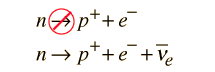
The first significant example was found in the decay of the neutron. When the decay of the neutron into a proton and an electron was observed, it did not fit the pattern of two-particle decay. That is, the electron emitted does not have a definite energy as is required by conservation of energy and momentum for a two-body decay. This implied the emission of a third particle, which we now identify as the electron antineutrino. 第一个重要的例子出现在中子的衰变中。当观察到中子衰变成质子和电子时,发现这不符合两个粒子衰变的模式。也就是说,发出的电子并不具有确定的能量,这不符合能量和动量守恒的两体衰变要求。这暗示了第三个粒子的发射,我们现在将其识别为电子中微子。
![]() The assignment of a lepton number of 1 to the electron and -1 to the electron antineutrino keeps the lepton number equal to zero on both sides of the second reacton above, while the first reaction does not conserve lepton number. 将电子的轻子数定为1,将电子反中微子的轻子数定为-1,使上述第二个反应两边的轻子数保持相等,而第一个反应不守恒轻子数。
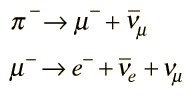
The observation of the following two decay processes leads to the conclusion that there is a separate lepton number for muons which must also be conserved. 观察以下两个衰变过程得出结论:muons有一个独立的轻子数,该数也必须守恒。
![]() The first reaction above (decay of the pion) is known to be a two-body decay by the fact that a well-defined muon energy is observed from the decay. However, the decay of the muon into an electron produces a distribution of electron energies, showing that it is at least a three-body decay. In order for both electron lepton number and muon lepton number to be conserved, then the other particles must be an electron anti-neutrino and a muon neutrino. 上面的第一个反应(π介子的衰变)被已知为一个两体衰变,因为从衰变中观察到一个明确的μ子能量。然而,μ子衰变成电子会产生一个电子能量分布,表明至少是一个三体衰变。为了使电子轻子数和μ子轻子数都守恒,其他粒子必须是一个电子反中微子和一个μ子中微子。
|
Index Particle concepts 索引粒子概念 | ||
|
Go Back
返回 |
Parity宇称
One of the conservation laws which applies to particle interactions is associated with parity. 适用于粒子相互作用的一种守恒定律与宇称有关。
Quarks have an intrinsic parity which is defined to be +1 and for an antiquark parity = -1. Nucleons are defined to have intrinsic parity +1. For a meson with quark and antiquark with antiparallel spins (s=0), then the parity is given by 夸克具有内在宇称,定义为+1,而反夸克的宇称为-1。核子被定义为具有内在宇称+1。对于由一个夸克和一个反夸克组成且自旋反平行(s=0)的介子,其宇称由
![]() The meson parity is given by 介子的宇称由
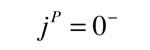
![]() The lowest energy states for quark-antiquark pairs (mesons) will have zero spin and negative parity and are called pseudoscalar mesons. The nine pseudoscalar mesons can be shown on a meson diagram. One kind of notation for these states indicates their angular momentum and parity 夸克-反夸克对的最低能量态(介子)将具有零自旋和负宇称,并被称为伪标量介子。九种伪标量介子可以在介子图上表示。一种表示这些态的符号表明它们的角动量和宇称。
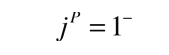
![]() Excited states of the mesons occur in which the quark spins are aligned, which with zero orbital angular momentum gives j=1. Such states are called vector mesons. 介子的激发态发生在夸克自旋对齐的情况下,此时轨道角动量为零,使得总角动量j=1。这类态被称为矢量介子。
![]() The vector mesons have the same spin and parity as photons. 矢量介子具有与光子相同的自旋和宇称。
All neutrinos are found to be "left-handed", with an intrinsic parity of -1 while antineutrinos are right-handed, parity =+1. 所有中微子都被发现是“左旋”的,其内在宇称为-1;而反中微子则是右旋的,宇称为+1。
|
Index Particle concepts References Rohlf Ch. 17 索引 质点概念 参考文献 Rohlf 第17章 | ||
|
Go Back
返回 |
Isospin同位旋
Isospin is a term introduced to describe groups of particles which have nearly the same mass, such as the proton and neutron. This doublet of particles is said to have isospin 1/2, with projection +1/2 for the proton and -1/2 for the neutron. The three pions compose a triplet, suggesting isospin 1. The projections are +1 for the positive, 0 and -1 for the neutral and negative pions. Isospin is used as an axis in particle diagrams, with strangeness being the other axis. Isospin is not really spin, and doesn't have the units of angular momentum - the spin term is tacked on because the addition of the isospins follows the same rules as spin. 同位旋是一个术语,用于描述质量几乎相同的粒子组,例如质子和中子。这些双态粒子被称为具有同位旋1/2,其中质子的投影为+1/2,中子的投影为-1/2。三个π介子组成一个三元组,暗示同位旋为1。其投影分别为正π介子为+1,中性π介子为0,负π介子为-1。同位旋被用作粒子图中的一个轴, strangeness 是另一个轴。同位旋并不是真正的自旋,也不具有角动量的单位 - 自旋术语被附加上是因为同位旋的加法遵循与自旋相同的规则。
Isospin is a dimensionless quantity associated with the fact that the strong interaction is independent of electric charge. Any two members of the proton-neutron isospin doublet experience the same strong interaction: proton-proton, proton-neutron, neutron-neutron have the same strong force attraction. 同位旋是一个与强相互作用与电荷无关的事实相关的无量纲量。质子-中子同位旋双重态中的任意两个成员体验到相同的强相互作用:质子-质子,质子-中子,中子-中子具有相同的强作用力吸引力。
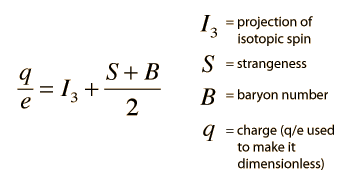
At the quark level, the up and down quarks form an isospin doublet (I=1/2) and the projection I3 = +1/2 is assigned to the up quark and I3 =-1/2 to the down. (The subscript 3 is used here for the third component rather than the z used with spin and orbital angular momentum because most of the literature does so.) The other quarks are assigned isospin I=0. Isospin is related to other quantum numbers for the particles by 在夸克层面,上夸克和下夸克形成一个同位旋双重态(I=1/2),其中I₃=+1/2被分配给上夸克,I₃=-1/2被分配给下夸克。(这里下标3用于表示第三分量,而不是通常用于自旋和轨道角动量的z分量,因为大多数文献都是如此处理的。)其他夸克被分配同位旋I=0。同位旋与其他粒子的量子数有关联。
![]() This relationship is called the Gell Mann-Nishijima formula. Some references use T for isospin, but it appears that most use I for isospin and T for weak isospin. 这种关系称为盖尔曼-尼希吉玛公式。一些参考文献使用T表示同位旋,但似乎大多数使用I表示同位旋,而用T表示弱同位旋。
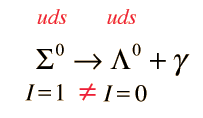
Isospin is associated with a conservation law which requires strong interaction decays to conserve isospin, as illustrated by the process 同位旋与一个守恒定律有关,该定律要求强相互作用衰变必须守恒同位旋,如图所示
![]() which does not involve any transmutation of quarks, so would be expected to decay by strong interaction. However, it does not conserve isospin, and is observed to decay by the electromagnetic interaction, but not by the strong interaction. The experimental discrimination is made by the observation of its decay lifetime, presuming by the totalitarian principle that if it could decay by the strong interaction, it would. 这并不涉及夸克的转变,因此预期通过强相互作用衰变。然而,它不守恒同位旋,并被观测到通过电磁相互作用衰变,而非通过强相互作用。实验上的区分是通过观察其衰变寿命来实现的,假定根据总裁原则,如果它能通过强相互作用衰变,它就会这样做。
|
Index Particle concepts References Rohlf Ch. 17 Blatt Ch. 17 Griffiths Sec. 4.5 索引 质点概念 参考文献 Rohlf 第17章 Blatt 第17章 Griffiths 第4.5节 | ||
|
Go Back
返回 |