Bilingual edition: English is preserved and Chinese follows each unit. Terminology uses the confirmed v20260916 glossary; automated semantic review remains traceable.
中英双语版:英文原文完整保留,中文紧随对应单元;术语采用 v20260916 确认表,自动语义审校结果可追溯。

Gluons

胶子

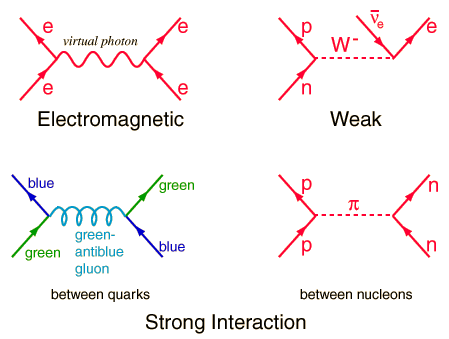
Gluons are the exchange particles for the color force between quarks, analogous to the exchange of photons in the electromagnetic force between two charged particles. The gluon is considered to be a massless vector boson with spin 1. The gluon can be considered to be the fundamental exchange particle underlying the strong interaction between protons and neutrons in a nucleus. That short-range nucleon-nucleon interaction can be considered to be a residual color force extending outside the boundary of the proton or neutron. That strong interaction was modeled by Yukawa as involving an exchange of pions, and indeed the pion range calculation was helpful in developing our understanding of the strong force.

胶子是夸克之间颜色力的交换粒子,类似于带电粒子之间电磁力的光子交换。胶子被认为是一种无质量的矢量玻色子,自旋为1。胶子可以被视为是质子和中子在核内强相互作用的根本交换粒子。这种短程的核-核相互作用可以被视为一种延伸到质子或中子边界外的颜色力。这种强相互作用曾由尤卡夫模型描述为涉及介子的交换,事实上,介子范围的计算在发展我们对强力的理解方面起到了帮助作用。
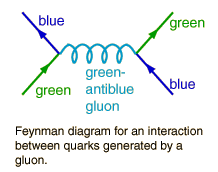
Gluon interactions are often represented by a Feynman diagram. Note that the gluon generates a color change for the quarks. The gluons are in fact considered to be bi-colored, carrying a unit of color and a unit of anti-color as suggested in the diagram at right. The gluon exchange picture there converts a blue quark to a green one and vice versa. The range of the strong force is limited by the fact that the gluons interact with each other as well as with quarks in the context of quark confinement. These properties contrast them with photons, which are massless and of infinite range. The photon does not carry electric charge with it, while the gluons do carry the "color charge".

胶子相互作用通常用费曼图表示。请注意,胶子会使夸克产生颜色变化。实际上,胶子被认为是双色的,携带一个颜色单位和一个反颜色单位,如右图所示。该图中的胶子交换图将蓝色夸克转换为绿色夸克,反之亦然。强相互作用的范围受到限制,因为胶子不仅与夸克相互作用,而且在夸克禁闭的背景下也相互作用。这些特性与光子形成对比,光子是无质量的,作用范围无限。光子不携带电荷,而胶子则携带“颜色电荷。”

Within their range of about a fermi, the gluons can interact with each other, and can produce virtual quark-antiquark pairs. The property of interaction with each other is very different from the other exchange particles, and raises the possibility of gluon collections referred to as "glueballs". The internal state of a hadron is viewed as composed of a fixed net number of quarks, but with a dynamic cloud of gluons and quark-antiquark pairs in equilibrium.

在约一个费米的范围内,胶子可以相互作用,并能产生虚的夸克-反夸克对。这种相互作用的性质与其他交换粒子非常不同,从而提出了被称为‘胶球’的胶子集合的可能性。重子的内部状态被视作由固定数量的夸克组成,但其中包含一个动态的胶子和夸克-反夸克对的平衡云。
Index

Particle concepts

Reference
Griffiths
Section 2.3

Gluon Wiki
索引 质点 概念 参考 Griffiths 第2.3节 胶子维基
 
HyperPhysics***** Quantum Physics
HyperPhysics ***** 量子物理
R Nave
Go Back
返回


Feynman Diagrams

费曼图

Feynman diagrams are graphical ways to represent exchange forces. Each point at which lines come together is called a vertex, and at each vertex one may examine the conservation laws which govern particle interactions. Each vertex must conserve charge, baryon number and lepton number.

费曼图是表示交换力的图形方法。每条线交汇的点称为顶点,在每个顶点上可以检查支配粒子相互作用的守恒定律。每个顶点必须守恒电荷、重子数和轻子数。

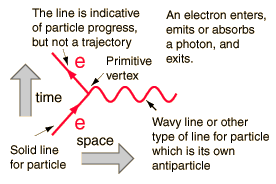
Developed by Feynman to describe the interactions in quantum electrodynamics (QED), the diagrams have found use in describing a variety of particle interactions. They are spacetime diagrams, ct vs x. The time axis points upward and the space axis to the right. (Particle physicists often reverse that orientation.) Particles are represented by lines with arrows to denote the direction of their travel, with antiparticles having their arrows reversed. Virtual particles are represented by wavy or broken lines and have no arrows. All electromagnetic interactions can be described with combinations of primitive diagrams like this one.

由费曼发展用于描述量子电动力学(QED)中的相互作用,这些图在描述各种粒子相互作用时得到了应用。它们是时空图,以ct vs x表示。时间轴指向向上,空间轴指向右方。(粒子物理学家常常反转这种方向。)粒子用带有箭头的线条表示,以表示其运动方向,反粒子的箭头方向则相反。虚粒子用波浪线或断续线表示,没有箭头。所有电磁相互作用都可以用这种基本图的组合来描述。

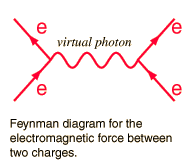
Only lines entering or leaving the diagram represent observable particles. Here two electrons enter, exchange a photon, and then exit. The time and space axes are usually not indicated. The vertical direction indicates the progress of time upward, but the horizontal spacing does not give the distance between the particles.

只有进入或离开图示的线代表可观测的粒子。这里两个电子进入,交换一个光子,然后离开。时间轴和空间轴通常不标明。垂直方向表示时间向上的进展,但水平间距并不表示粒子之间的距离。

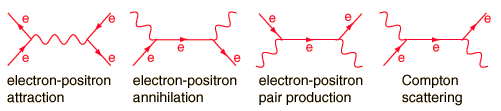
Other electromagnetic processes can be represented, as in the examples below. A backward arrow represents the antiparticle, in these cases a positron. Keep in mind that time progresses upward, and that a downward arrow is not a particle progressing downward, but an antiparticle progressing upward (forward in time).

其他电磁过程可以像下面的例子所示那样表示。一个向后的箭头表示反粒子,这种情况下是正电子。请记住时间是向上的,一个向下的箭头并不是粒子向下运动,而是反粒子向上(即时间前进)运动。

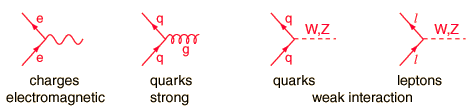
After being introduced for electromagnetic processes, Feynman diagrams were developed for the weak and strong interactions as well. Forms of primitive vertices for these three interactions are

在电磁过程被引入之后,费曼图也被发展用于弱相互作用和强相互作用。这三种相互作用的原始顶点形式为

Particle interactions can be represented by diagrams with at least two vertices. They can be drawn for protons, neutrons, etc. even though they are composite objects and the interaction can be visualized as being between their constituent quarks.

粒子相互作用可以用至少有两个顶点的图来表示。即使质子、中子等是复合粒子,它们的相互作用也可以可视化为发生在其构成的夸克之间。

Feynman diagrams for:
Lamb shift
Lamb 移位
Neutron decay
中子衰变
Weak interaction
弱相互作用
Quark decay
夸克衰变
Strong interaction
强相互作用
Electron capture
电子捕获
Twisted Feynman diagrams and crossing symmetry
扭结费曼图与交叉对称性
费曼图用于:
Index

Particle concepts

References
Griffiths
Ch 2
索引 质点概念 参考文献 Griffiths 第2章
 
HyperPhysics***** Quantum Physics
HyperPhysics ***** 量子物理
R Nave
Go Back
返回


Intermediate Vector Bosons

中间矢量玻色子

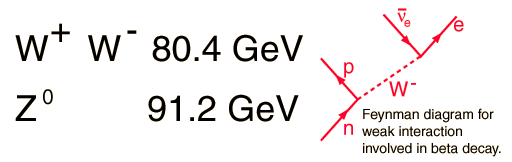
The W and Z particles are the massive exchange particles which are involved in the nuclear weak interaction, the weak force between electrons and neutrinos. They were predicted by Weinberg, Salam, and Glashow in 1979 and measured at CERN in 1982. The prediction included a prediction of the masses of these particles as a part of the unified theory of the electromagnetic and weak forces, the electroweak unification. "If the weak and electromagnetic forces are essentially the same, then they must also have the same strength. The fact that the experimentally observed strengths seem quite different is attributed to the masses of the W and Z particles-under certain conditions a force of large strength can have the appearance of a force of small strength if the particle that carries the force is very massive. Theoretical calculations show that at a fundamental level the weak and electromagnetic forces have the same strength if the W and Z particles have masses of 80 and 90 GeV respectively." The masses measured at CERN were 82 and 93 GeV, a brilliant confirmation of the electroweak unification.

W和Z粒子是参与弱相互作用的重交换粒子,即电子与中微子之间的弱力。它们于1979年由Weinberg、Salam和Glashow预测,并于1982年在CERN被测量。预测包括了这些粒子质量的预测,作为电磁力与弱力统一理论的一部分,即电弱统一。‘如果弱力和电磁力本质上是相同的,那么它们也必须具有相同的强度。实验观测到的强度似乎相当不同,这是由于W和Z粒子的质量——在某些条件下,一个强的力可以看起来像一个弱的力,如果传递该力的粒子非常重。理论计算显示,如果W和Z粒子的质量分别为80和90 GeV,那么在基本层面上,弱力和电磁力的强度是相同的。’CERN测量到的质量为82和93 GeV,这是电弱统一的辉煌确认。

The experiments at CERN detected a total of 10 W bosons and 4 Z bosons. In the extended experiment at Fermilab's Tevatron known as "Run 1" (1992-96), the D0 detector facility measured over 100,000 W particles. The D0 value for the mass of the W is 80.482 +/- 0.091 GeV. Current values combining the experiments at the Tevatron and at CERN's LEP electron-positron collider are MW = 80.41 +/- 0.18 GeV and MZ = 91.1884 +/- 0.0022 GeV.

在欧洲核子研究中心(CERN)的实验中,检测到总共10个W玻色子和4个Z玻色子。在费米实验室的Tevatron上进行的称为“Run 1”(1992-96)的扩展实验中,D0探测器设施测量了超过100,000个W粒子。W玻色子的质量D0值为80.482 ± 0.091 GeV。目前结合Tevatron和CERN的LEP电子-正电子对撞机实验结果的值为M W = 80.41 ± 0.18 GeV和M Z = 91.1884 ± 0.0022 GeV。
Index

Particle concepts

Reference
Ohanian
Sec 46.5
索引 质点 概念 参考 Ohanian 第46章第5节
 
HyperPhysics***** Quantum Physics
HyperPhysics ***** 量子物理
R Nave
Go Back
返回


Properties of W and Z

W 和 Z 的性质

The W and Z particles are called intermediate vector bosons and are the exchange particles for the weak interaction. The weak interaction visualized in the Feynman diagram below is responsible for the decay of the neutron and for beta decay.

W 和 Z 粒子被称为中间矢量玻色子,是弱相互作用的交换粒子。下面的费曼图中展示的弱相互作用负责中子的衰变和β衰变。

The charged W bosons participate in the transformation of quarks in which the flavor of the quark is changed. The neutral Z boson does not participate in changing the flavor of quarks, so its interactions are harder to detect. It interacts by influencing the scattering cross sections for neutrinos in what are called "neutral currents".

带电的W玻色子参与改变夸克风味的转变过程。中性Z玻色子不参与改变夸克的风味,因此其相互作用更难检测。它通过影响中微子的散射截面,在所谓的‘中性电流’中发生相互作用。

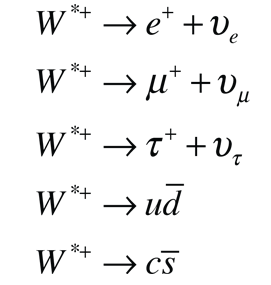
The W bosons can decay by a number of processes, and this provides a variety of decay paths for those particles which decay by the weak interaction. An interesting example is the decay of the D meson.

W玻色子可以通过多种过程衰变,这为那些通过弱相互作用衰变的粒子提供了多种衰变路径。一个有趣的例子是D介子的衰变。
Feynman diagrams of quark transformations
夸克变换的费曼图
Index

Particle concepts

Reference
Rohlf
Ch. 18
索引 质点 概念 参考 Rohlf 第18章
 
HyperPhysics***** Quantum Physics
HyperPhysics ***** 量子物理
R Nave
Go Back
返回


Photon

光子

Photon is the name given to a quantum of light or other electromagnetic radiation. The photon energy is given in the Planck relationship. The photon is the exchange particle responsible for the electromagnetic force. The force between two electrons can be visualized in terms of a Feynman diagram as shown below. The infinite range of the electromagnetic force is owed to the zero rest mass of the photon. While the photon has zero rest mass, it has finite momentum, exhibits deflection by a gravity field, and can exert a force.

光子是光或其他电磁辐射的量子。光子的能量由普朗克关系给出。光子是电磁力的交换粒子。两个电子之间的力可以借助如下的费曼图来可视化。电磁力的无限作用范围归因于光子的零静止质量。尽管光子静止质量为零,但它具有有限的动量,会受到引力场的偏转,并能施加力。
The photon has an intrinsic angular momentum or "spin" of 1, so that the electron transitions which emit a photon must result in a net change of 1 in the angular momentum of the system. This is one of the "selection rules" for electron transitions.
光子具有内在的角动量或‘自旋’为1,因此发射光子的电子跃迁必须导致系统角动量的净变化为1。这是电子跃迁的‘选择规则’之一。
What is the evidence that the photon has zero mass?
photons 有零质量的证据是什么?
Index

Particle concepts
索引粒子概念
 
HyperPhysics***** Quantum Physics
HyperPhysics ***** 量子物理
R Nave
Go Back
返回


Graviton

重力子

The graviton is the exchange particle for the gravity force. Although it has not been directly observed, a number of its properties can be implied from the nature of the force. Since gravity is an inverse square force of apparently infinite range, it can be implied that the rest mass of the graviton is zero. Forces are transmitted by bosons including the photon for the electromagnetic force and the W and Z bosons for the weak interaction. Associated with the color force, the gluons are the exchange particles. All of these except the graviton have spin 1, but the graviton has spin 2.

The current experiments LIGO and VIRGO seek to detect gravitational waves, which would be considered to be coherent collections of gravitons.

LIGO和VIRGO这两个实验旨在探测引力波,这些引力波会被视为一致的引力子集合。
引力子是重力力的交换粒子。尽管尚未直接观测到,但可以从重力的性质推断出其一些特性。由于重力是一种具有无限作用范围的反平方力,可以推断出引力子的静止质量为零。力通过玻色子传递,包括光子传递电磁力,以及W和Z玻色子传递弱相互作用。与色力相关,胶子是交换粒子。除了引力子外,所有这些粒子的自旋均为1,但引力子的自旋为2。
Index

Particle concepts

graviton Wiki
索引 质点 概念 彳子 维基
 
HyperPhysics***** Quantum Physics
HyperPhysics ***** 量子物理
R Nave
Go Back
返回