Pentaquark
In 2003 came experimental evidence of a five-quark combination which is being called a pentaquark. Strong evidence for the pentaquark came from experiments at the Jefferson Lab in Newport News, Virginia during 2003. The experiments involved multi-GeV photons impacting a deuterium target. The evidence showed a five-quark baryon state at a mass of 1.54 GeV with a narrow width of 22 MeV. The new particle is being called Theta-plus, with a composition of two up quarks, two down quarks and an anti-strange quark. The combination of quark charges +2/3(u), -1/3 (d) and 1/3 (anti-strange) gives a net charge of +1. The lifetime of the particle is about 10-20 seconds. The decay is classified as a strong interaction decay to a neutron and a K+ meson
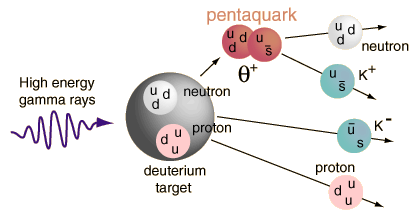
The Jefferson Lab results corroborated the growing body of evidence for the pentaquark from the last few years. Work done by a Japanese team led by Takashi Nakano of Osaka University involved bombarding a carbon target with X-rays and led to a report of pentaquark evidence in 2002. A retrospective study of 1986 bubble chamber experiments at ITEP in Moscow also revealed a 1.54 GeV peak. A review of data taken in 1997/98 at the ELSA accelerator in Bonn, Germany showed evidence of a particle of mass 1.54 GeV and width less than 25 MeV. The existence of the pentaquark was hypothesized by Maxim Polyakov, Dmitri Diakonov, and Victor Petrov at the Petersburg Nuclear Physics Institute in Russia in 1997.
While the postulated pentaquark has made an interesting story, continued experimentation has not borne it out. The 2006 Particle Data Group publication expressed its pessimism with the statement "There has not been a high-statistics confirmation of any of the original experiments that claimed to see the θ+; there have been two high-statistics repeats from Jefferson Lab that have clearly shown the original positive claims in those two cases to be wrong; there have been a number of other high-statistics experiments, none of which have found any evidence for the θ+; and all attempts to confirm the two other claimed pentaquark states have led to negative results. The conclusion that pentaquarks in general, and the θ+, in particular, do not exist, appears compelling."
But theorists are not seeing any firm exclusion of the possibility that the strong force could form larger particles. In 2014 and 2015, experiments at the Large Hadron Collider have found evidence of two unknown particles, one about 4.7 times the proton mass and one slightly more massive. Analysis indicates a composition of a charm quark, an anti-charm, two up quarks and a down quark (Grant, Science News, August 8, 2015).
| Table of Baryons
重子表 | Table of Mesons
介子表 |
| Table of quark properties
夸克性质表 |
Particle concepts
Reference
Schwarzschild
| HyperPhysics***** Quantum Physics
HyperPhysics ***** 量子物理 | R Nave |