Bilingual edition: English is preserved and Chinese follows each unit. Terminology uses the confirmed v20260916 glossary; automated semantic review remains traceable.
中英双语版:英文原文完整保留,中文紧随对应单元;术语采用 v20260916 确认表,自动语义审校结果可追溯。

CERN

欧洲核子研究中心

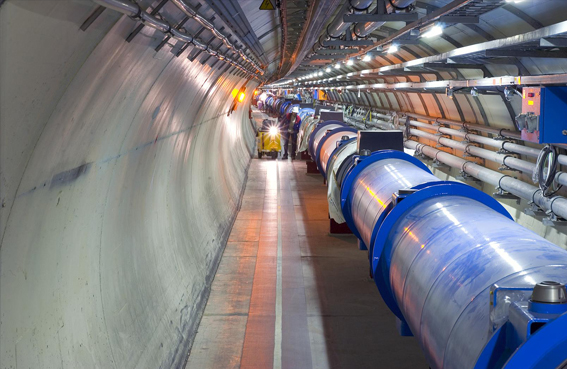
The European Laboratory for Particle Physics (CERN) is located just outside Geneva, Switzerland and overlaps the border between France and Switzerland. It has a 27 kilometer circumference circular tunnel which houses the Large Electron-Positron Collider (LEP). Entering service in 2008 in the same tunnel used for the LEP was the Large Hadron Collider which should produce proton-proton collisions in the energy range 10-14 TeV. This was the major tool used in the search for the Higgs boson.

欧洲粒子物理实验室(CERN)位于瑞士日内瓦郊外,处于法国和瑞士的边境线上。它有一个周长27公里的环形隧道,其中容纳了大型电子-正电子对撞机(LEP)。2008年,该隧道内还开始运行大型强子对撞机,其应能产生能量范围在10-14 TeV的质子-质子碰撞。这是寻找希格斯玻色子的主要工具。

The Super Proton Synchrotron (SPS) at CERN is one of the worlds largest protron synchrotrons, reaching energies of 450 GeV.

位于欧洲核子研究中心(CERN)的超导质子同步加速器(SPS)是世界上最大的质子同步加速器之一,其能量可达450 GeV。

Another major facility at CERN is the Intersecting Storage Rings (ISR), the first proton-proton collider to be put into operation (1971). It had a maximum proton energy of 31 GeV per beam.

CERN 还有另一个重要设施,即相交存储环(ISR),它是首个投入运行的质子-质子对撞机(1971年)。它每个束流中的质子最大能量为31 GeV。
Organisation Europeenne pour la Recherche Nucleaire
Accelerators
加速器
欧洲核子研究组织
Index

Particle concepts

Search for elementary particles


CERN
索引粒子概念搜索 用于寻找基本粒子的CERN
 
HyperPhysics***** Quantum Physics
HyperPhysics ***** 量子物理
R Nave
Go Back
返回


LEP

The world's largest electron synchrotron was the Large Electron-Positron Collider (LEP) at CERN. It operated from 1989 to 2000 in the same tunnel used to build the Large Hadron Collider. It has a radius of about 4 km. For the electron synchrotrons, the maximum energy is limited by the losses to synchrotron radiation which increases with the fourth power of the particle energy. Since those losses are inversely proportional to the square of the orbit radius, these accelerators are made as large as possible.

世界上最大的电子同步回旋加速器是位于欧洲核子研究组织(CERN)的大型电子-正电子对撞机(LEP)。它于1989年至2000年在建造大型强子对撞机所用的同一隧道中运行。其半径约为4公里。对于电子同步回旋加速器来说,最大能量受到同步辐射损失的限制,而这种损失与粒子能量的四次方成正比。由于这些损失与轨道半径的平方成反比,因此这些加速器尽可能地被制造得尽可能大。

A part of CERN, the Large Electron-Positron Collider (LEP) occupied a 27 kilometer circumference circular tunnel near Geneva which overlaps the Swiss-French border. It was designed to study electron-positron collisions at a center of mass energy equal to the Z0 mass energy, about 100 GeV. It was capable of very precise measurements, but didn't reach a high enough energy to find the Higgs boson.

欧洲核子研究中心(CERN)的一部分,即大型电子-正电子对撞机(LEP),位于瑞士和法国边境附近的一个周长为27公里的环形隧道中。它被设计用来研究电子-正电子对撞时的质心能量,等于Z玻色子的质量能量,约为100 GeV。它能够进行非常精确的测量,但能量不足以发现希格斯玻色子。
Accelerators
加速器
Index

Particle concepts

Search for elementary particles

Reference
Rohlf
Ch. 16
索引 质点概念 搜索基本粒子 参考Rohlf第16章
 
HyperPhysics***** Quantum Physics
HyperPhysics ***** 量子物理
R Nave
Go Back
返回


Large Hadron Collider

大型强子对撞机

The Large Hadron Collider is latest member of CERN's collection of extraordinary high-energy facilities and is the world's largest and highest-energy accelerator. It occupies a 27 kilometer circumference circular tunnel near Geneva which overlaps the Swiss-French border, the same tunnel that contained the LEP. It is designed to produce proton-proton collisions. Successful particle beams were produced in the LHC in 2008 and in 2010 the two beams reached 3.5 TeV, half the target maximum for the accelerator. The Atlas bulletin of 2018 reported on data taken at 13 TeV.

Currently the work at the LHC is divided into six experiments denoted by the names ATLAS, CMS, ALICE, LHCb, TOTEM and LHCf.

目前,大型强子对撞机(LHC)的实验工作分为六个部分,分别用ATLAS、CMS、ALICE、LHCb、TOTEM和LHCf来命名。
大型强子对撞机是欧洲核子研究中心(CERN)一系列非凡高能设施中的最新成员,是世界上最大且最高能的加速器。它位于瑞士和法国边境附近,周长27公里的环形隧道中,与此前位于同一隧道中的LEP(粒子对撞机)相重叠。该对撞机设计用于产生质子-质子碰撞。2008年,LHC成功产生了质子束流,2010年,两束质子达到3.5 TeV,达到加速器目标最大值的一半。2018年,Atlas报告了在13 TeV条件下获取的数据。

A major objective for the LHC was the search for the Higgs boson. The Atlas and CMS detectors were major parts of that discovery and subsequent study.
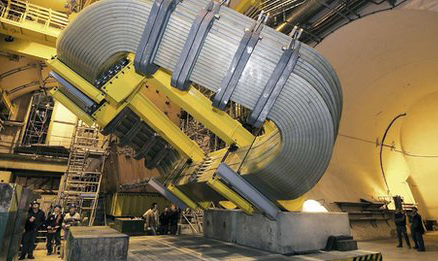
Currently some excitement is being generated by results at the LHCb or "Beauty" detector, a portion of which is shown at left. A 0.8% imbalance between the decay rates of the D-meson and its antiparticle has been discovered.
目前,LHCb或“Beauty”探测器的某些结果正在引起关注,其中一部分如左图所示。已发现D介子与其反粒子的衰变率之间存在0.8%的不平衡。

LHC的主要目标之一是寻找希格斯玻色子。Atlas和CMS探测器在这一发现及后续研究中发挥了重要作用。

Though a small difference, it is a newly discovered difference between matter and antimatter and could contribute to the solution of the "antimatter problem" in cosmology.

尽管差异微小,但这是物质与反物质之间新发现的差异,可能有助于解决宇宙学中的‘反物质问题’。

References:

参考文献:

CERN Home

CERN 首页

CERN Document Server

CERN 文档服务器

Wiki Large Hadron Collider

Accelerators
加速器
维基百科大型强子对撞机
Index

Particle concepts

Search for elementary particles

Reference
Rohlf
Ch. 16


CERN
索引 质点概念 搜索基本粒子 参考Rohlf第16章 CERN
 
HyperPhysics***** Quantum Physics
HyperPhysics ***** 量子物理
R Nave
Go Back
返回