The Mystery of Quark Mass
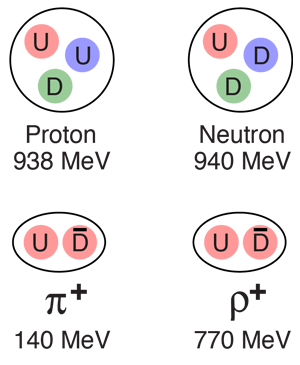
| The combination of up and down quarks to form protons and neutrons suggests that the u and d are of about equal mass: about 1/3 the mass of a nucleon. 由上夸克和下夸克结合形成质子和中子,表明u和d夸克的质量大约相等:约为核子质量的1/3。
But in the extraordinary case of the pion, an up and antidown quark combination has a mass energy of only 140 MeV! Yet the same quark combination in a rho meson has a mass energy of 770 MeV! The concept of mass is a lot stranger than classical physics would suggest. 但以π介子为例,一个上夸克和反下夸克的组合其质量能量仅为140 MeV!然而,同样的夸克组合在ρ介子中其质量能量却为770 MeV!质量的概念比经典物理所暗示的要奇怪得多。 |
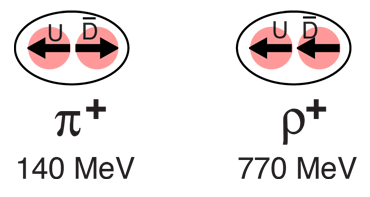
The difference between a pion and a rho is the spin alignment of the quarks. The pion is a pseudoscalar meson with zero angular momentum. The quarks have spin 1/2 and the spins are "paired" or anti-aligned. In the rho meson, a vector meson, the angular momentum is j=1, indicating parallel spins. Under the influence of the strong color force, the state with spins aligned has a higher energy which shows up as a larger mass energy. The analogy to the higher energy of aligned spins in a magnetic field (Zeeman effect) is instructive, but this difference in energy associated with the color force is enormous.
Georgi comments "There is good reason to believe that most of the mass of the quark that we 'see' in the mass of the proton or the rho is a dynamical effect of quark confinement, that the u and d quarks in the underlying QCD theory actually have masses much smaller than 1/3 the mass of the proton."
Particle concepts
Reference
Georgi
| HyperPhysics***** Quantum Physics
HyperPhysics ***** 量子物理 | R Nave |