Bilingual edition: English is preserved and Chinese follows each unit. Terminology uses the confirmed v20260916 glossary; automated semantic review remains traceable.
中英双语版:英文原文完整保留,中文紧随对应单元;术语采用 v20260916 确认表,自动语义审校结果可追溯。

Nitrogen

氮气
Symbol
符号
NAtomic number
原子序数
7
Atomic mass
原子质量
14.0067
Thermal conductivity
热导率
0.000259
Atomic radius
原子半径
0.75
Covalent radius
共价半径
0.75
Density
密度
0.001251
Atomic volume
原子体积
17.3
Melting point
熔点
63.29
Oxidation states
氧化态
3,5,4,2
Boiling point
沸点
77.25
Stable isotopes
稳定同位素
2
Heat of vapor.
汽化热
2.7928
Electronegativity
电负性
3.04
Heat of fusion
熔化热
0.3604
First ionization
第一电离能
14.534
Specific heat
比热容
1.04
Electrical conduct.
电导率
...
Electron configuration
电子排布

General description
一般说明
Nuclear data
核数据
Index

Periodic Table

Chemistry concepts
索引 元素周期表 化学概念
 
HyperPhysicsR Nave
Go Back
返回


Nitrogen

氮气

Nitrogen is a colorless, odorless, and tasteless gas which is composed of diatomic molecules N2. It constitutes 78% of the air by volume. At 0°C and 1 atmosphere pressure, a liter has a mass of 1.2506 grams. The gas condenses to a colorless liquid at 77.25 K and to a white solid at 63.3 K.

氮气是一种无色、无味、无嗅的气体,由双原子分子N₂组成。它在体积上占空气的78%。在0°C和1个大气压下,1升氮气的质量为1.2506克。该气体在77.21 K时凝结为无色液体,在63.3 K时凝结为白色固体。

Nitrogen is chemically unreactive. It does not burn, and at ordinary temperatures it does not react with other elements. It is prepared commercially by distillation of liquid air. Liquid nitrogen is extremely useful in the laboratory for cooling and pumping applications.

氮气化学性质不活泼。它不燃烧,在常温下不与其他元素反应。它通过液态空气蒸馏法进行工业制备。液态氮在实验室中被广泛用于冷却和泵送应用。

Though mineral sources of nitrogen are rare, it does occur in a mercury sulfate called kleinite.

Nitrogen is an essential element in most of the substances which make up living organisms, including the proteins. Important compounds include fertilizers and explosives. An essential source of nitrogen for living organism is nitrogen fixation in plants since animal metabolisms cannot form the needed nitrogen compounds from N2 even though it is the major constituent of the atmosphere.

氮是构成大多数生物物质的重要元素,包括蛋白质。重要的化合物包括肥料和炸药。对于生物来说,氮的主要来源是植物中的固氮作用,因为动物代谢无法从N₂形成所需的氮化合物,尽管N₂是大气的主要成分。
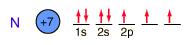
Atomic data
原子数据
Nuclear data
核数据
尽管氮的矿物来源稀少,但它存在于一种名为克莱伊特的汞硫酸盐中。
Index

Periodic Table

Chemistry concepts

Carbon chemistry concepts

Reference
Pauling
Ch. 15
索引 元素周期表 化学概念 碳化学概念 参考 Pauling 第15章
 
HyperPhysicsR Nave
Go Back
返回


Nitrogen Nuclear Data

氮核数据
Z
A
Atomic
Mass (u)
原子质量(u)
Nuclear
Mass(GeV/c2
核质量(GeV/c²)
Binding
Energy(MeV)
结合能(MeV)
Spin
自旋
Natural
Abund.
天然丰度
Half-life
半衰期
Decay
衰变
Q
MeV
Q值(MeV)
7
12
12.018613
11.1918
74.04
1
...
11ms
b+
17.34
7
13
13.005738
12.1113
94.11
1/2
...
9.97m
b+
2.22
7
14
14.003074
13.0403
104.66
1
0.99634
stable
稳定
...
...
7
15
15.000108
13.9690
115.49
1/2
0.00366
stable
稳定
...
...
7
16
16.006099
14.9061
117.98
2
...
7.13s
b-
8.68
Atomic data
原子数据
Index

Periodic Table

Chemistry concepts

Reference
Rohlf
索引 元素周期表 化学概念 参考 Rohlf
 
HyperPhysicsR Nave
Go Back
返回