Bilingual edition: English is preserved and Chinese follows each unit. Terminology uses the confirmed v20260916 glossary; automated semantic review remains traceable.
中英双语版:英文原文完整保留,中文紧随对应单元;术语采用 v20260916 确认表,自动语义审校结果可追溯。

Corona from Fogged Eyeglasses
电晕从雾蒙的眼镜

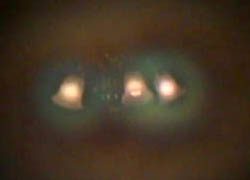
When light from a point source passes through a small circular aperture, it does not produce a bright dot as an image, but rather a diffuse circular disc known as Airy's disc surrounded by much fainter concentric circular rings. This example of diffraction is of great importance because the eye and many optical instruments have circular apertures. Diffraction also occurs in the inverse situation when you have a small opaque circle. The corona sometimes seen around the moon is attributed to diffraction from small water droplets or ice crystals.

当来自点光源的光通过一个小的圆形孔径时,它不会产生一个明亮的点作为像,而是产生一个模糊的圆形盘,称为阿贝-里德盘,周围有更暗的同心圆环。这种衍射现象非常重要,因为眼睛和许多光学仪器都有圆形孔径。当有小的不透明圆圈时,衍射也发生在相反的情况。有时可以看到围绕月亮的光环,这是由于小水滴或冰晶的衍射造成的。

The image above seems to be the same phenomenon observed when my eyeglasses were fogged upon entering the warm house after walking the dog on a cold January morning. It is attributed to diffraction from very tiny water droplets which condensed from the fairly dry room air. This diffraction pattern might be used to estimate the size of the condensed water droplets, but the two images below exhibit different colors in the inner part of the diffraction pattern and suggest that different orders of diffraction are manifested in the color patterns.
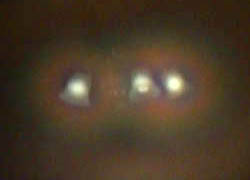
上图似乎是在我从寒冷的一月份早晨遛狗后进入温暖的房屋时,眼镜被雾气弄模糊时观察到的相同现象。这种现象归因于从相对干燥的室内空气凝结出的非常微小的水滴的衍射。这种衍射图案可能被用来估计凝结水滴的大小,但下面的两个图像显示衍射图案的内部分呈现出不同的颜色,这表明不同级次的衍射在颜色图案中有所体现。

The two images above were taken within seconds of each from areas on the fogged eyeglasses probably within a centimeter of each other. The different color patterns are taken as evidence of different sized droplets, although it is not clear what order of diffraction is being manifested.
上面的两张图片是在从被雾化的眼镜上几个厘米内不同位置拍摄的,相隔仅几秒钟。不同的颜色图案被视作不同大小的水滴的证据,尽管所表现的衍射阶次并不明确。

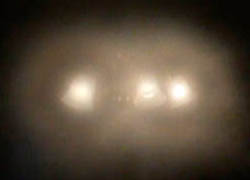
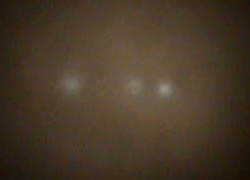
Another phase of the fogged eyeglass experiment was facilitated by the fact that my wife had a nice pot of bean soup boiling on the kitchen stove on this cold morning. Another short walk around the cold neighborhood and then putting my glasses above the boiling pot produced a fog which did not exhibit the colored diffraction rings. Presumably the hot saturated air rising from the soup formed larger droplets which did not show the visible diffraction rings - the larger the aperture, the smaller the diffraction pattern. The scattered light in the left image above showed a symmetric decrease in intensity as you moved further from the light. It might be properly described as Mie scattering. At right above is an image taken once the fog on my glasses had time to partially evaporate. There is evidence of diffraction here in the slight modulation of the intensity close to the lights. This is taken as evidence that the evaporation process was leaving smaller droplets which were beginning to produce visible diffraction effects.

另一阶段的雾气眼镜实验得以进行,是因为我妻子在厨房炉上煮着一锅美味的豆汤。在寒冷的早晨,再绕着冷清的街区走一段路,然后把眼镜放在煮沸的汤锅上方,产生了雾气,但这种雾气并没有显示出彩色的衍射环。很可能,从汤中上升的热饱和空气形成了更大的液滴,这些液滴没有显示出可见的衍射环——孔径越大,衍射图案越小。上面左图中散射的光显示,当你离光源越远,强度越低。这可以适当描述为米氏散射。右上方的图像是在雾气在眼镜上部分蒸发后拍摄的。这里显示出衍射的证据,在光源附近强度的轻微调制。这被看作是蒸发过程留下较小的液滴,开始产生可见的衍射效应的证据。
Estimation of fog droplet size
雾滴大小估计
Index

Diffraction concepts

Fraunhofer diffraction
索引衍射概念 夫琅禾费衍射
 
HyperPhysics***** Light and Vision
HyperPhysics ***** 光与视觉
R Nave
Go Back
返回


Corona from Fogged Eyeglasses: Estimation of Droplet Size

从雾起眼镜的电晕:液滴大小的估算

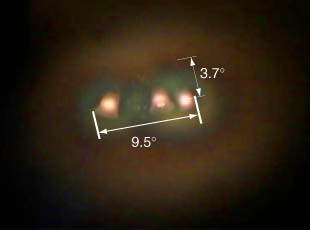
From an image of aperture diffraction formed by fog droplets on cold eyeglasses, an estimate of droplet size can be made. The colored fringes are presumed to be droplet diffraction like that sometimes seen as a corona around the moon. The glasses were positioned at 3.66 m (12 ft) and the horizontal span of the lights was 0.6 m (2 ft). The span of the lights then represents an angle of 9.5°. Scaling the image gave an angle of 3.7° out to the red fringe.

从冷眼镜上雾滴形成的衍射图像中,可以估计出雾滴的大小。彩色的条纹被假定为类似有时在月球周围出现的电晕的衍射现象。眼镜位于3.66米(12英尺)处,灯光的水平跨度为0.6米(2英尺)。此时灯光的跨度代表一个角度为9.5°。将图像放大后,得到到红色条纹的角为3.7°。

For a first estimate, assume a wavelength of about 600 nm for the red fringe and assume that the red fringe represents the first subsidiary maximum of the aperture diffraction. Using the aperture calculation with 3.7° as the first maximum gives a circular aperture diameter of about 15 microns. If that represents the diameter of the fog droplets, then that is a measure of 15 microns for the droplet size.

对于初步估算,假设红光条纹的波长约为600纳米,并假设红光条纹代表孔径衍射的第一个副极大值。使用3.7°作为第一极大值进行孔径计算,得到圆形孔径直径约为15微米。如果这代表雾滴的直径,那么这就是滴状物大小的度量,约为15微米。

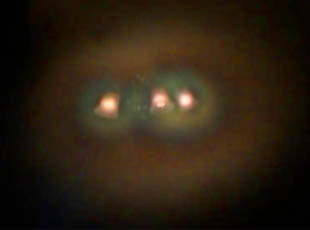
There are many reasons for caution about claiming that the above estimate represents a real measurement of droplet size. One of them is illustrated in the two images above. Two images taken within seconds of each other and very close together spatially show different diffraction patterns. The one on the left has a red fringe about half as far out as that one used in the estimate above, which would give droplet size 30 microns. While that may be reasonable, one cannot be sure that it is the first subsidiary maximum which is giving the color to the fringe. If the red fringe in the first estimate above were the second subsidiary maximum, then the estimated size would be 25 microns and if it were the third, the estimate would be 34 microns.

对上述估算代表真实液滴尺寸的说法持谨慎态度的原因有很多。其中一个例子如上两幅图像所示。两幅图像是在几秒钟内拍摄的,且在空间上非常接近,显示出不同的衍射图样。左边的图中,红色条纹大约只出现在上述估算所用条纹的一半位置,这会给出液滴尺寸为30微米。虽然这可能合理,但无法确定该红色条纹是否是第一个次级极大值所导致的。如果上述估算中红色条纹是第二个次级极大值,则估算的尺寸将是25微米;如果是第三个次级极大值,则估算的尺寸将是34微米。

A further reason for caution about claims for particle size is that the diffraction is occuring around a droplet which is itself partially transparent. The diffraction pattern is not in fact the same as that expected from a circular opaque barrier. Experiences with estimating the diameter of human hairs by measuring the diffraction from them has led to caution about claiming to have measured size from the diffraction.

关于粒子尺寸的主张还需要谨慎,因为衍射是在围绕一个本身部分透明的液滴发生。实际上,衍射图样并不等同于从一个圆形不透明屏障所预期的图样。通过测量头发的衍射来估计其直径的经验,已经促使人们对于仅凭衍射来声称测量出尺寸持谨慎态度。

A similar phenomenon, also attributed to aperture diffraction from small particles, is the set of colored fringes one can sometimes see around a bright light source like a lightbulb. This corona effect is attributed to small particles on the surface of your eye. My personal observation of this effect is usually early in the morning. The act of blinking changes the intensity of the fringes and they disappear after a few minutes of blinking, suggesting that they are surface phenomena. One particularly prominent set of colored fringes was measured by locating the center of the prominent red ring at about 15 cm from the center of the light I was looking at. The distance to the light was 2.44 meters. The red color seemed to be of a similar hue to a helium-neon laser, so a wavelength of 630 nm was estimated. Assuming that the prominent red ring was the first subsidiary maximum of the aperture diffraction gives a calculated aperture size of 16 micrometers. This estimate is certainly subject to the uncertainties described above in regard to the fog droplets.

类似的现象,也归因于小颗粒的衍射,是人们有时在明亮光源如灯泡周围可以看到的一系列彩色条纹。这种电晕效应被认为是由眼睛表面的小颗粒引起的。我观察到这种现象通常发生在清晨。眨眼动作会改变条纹的强度,几分钟后条纹会消失,这表明它们是表面现象。一组特别明显的彩色条纹被测量时,发现突出的红色环中心位于我所观察的光源中心约15厘米处。光源距离为2.44米。红色颜色似乎与氦-氖激光器相似,因此估计波长为630纳米。假设突出的红色环是孔径衍射的首个次级极大值,则计算出的孔径大小为16微米。这个估计显然受到上述关于雾滴不确定性的限制。

Meyer-Arendt in Section 3.5 of Introductory Classical and Modern Optics, 3rd Ed. reports his personal measurement and arrives at a particle diameter of 12.4 micrometers. He suggests that it might be the epithelium cells of the cornea that cause the effect.

梅耶-阿伦德特在《入门经典与现代光学》第三版第三章5节中报告了他的个人测量结果,并得出粒子直径为12.4微米的结论。他建议这可能是角膜上皮细胞引起的这种效应。
Mathematical description of aperture diffraction
孔径衍射的数学描述
Index

Diffraction concepts

Fraunhofer diffraction

Reference
Meyer-Arendt
索引衍射概念夫琅禾费衍射参考Meyer-Arendt
 
HyperPhysics***** Light and Vision
HyperPhysics ***** 光与视觉
R Nave
Go Back
返回