Bilingual edition: English is preserved and Chinese follows each unit. Terminology uses the confirmed v20260916 glossary; automated semantic review remains traceable.
中英双语版:英文原文完整保留,中文紧随对应单元;术语采用 v20260916 确认表,自动语义审校结果可追溯。

Position

位置

Specifying the position of an object is essential in describing motion. In one dimension some typical ways are
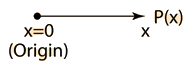
x(t) is used to represent position as a function of time.
x(t) 用于表示位置作为时间的函数。
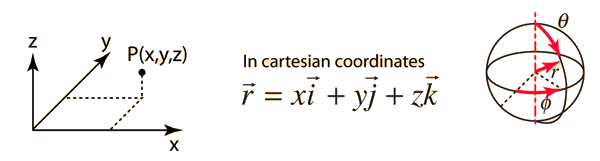
In two dimensions, either cartesian or polar coordinates may be used, and the use of unit vectors is common. A position vector r may be expressed in terms of the unit vectors.

指定物体的位置对于描述运动是至关重要的。在一维情况下,有一些典型的方法;在二维情况下,可以使用笛卡尔坐标或极坐标,使用单位矢量是常见的。位置矢量 r 可以用单位矢量来表示。

In three dimensions, cartesian or spherical polar coordinates are used, as well as other coordinate systems for specific geometries.
The vector change in position associated with a motion is called the displacement.

在三维空间中,使用笛卡尔坐标或球坐标,以及其他特定几何形状的坐标系统。与运动相关的矢量位置变化称为位移。
Index
索引
 
HyperPhysics***** Mechanics
力学
R Nave
Go Back
返回


Displacement

位移
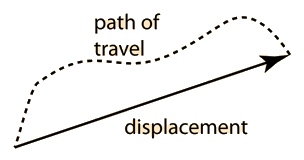
The displacement of an object is defined as the vector distance from some initial point to a final point. It is therefore distinctly different from the distance traveled except in the case of straight line motion in one direction. The distance traveled divided by the time is called the speed, while the displacement divided by the time defines the average velocity.
If the positions of the initial and final points are known, then the distance relationship can be used to find the displacement.
如果初始点和终 点的位置已知,就可以利用距离关系来求出位移。
物体的位移被定义为从某个初始点到最终点的矢量距离。因此,它与所经过的路程在大多数情况下是不同的,只有在单方向直线运动的情况下才相同。路程除以时间称为速率,而位移除以时间则定义为平均速度。
Index
索引
 
HyperPhysics***** Mechanics
力学
R Nave
Go Back
返回