Turbulent Flow湍流
Flow descriptions such as Poiseuille's law are valid only for conditions of laminar flow. At some critical velocity, the flow will become turbulent with the formation of eddies and chaotic motion which do not contribute to the volume flowrate. This turbulence increases the resistance dramatically so that large increases in pressure will be required to further increase the volume flowrate. Experimental studies have characterized the critical velocity for a long straight tube in the form 类似于泊肃叶定律的流动描述仅在层流条件下有效。当达到某一临界速度时,流动将变得湍流,形成涡旋和混沌运动,这些运动不贡献于体积流量。这种湍流显著增加阻力,因此要进一步增加体积流量,需要较大的压力增加。实验研究已将长直管的临界速度表征为
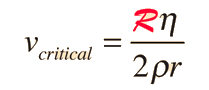
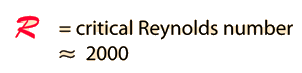
![]() which depends upon the viscosity η in poise, the density ρ in gm/cm3 , the radius of the tube r in cm. The script R is an experimental constant called the Reynold's number. The reported Reynolds number for blood flow is about 2000. Modeling blood flow in the human aorta according to this criterion leads to the expectation of some turbulence in the center of the flow. 这取决于粘度η(单位为泊)、密度ρ(单位为克/立方厘米)以及管的半径r(单位为厘米)。R是一个实验常数,称为雷诺数。据报道,血液流动的雷诺数约为2000。根据这一标准模拟人体主动脉中的血液流动,会导致流动中心出现一些湍流。
|
Index Poiseuille's law concepts 索引 埃奥菲定律概念 | ||
|
Go Back
返回 |
Reynolds Number雷诺数
The Reynolds number is an experimental number used in fluid flow to predict the flow velocity at which turbulence will occur. It is described as the ratio of inertial forces to viscous forces. For flow through a tube it is defined by the relationship:
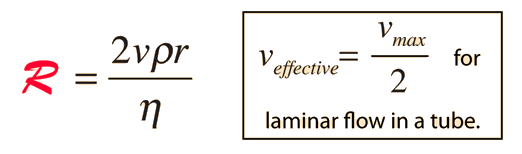
The parameters are viscosity η, density ρ and radius r. The suggested number of 2000 is used for the application to blood flow for the example of the aorta. Another approach is to define a variable Reynolds number in terms of the maximum velocity for laminar flow in a tube by 这些参数包括粘度 η、密度 ρ 和半径 r。对于主动脉中血流应用,建议使用 2000 作为数值。另一种方法是通过定义一个变量的雷诺数,该雷诺数基于管内层流的最大速度来确定。
![]() and characterize the condition for turbulence as the condition when the Reynolds number reaches a critical value like 2000. For a more general approach to turbulence when objects move through a fluid, the relation takes the following form: 并把湍流的条件表征为雷诺数达到临界值(如2000)时的条件。对于物体在流体中运动时的湍流问题,其关系形式如下:
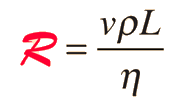
![]() where L is a characteristic length associated with the object. 其中 L 是与物体相关的特征长度。 Turbulence in flow is not something that can be calculated precisely, but the concept of the Reynolds number is a helpful one for general engineering of fluid flow problems. It can have some predictive power when measurements are made for a particular geometry to establish an experimental Reynolds number, and can then be helpful in scaling up the size of that geometry. 流体中的湍流不能被精确计算,但雷诺数的概念对于流体流动问题的工程处理是有帮助的。当对特定几何形状进行测量以确定实验雷诺数时,它可以具有一定的预测能力,并有助于将该几何形状的尺寸放大。 References: 参考文献: Encyclopedia of Science, Darling 《科学百科全书》(Darling) 雷诺数,NASA
雷诺数是一个用于预测流体流动中湍流发生速度的实验数。它被定义为惯性力与粘性力的比值。对于管内流动,它由以下关系式定义: |
Index Poiseuille's law concepts 索引 埃奥菲定律概念 | ||
|
Go Back
返回 |
Turbulent Flow in Aorta?主动脉中的湍流?
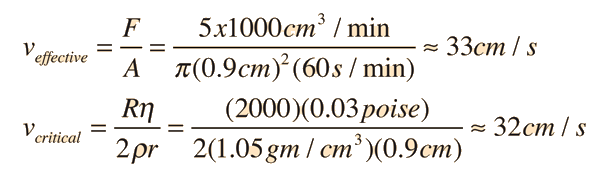
Blood flow in the human body is remarkably free of turbulence , but sounds attributed to turbulence are sometimes detected by stethescope associated with the aorta. Modeling the flow makes use of the Reynold's number and the associated critical velocity. Assuming a nominal blood volume flowrate of 5 liters/min and a radius of 0.9 cm for the aorta: 人体内的血液流动 remarkably 无湍流,但有时用听诊器可以检测到与主动脉相关的湍流声音。建模使用雷诺数和相关的临界速度。假设主动脉的血流量为5升/分钟,半径为0.9厘米:
But when the velocity profile for tube flow is taken into account, it is found that the maximum velocity of flow is twice the effective value, so a velocity of 66 cm/s would be expected to produce turbulence in the center of the aorta. 但当考虑管流的速度分布时,发现最大流速是有效值的两倍,因此预期流速为66 cm/s时,在主动脉中心处会产生湍流。
|
Index Poiseuille's law concepts 索引 埃奥菲定律概念 | ||
|
Go Back
返回 |
Non-Newtonian Fluids非牛顿流体
Fluids for which the viscosity is independent of pressure are called Newtonian fluids, and the flow of Newtonian fluids such as water are described reasonably well by Poiseuille's law so long as the conditions for laminar flow are met. The synovial fluid in joints such as the knee shows a decreased viscosity with increasing pressure (helping to lubricate the joints), and is said to be a non-Newtonian fluid. Departures from Poiseuille's Law may be substantial for suspensions and mixtures of fluids. Blood is a complicated fluid with many types of materials in solution and suspension and shows departures from Poiseuille's Law in small vessels. One explanation offered is that in small vessels the large red blood cells tend to accumulate in the faster axial part of the flow, so that there are fewer cells close to the walls to contribute to wall friction. In most blood vessels under normal ranges of blood pressure, the flow is well described by Poiseuille's Law.
对于粘度不随压力变化的流体称为牛顿流体,只要满足层流条件,牛顿流体(如水)的流动可以很好地用泊肃叶定律描述。例如,膝关节等关节中的滑液在压力增加时粘度会降低(有助于润滑关节),这种流体被称为非牛顿流体。对于悬浮液和混合流体,泊肃叶定律的偏离可能相当显著。血液是一种复杂的流体,含有多种溶解和悬浮物质,并在小血管中表现出对泊肃叶定律的偏离。一种解释是,在小血管中,较大的红细胞倾向于聚集在流动的轴向部分,因此靠近壁面的细胞较少,从而减少了壁面摩擦。在正常血压范围内,大多数血管中的流动可以很好地用泊肃叶定律描述。 |
Index Poiseuille's law concepts 索引 埃奥菲定律概念 | ||
|
Go Back
返回 |