Bilingual edition: English is preserved and Chinese follows each unit. Terminology uses the confirmed v20260916 glossary; automated semantic review remains traceable.
中英双语版:英文原文完整保留,中文紧随对应单元;术语采用 v20260916 确认表,自动语义审校结果可追溯。

The Hydrogen Atom

氢原子
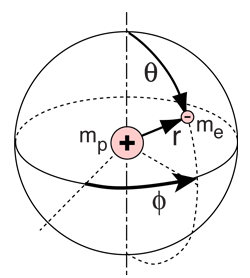
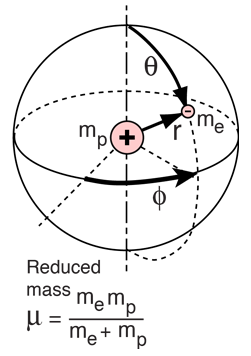
Spherical polar coordinates
球面极坐标

The solution of the Schrodinger equation for the hydrogen atom is a formidable mathematical problem, but is of such fundamental importance that it will be treated in outline here. The solution is managed by separating the variables so that the wavefunction is represented by the product:

氢原子的薛定谔方程的求解是一个复杂的数学问题,但因其基础重要性,这里将简要介绍其解法。解法通过分离变量实现,使得波函数表示为乘积形式:
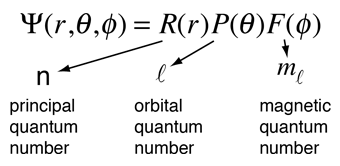
The separation leads to three equations for the three spatial variables, and their solutions give rise to three quantum numbers associated with the hydrogen energy levels.

分离导致了三个空间变量的三个方程,其解给出了与氢原子能级相关的三个量子数。
Index

Schrodinger equation concepts

Hydrogen concepts
索引 希尔伯特方程概念 氢原子概念
 
HyperPhysics***** Quantum Physics
HyperPhysics ***** 量子物理
R Nave
Go Back
返回


Hydrogen Schrodinger Equation

氢原子的薛定谔方程

The electron in the hydrogen atom sees a spherically symmetric potential, so it is logical to use spherical polar coordinates to develop the Schrodinger equation. The potential energy is simply that of a point charge:

氢原子中的电子感受到一个球对称的势场,因此使用球坐标来发展薛定谔方程是合乎逻辑的。势能 simply 就是点电荷的势能:

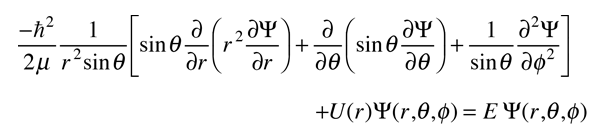
The expanded form of the Schrodinger equation is shown below. Solving it involves separating the variables into the form

薛定谔方程的展开形式如下所示。求解该方程需要将变量分离为形式
The starting point is the form of the Schrodinger equation:
起点是薛定谔方程的形式:
Index

Schrodinger equation concepts
索引:薛定谔方程概念
 
HyperPhysics***** Quantum Physics
HyperPhysics ***** 量子物理
R Nave
Go Back
返回


Quantum Numbers from Hydrogen Equations

氢原子方程中的量子数
The hydrogen atom solution requires finding solutions to the separated equations which obey the constraints on the wavefunction. The solution to the radial equation can exist only when a constant which arises in the solution is restricted to integer values. This gives the principal quantum number:

Similarly, a constant arises in the colatitude equation which gives the orbital quantum number:

Finally, constraints on the azimuthal equation give what is called the magnetic quantum number:

同样,在极角方程中会出现一个常数,这给出了轨道量子数:最后,对方位角方程的限制给出了所谓的磁量子数:

Discussion of concepts

概念讨论
氢原子的解需要求解分离后的方程,这些方程必须满足波函数的约束条件。只有当解中出现的常数被限制为整数值时,径向方程的解才存在。这给出了主量子数:
Index

Schrodinger equation concepts

Hydrogen concepts
索引 希尔伯特方程概念 氢原子概念
 
HyperPhysics***** Quantum Physics
HyperPhysics ***** 量子物理
R Nave
Go Back
返回


Separating the Hydrogen Equation

分离氢方程

One of the approaches to solving a partial differential equation is to separate it into individual equations for each variable involved. The hydrogen Schrodinger equation is separable, and collecting all the radius-dependent terms and setting them equal to a constant gives the radial equation:

解偏微分方程的一种方法是将其分解为每个变量的独立方程。氢原子的薛定谔方程是可以分离的,将所有与半径有关的项收集起来,并将它们设为一个常数,即可得到径向方程:

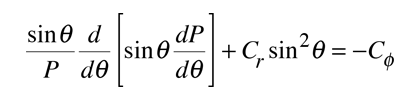
Then the angular parts of the equation can be separated into a colatitude equation:

然后,方程的角部分可以分离为一个极角方程:

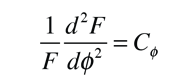
and an azimuthal equation.

以及一个方位方程。
Index

Schrodinger equation concepts

Hydrogen concepts
索引 希尔伯特方程概念 氢原子概念
 
HyperPhysics***** Quantum Physics
HyperPhysics ***** 量子物理
R Nave
Go Back
返回