Selection Rules for Electronic Transitions
电子跃迁的选择规则
In spectral phenomena such as the Zeeman effect it becomes evident that transitions are not observed between all pairs of energy levels. Some transitions are "forbidden" ( i.e., highly improbable) while others are "allowed" by a set of selection rules. The number of split components observed in the Zeeman effect is consistent with the selection rules:
在诸如塞曼效应这样的谱现象中,可以看出并非所有能量级之间的跃迁都会被观察到。某些跃迁是‘被禁止的’(即极不可能发生),而另一些则根据一组选择规则被‘允许’。在塞曼效应中观察到的分裂成分数目与选择规则一致:
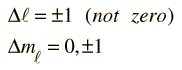
These are the selection rules for an electric dipole transition. One can say that the oscillating electric field associated with the transitions resembles an oscillating electric dipole. When this is expressed in quantum terms, photon emission is always accompanied by a change of 1 in the orbital angular momentum quantum number. The magnetic quantum number can change by zero or one unit.
这些是电偶极跃迁的选择规则。可以说,与跃迁相关的振荡电场类似于振荡的电偶极子。当用量子术语表达时,光子发射总是伴随着轨道角动量量子数的变化为1。磁量子数可以变化0或1个单位。
Another approach to the selection rules is to note that any electron transition which involves the emission of a photon must involve a change of 1 in the angular momentum. The photon is said to have an intrinsic angular momentum or "spin" of one, so that conservation of angular momentum in photon emission requires a change of 1 in the atom's angular momentum. The electron spin quantum number does not change in such transitions, so an additional selection rule is:
另一种确定选择规则的方法是注意到任何涉及光子发射的电子跃迁都必须导致角动量的变化为1。光子具有固有的角动量或“自旋”为1,因此在光子发射过程中,角动量守恒要求原子的角动量也必须变化1。电子自旋量子数在这种跃迁中不发生变化,因此又得到一个额外的选择规则:

The total angular momentum may change by either zero or one:
总角动量可能保持不变或增加一个单位:
 An exception to this last selection rule is that you cannot have a transition from j=0 to j=0; i.e., since the vector angular momentum must change by one unit in an electronic transition, j=0 -> 0 can't happen because there is no total angular momentum to re-orient to get a change of 1. 这个最后的选择规则有一个例外,即不能从j=0过渡到j=0;即由于矢量角动量在电子跃迁中必须改变一个单位,因此j=0到j=0的跃迁是不可能的,因为没有总角动量可以重新定向以产生1的改变。 |