Relativistic Velocity Transformation
No two objects can have a relative velocity greater than c! But what if I observe a spacecraft traveling at 0.8c and it fires a projectile which it observes to be moving at 0.7c with respect to it!? Velocities must transform according to the Lorentz transformation, and that leads to a very non-intuitive result called Einstein velocity addition.
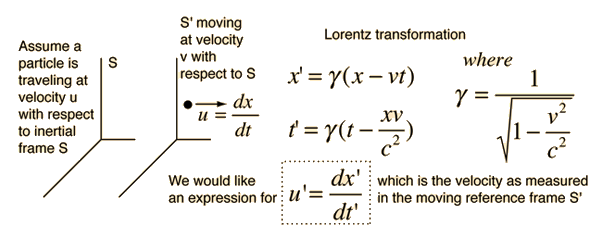
Just taking the differentials of these quantities leads to the velocity transformation. Taking the differentials of the Lorentz transformation expressions for x' and t' above gives
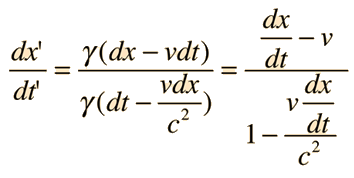
Putting this in the notation introduced in the illustration above:
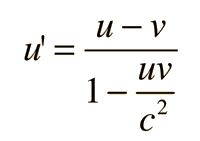
The reverse transformation is obtained by just solving for u in the above expression. Doing that gives
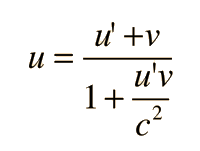
Applying this transformation to the spacecraft traveling at 0.8c which fires a projectile which it observes to be moving at 0.7c with respect to it, we obtain a velocity of 1.5c/1.56 = 0.96c rather than the 1.5c which seems to be the common sense answer.
基本应用 | 相对论性相对速度 |
| Velocity of projectile, external observer
projectile 的速度,外部观察者 | Velocity of projectile from target
从目标发射的弹体速度 |
| HyperPhysics***** Relativity
HyperPhysics ***** 相对论 | R Nave |