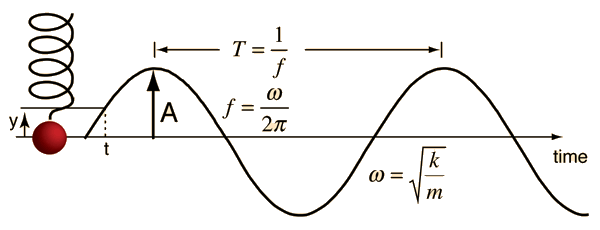
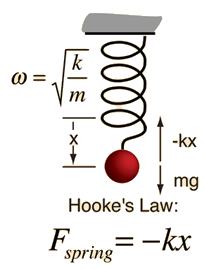
A mass on a spring has a single resonant frequency determined by its spring constant k and the mass m. Using Hooke's law and neglecting damping and the mass of the spring, Newton's second law gives the equation of motion:
挂在弹簧上的质量具有由其弹簧常数k和质量m决定的单一共振频率。利用胡克定律并忽略阻尼和弹簧的质量,牛顿第二定律给出了运动方程:
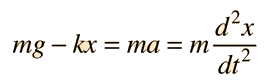
The solution to this differential equation is of the form:
这个微分方程的解形式为:

which when substituted into the motion equation gives:
将其代入运动方程得到:

Collecting terms gives B=mg/k, which is just the stretch of the spring by the weight, and the expression for the resonant vibrational frequency:
合并同类项得 B=mg/k,这正是弹簧因重量而产生的形变,且共振振动频率的表达式为:
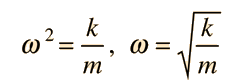
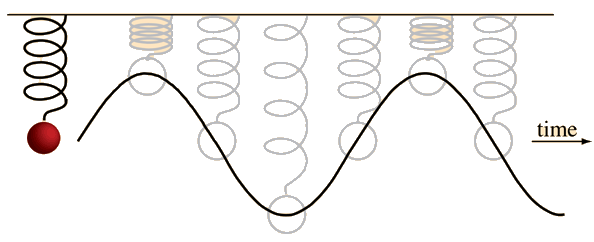
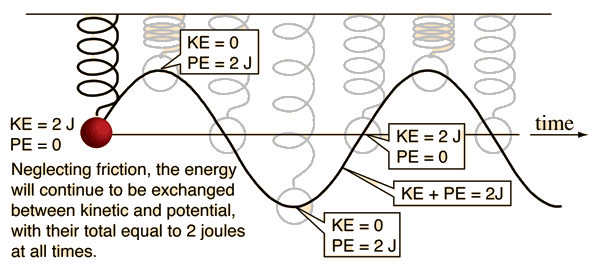
This kind of motion is called simple harmonic motion and the system a simple harmonic oscillator.
这种运动称为简谐运动,系统是一个简谐振子。
|