Callisto
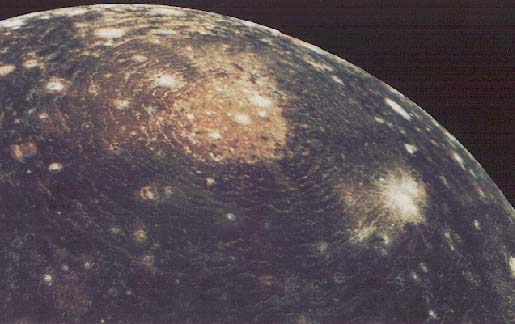
Callisto is similar in appearance to Ganymede, but with more craters and fewer of the linear fault features. The large series of concentric rings on the image above is named Valhalla. It measures some 3000 km across and is evidence of some cataclysmic impact. It is as if there was an upthrust of partially melted ice, but it refroze before the ripples could subside. The density of craters in Valhalla indicate that it is very old, and there is no evidence of any recent tectonic activity. There is another large basin with similar features, the smaller Asgard imaged below.
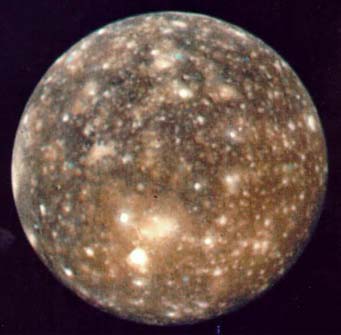 |
This image of Callisto was taken by Voyager 2 from a distance of about 2.3 million kilometers. The many bright impact features mark it as an old surface, presumably freezing so early that no plate tectonic or other activty occurred. 这张照片是旅行者2号从约230万公里的距离拍摄的。众多明亮的撞击坑表明其表面古老,可能在早期就冻结了,因此没有发生板块运动或其他活动。
|
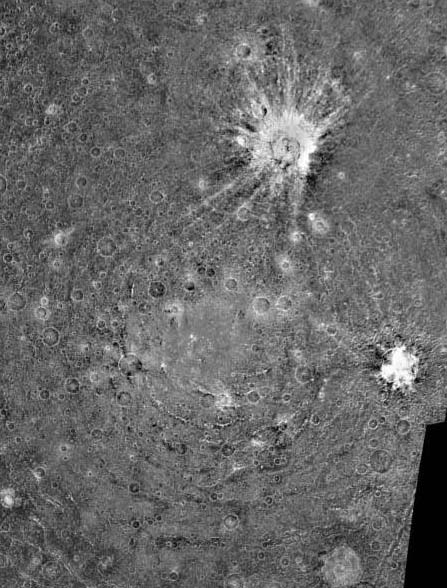
This four-frame mosaic shows the ancient impact structure Asgard on Jupiter's moon Callisto. This image is centered at 30 degrees north, 142 degrees west. The Asgard structure is approximately 1700 km across (1,056 mi) and consists of a bright central zone surrounded by discontinuous rings. The rings are tectonic features with scarps near the central zone and troughs at the outer margin. Several large impacts have smashed into Callisto after the formation of Asgard. The very young, bright-rayed crater Burr is located on the northern part of Asgard.
Callisto is one of the largest four moons of Jupiter. These moons are called the "Galilean moons" because they were first observed by Galileo.
Callisto orbits at about 26 Jupiter radii. It has a density of about 2000 kg/m^2 and is thought to be just an ice/rock mixture throughout.
Jupiter Concepts
Solar System Illustration
Solar System Concepts
References
Chaisson & McMillan,
Ch 11.
| HyperPhysics********** Astrophysics
HyperPhysics ********** 天体物理学 | R Nave |