Galileo Spacecraft
Galileo is the fifth spacecraft to visit Jupiter. It contains ten research instruments on a 15 ft long, 5200 lb framework. It launched a 744 lb, 34 inch diameter probe to Jupiter . The probe carried six instruments.
The Galileo spacecraft is powered by a 500 watt plutonium power plant. It's rendevouz with Jupiter puts it too far from the sun to be effectively solar powered.
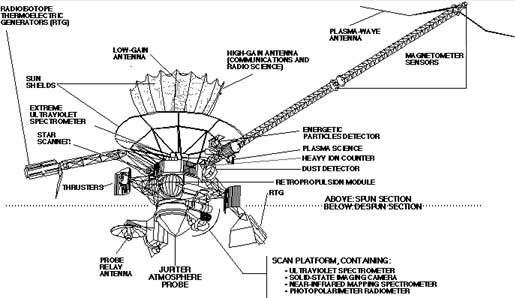
Galileo was launched in 1989 on a mission which would take it into orbit around Jupiter. Galileo passed asteroid Gaspra at 17,895 mph and passed within 1000 miles of the chunk of rock and iron. The signal took 23 minutes to travel the 255 million miles to earth. Two to 13 months were required to see the images because of the big antenna's failure. It passed closest to earth again in November 92 where it could use small antenna.
Galileo's Jupiter mission was to launch a probe into the Jupiter atmosphere and then orbit the planet. The probe was designed to withstand pressures of at least 10 Earth atmospheres and was supposed to transmit information about the Jupiter atmosphere's composition, structure, hydrogen-helium ratio, lightning activity, thermal balance, and size of cloud particles.
Solar System Illustration
Solar System Concepts
| HyperPhysics********** Astrophysics
HyperPhysics ********** 天体物理学 | R Nave |