Hubble Deep Space Image
Image by the Hubble Space Telescope's Wide Field and Planetary Camera 2 (WFPC2).
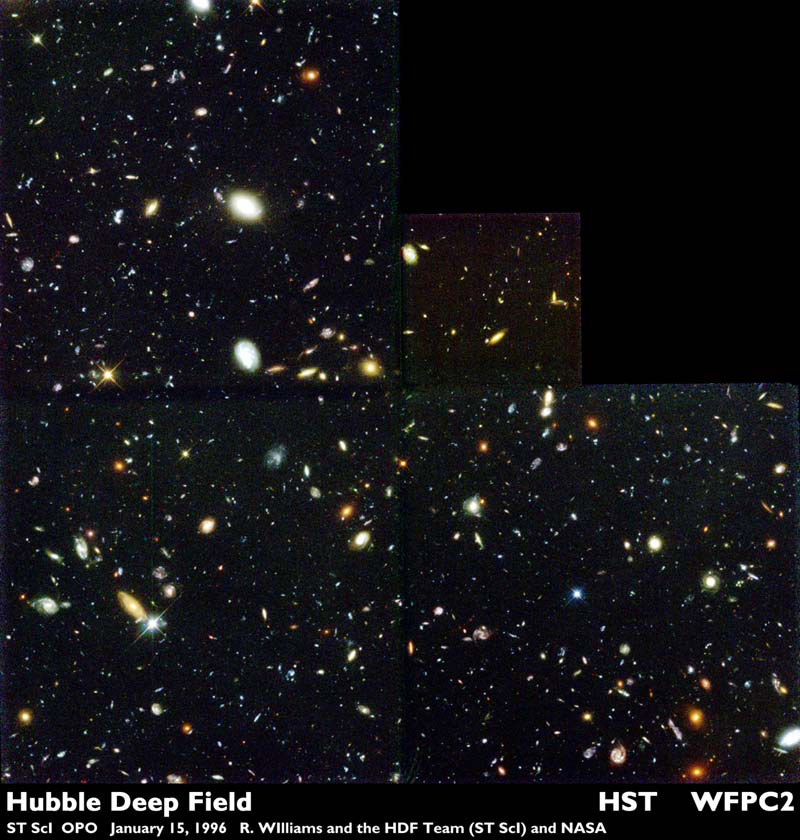
Except for a few obvious foreground stars, every visible object here appears to be another galaxy!
|
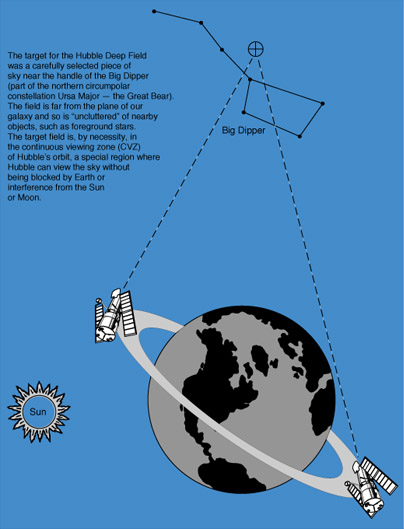
There are many geometries of galaxies including the spiral galaxy characteristic of our own Milky Way. In the remarkable deep space photograph made by the Hubble Space Telescope, every visible object except for the foreground stars is another galaxy. The image is a composite of 342 images taken over a period of 10 days with the Wide Field and Planetary Camera 2 on December 18-28, 1995. With an average exposure on the order of 30 minutes, that amounts to about 170 hours of exposure. NASA compares the field of view with that of a dime at 75 feet. The camera was directed almost perpendicular to the galactic plane to get a field of view as clear of foreground stars as possible. The NASA illustration at left shows the location in the constellation Ursa Major. 银河有多种几何形态,其中螺旋星系是我们的银河系的典型特征。在由哈勃空间望远镜拍摄的著名深空照片中,除了前景的恒星外,每一个可见的天体都是另一个星系。这张图像由1995年12月18日至28日期间,使用宽场和行星相机2拍摄的342张图像组成。平均曝光时间约为30分钟,总计约170小时。NASA将镜头的视野与75英尺处的一枚硬币进行比较。为了尽可能清晰地避开前景恒星,相机几乎垂直于银河平面进行指向。左图是NASA的示意图,显示了该天体位于大熊座的位置。
|
| Hubble Ultra Deep Field
哈勃超深场 | Hubble Extreme Deep Field
哈勃极深场 |
| HyperPhysics********** Astrophysics
HyperPhysics ********** 天体物理学 | R Nave |