The Hubble Space Telescope "Ultra Deep Field" View
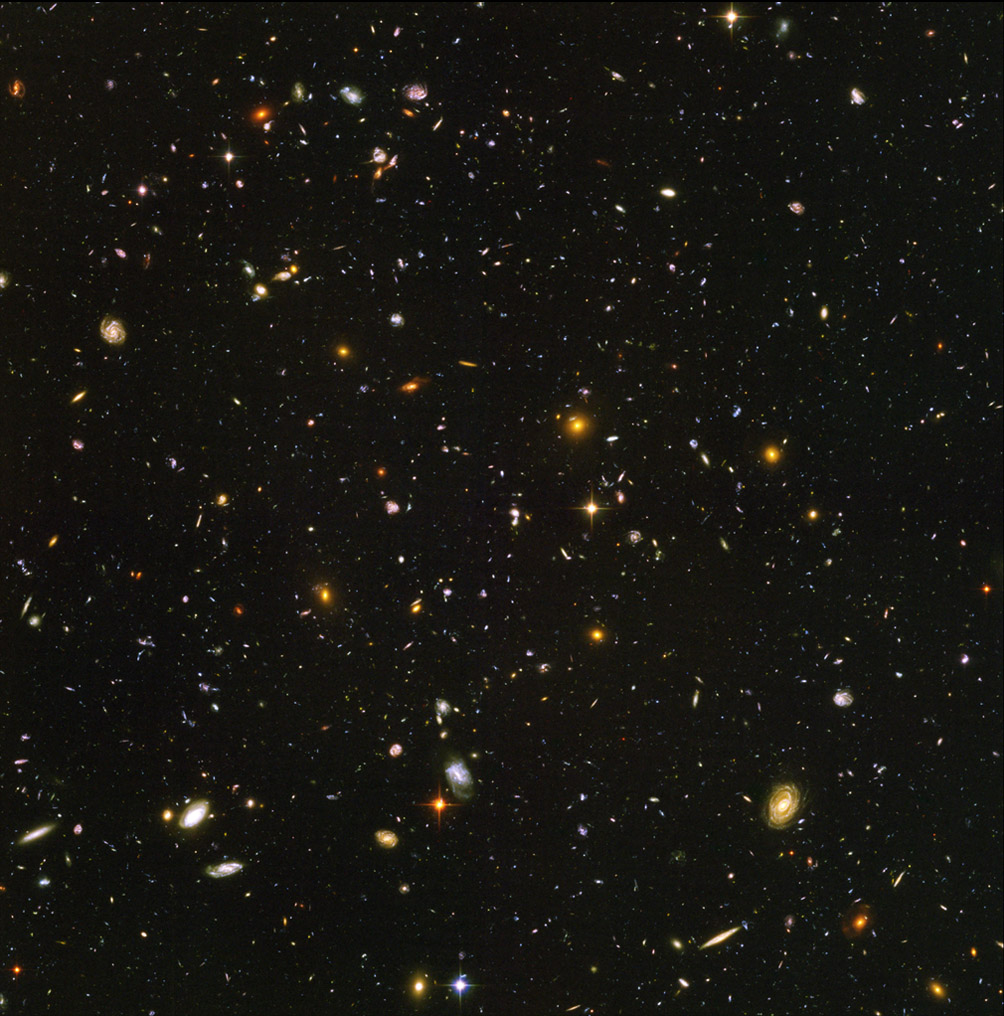
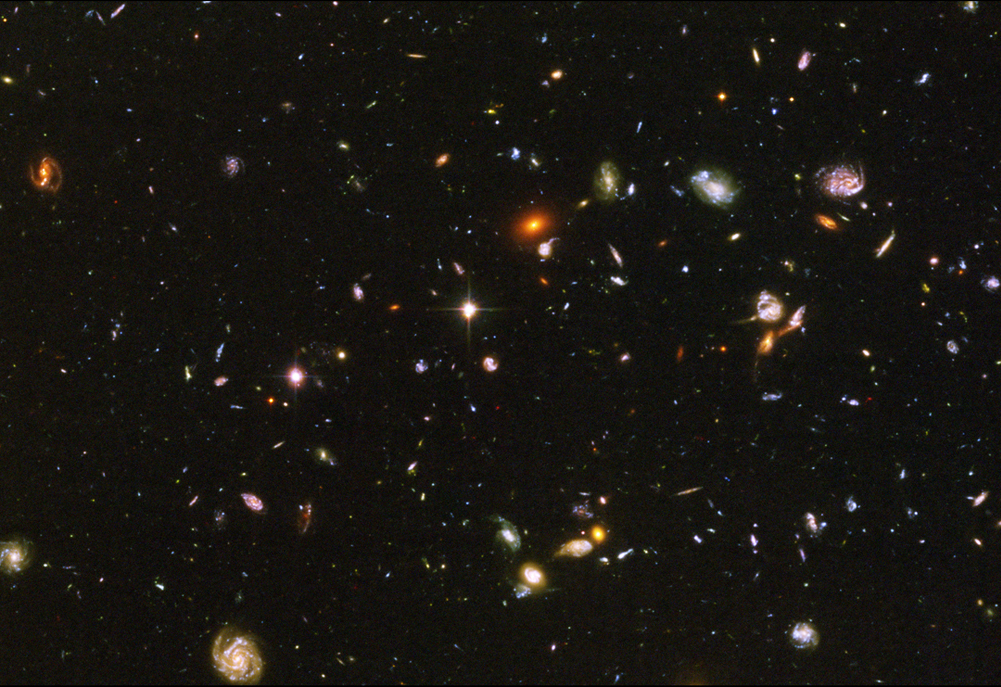
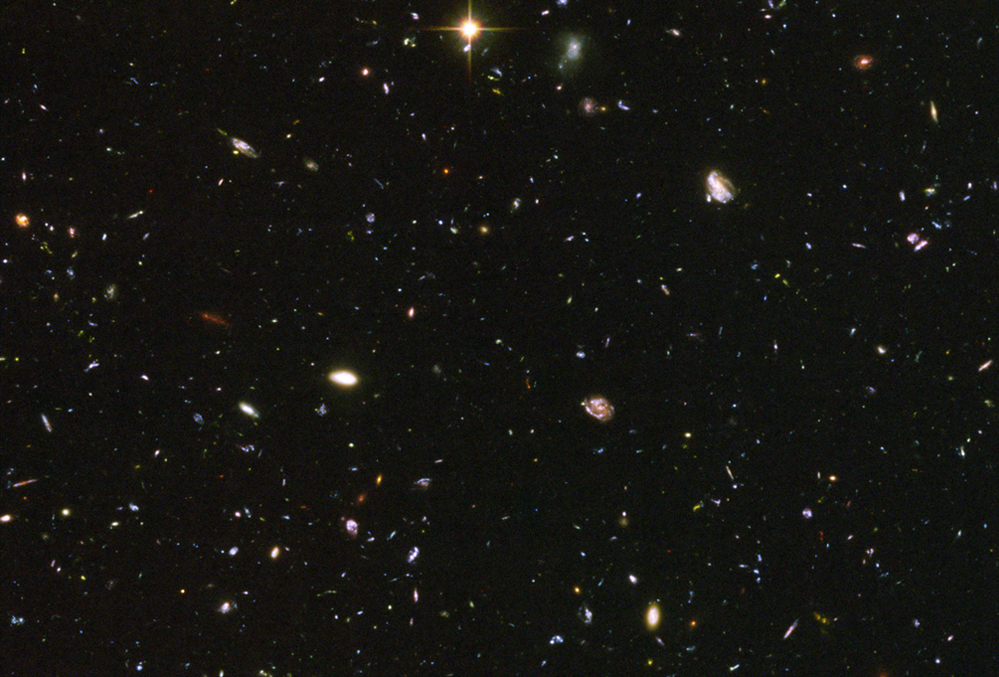
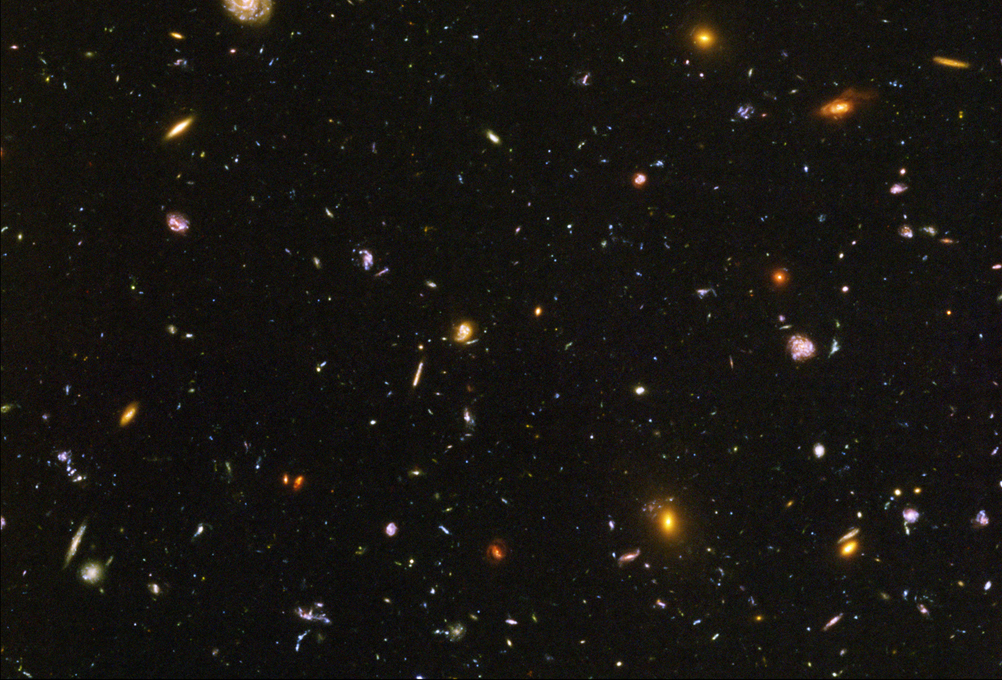
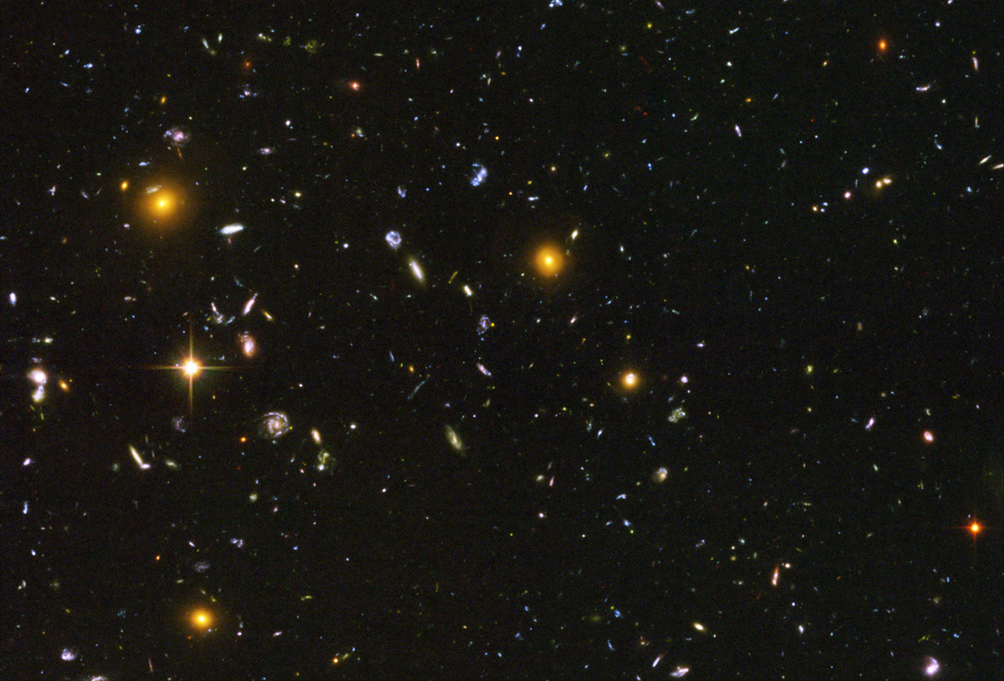
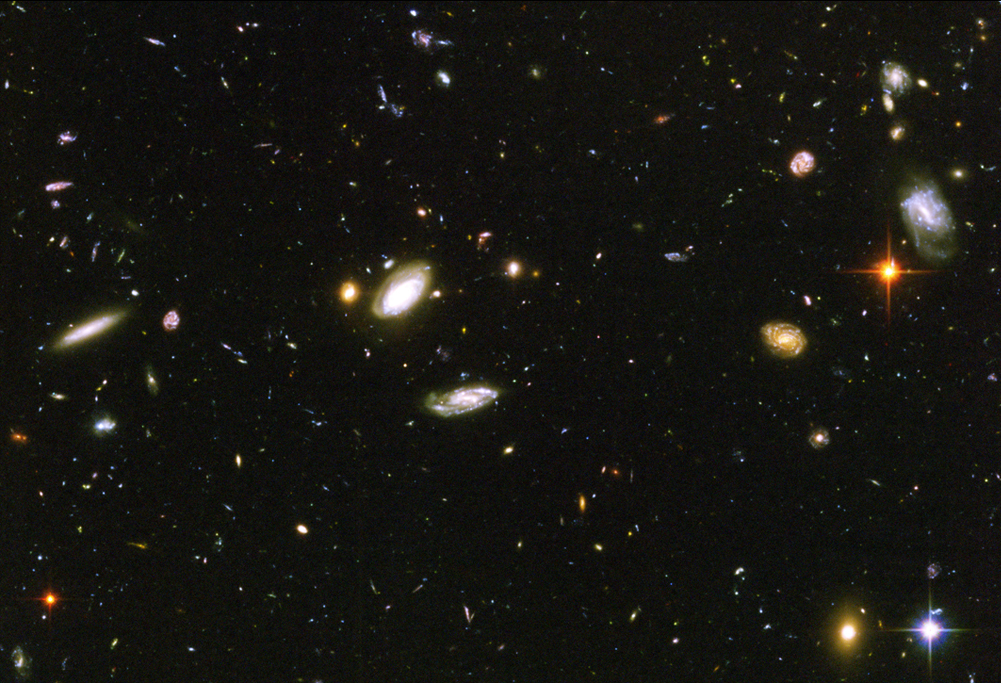

The images above are six segments of the deep field view arranged as a 3x2 matrix with the top image being the 11 element, then in the order 12, 21,22,31,32.
Described as a "million-second-long exposure", the HUDF was taken during 400 orbits of the Hubble Space Telescope. It made 800 exposures over the four month period September 24, 2003 to January 16, 2004. The average exposure time per image was 21 minutes. It detected objects as faint as 30th magnitude. It contains an estimated 10,000 galaxies, but the field of view is so empty that it contains only about seven stars from the Milky Way galaxy. It was taken by the ACS and NICMOS cameras. 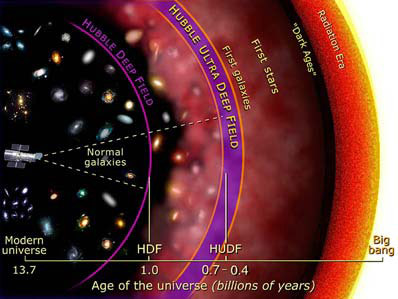 The above NASA illustration depicts the range of view of some of the galaxies of the ultradeep field as being in the range of 400 to 700 million years after the big bang, some of the most distant objects ever viewed. The NASA illustration at right shows the location of the view. 上述NASA插图展示了某些星系在大爆炸后4亿到7亿年内的视场范围,这些是人类曾观测到的最遥远的天体之一。右侧的NASA插图显示了该视场的位置。
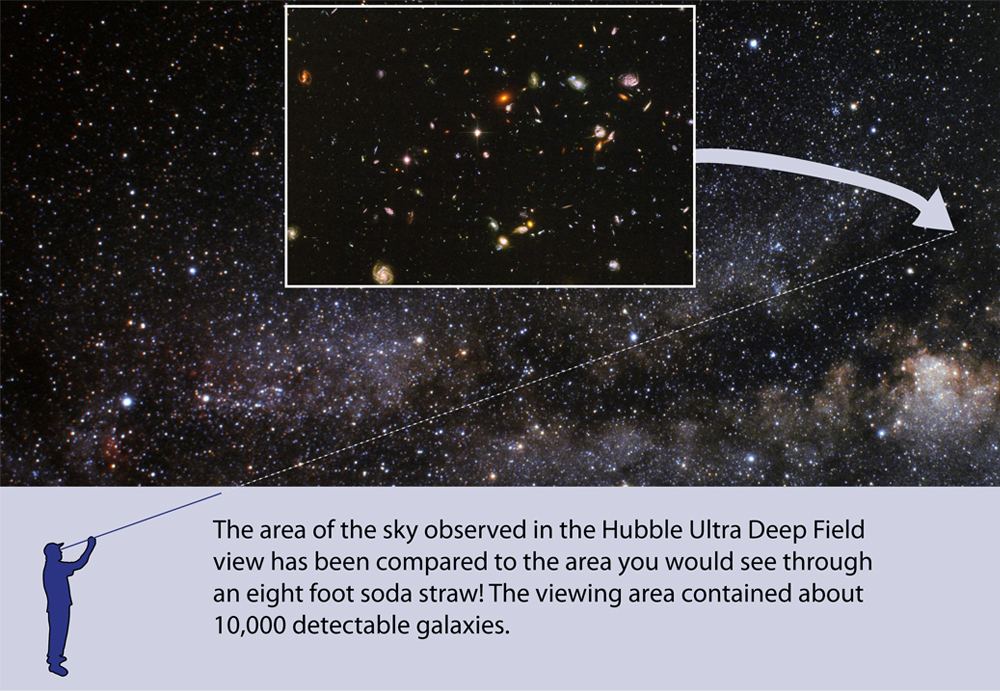
The location of the image is at right ascension 3h 32m 40.0s, declination -27° 47' 29" (J2000). The image covers 11.5 square arcminutes. One of the NASA comments is that this is about 1 ten millionth of the total sky. It has been compared to looking through an eight-foot-long soda straw. 图像位于赤经3小时32分40.0秒,赤纬-27°47'29"(J2000)。图像覆盖面积为11.5平方弧分。NASA的一项评论指出,这大约是全天区的100万分之一。它被比作透过一根八英尺长的苏打管观看。
If you assume uniformity, then the number of galaxies projected would be 如果你假设均匀性,那么投影出的星系数量会是
被描述为“百万秒曝光”,该HUDF是在哈勃空间望远镜的400次轨道期间拍摄的。在2003年9月24日至2004年1月16日的四个月内,共进行了800次曝光。每张图像的平均曝光时间为21分钟。它检测到了亮度仅为30等的天体。其中估计包含约10,000个星系,但由于视野非常空旷,其中仅包含来自银河系的约七颗恒星。该图像由ACS和NICMOS相机拍摄。 10 4 x 10 7 = 10 11 galaxies. 这个数字与银河系中估计的恒星数量的量级相当。 | 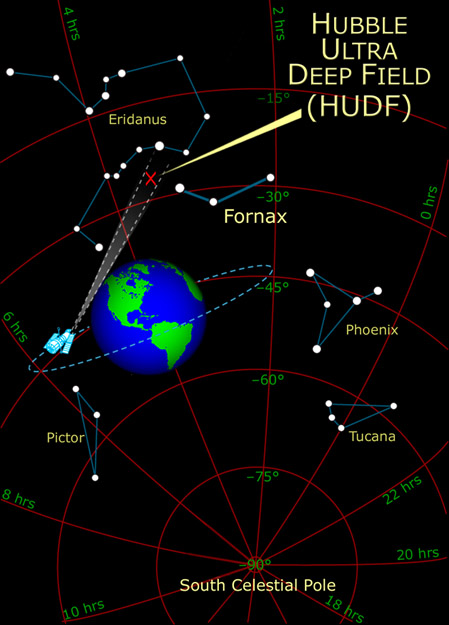 |
NASA "Exploring the Universe" page on HUDF.
European Space Agency page on HUDF.
| Classification of galaxies
星系分类 | Star Index
星索引 |
| Another Hubble deep space view
另一幅哈勃空间视图 |
Galaxy concepts
| HyperPhysics***** Astrophysics
HyperPhysics ***** 天体物理学 | R Nave |