Chandra X-ray Observatory
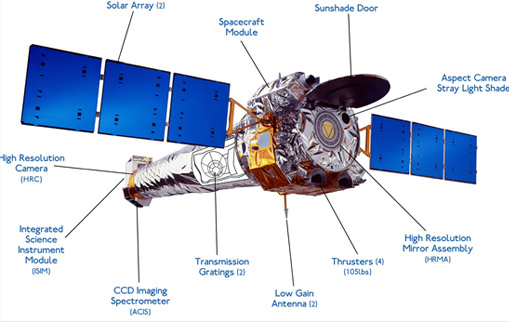
Chandra's unusual orbit was achieved after deployment by a built-in propulsion system which boosted the observatory to a high Earth orbit. This orbit, which has the shape of an ellipse, takes the spacecraft more than a third of the way to the moon before returning to its closest approach to the Earth of 16,000 kilometers (9,942 miles). The time to complete an orbit is 64 hours and 18 minutes. The spacecraft spends 85% of its orbit above the belts of charged particles that surround the Earth. Uninterrupted observations as long as 55 hours are possible and the overall percentage of useful observing time is much greater than for the low Earth orbit of a few hundred kilometers used by most satellites.
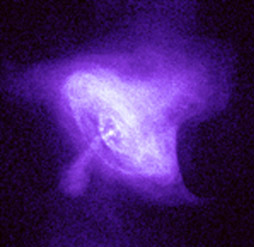 |
One of Chandra's investigations was the X-ray image of the Crab Nebula shown at left. It was included in a composited image created by NASA using X-ray, visible, and infrared images. 钱德勒的一项研究是左侧所示的蟹状星云的X射线图像。该图像由NASA利用X射线、可见光和红外线图像合成而成。 |
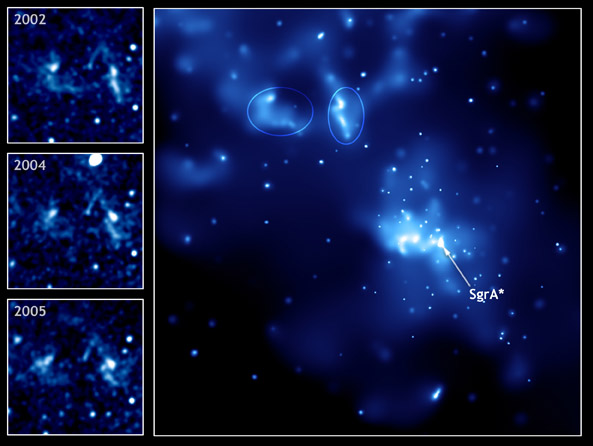
This set of Chandra images shows evidence for a light echo generated by the Milky Way's supermassive black hole, a.k.a. Sagittarius A* (pronounced "A-star"). Astronomers believe a mass equivalent to the planet Mercury was devoured by the black hole about 50 years earlier, causing an X-ray outburst which then reflected off gas clouds near Sagittarius A*. The large image shows a Chandra view of the middle of the Milky Way, with Sagittarius A* labeled. The smaller images show close-ups of the region marked with ellipses. Clear changes in the shapes and brightness of the gas clouds are seen between the 3 different observations in 2002, 2004 and 2005. This behavior agrees with theoretical predictions for a light echo produced by Sagittarius A* and helps rule out other interpretations.
While the primary X-rays from the outburst would have reached Earth about 50 years ago, before X-ray observatories were in place to see it, the reflected X-rays took a longer path and arrived in time to be recorded by Chandra.
| Telescopes
望远镜 |
Chandra X-ray Observatory
Solar System Concepts
| HyperPhysics********** Astrophysics
HyperPhysics ********** 天体物理学 | R Nave |