Solar Eclipse
A solar eclipse occurs when the Moon's shadow falls on the Earth, and a lunar eclipse occurs when the Earth's shadow falls on the Moon.
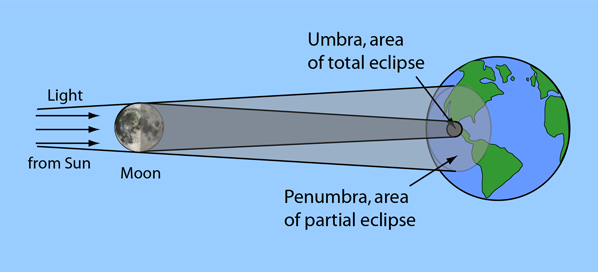
The image below is a modified version of a GOES weather satellite picture taken on July 11, 1991. A solar eclipse was occurring near the Baja Peninsula of Mexico.
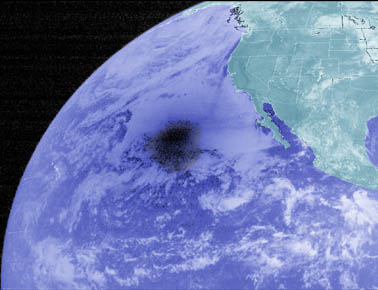 | The image was lightly colorized to emphasize the location of the shadow, but it gives a perspective of the size of the Moon's shadow on the Earth.
图像被轻微着色以突出阴影的位置,但展示了月影在地球上的大小。 |
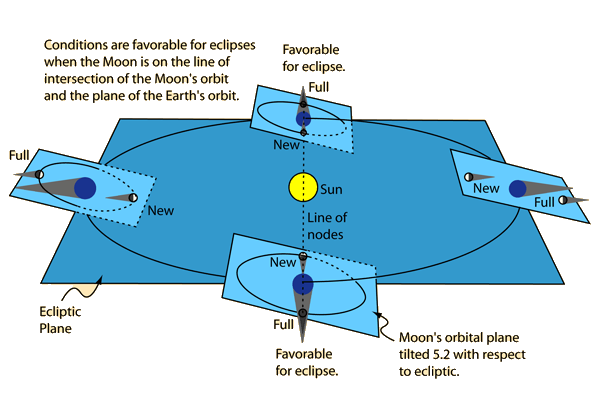
A look at the geometry of Moon phases would make it appear that a solar eclipse should happen at every new moon. This does not occur because the plane of the Moon's orbit is tilted 5.2° with respect to the plane of the Earth's orbit around the Sun (the ecliptic plane). The conditions for eclipses occur only at the points at which the Moon's orbit passes through the ecliptic plane.The illustration below is not to scale and of course greatly exaggerates the 5.2° angle of the Moon's orbit with the ecliptic, but conceptually it shows the conditions for eclipses. The illustration was inspired by one in Chaisson and McMillan.
| Moon Phases
月相 |
| Eclipse on Jupiter
木星掩星 |
Solar System Illustration
Solar System Concepts
Moon Concepts
Reference
Chaisson & McMillan
Ch 1
| HyperPhysics********** Astrophysics
HyperPhysics ********** 天体物理学 | R Nave |