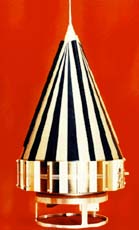
Pioneer
先驱
The Pioneer series is a long running series of space probes which started with Pioneers 1-3 in 1958 which never got far from the Earth but provided new data about the Earth, the Van Allen Belts, magnetic fields, etc. Pioneer 4 made it to within 60,000 km of the Moon in 1959 but had been upstaged by the Soviet Luna I which had passed within 7,500 km two months earlier. After intervening deep space probes which gave much information about the Sun, Pioneer 10 was launched outward toward Jupiter. After passing through the asteroid belt unharmed, Pioneer 10 passed Jupiter on December 3, 1973 and continued to send back data after it passed the orbit of Pluto in April 1983.
先锋系列是一系列持续运行的太空探测器,始于1958年的先锋1-3号,这些探测器从未远离地球,但提供了关于地球、范艾伦辐射带、磁场等的新数据。1959年,先锋4号接近月球仅60,000公里,但被苏联的月球1号探测器超越,后者早在两个月前就飞过距离月球仅7,500公里的地方。在中间的深空探测器提供了大量关于太阳的信息之后,先锋10号被发射向木星。经过小行星带后,先锋10号于1973年12月3日飞过木星,并在1983年4月飞过冥王星轨道后继续发送数据。
Pioneer 11 was launched in April of 1973 and reached Saturn on Sep 1, 1979. It came within 21,000 km of Saturn and only 2,000 to 10000 km below the visible rings. Pioneer Venus was launched on May 20, 1978 and was inserted into orbit around Venus on Dec 4, 1978 (198 day trip). Pioneer Venus launched a "multiprobe" consisting of five separate instrument packages on Aug 8, 1978 and it reached Venus on Dec 9, 1978 (123 day trip). At this point it made an hour-long descent to the Venus surface, returning information about the variation of density, temperture and chemical composition of the atmosphere with height. The orbiter stayed at an altitude of 150 km and mapped most of the planet's surface.
徘徊者11号于1973年4月发射,于1979年9月1日到达土星,并飞掠至距离土星仅21,000公里处,仅在可见环之下2,000至10,000公里处。徘徊者金星号于1978年5月20日发射,并于1978年12月4日进入金星轨道(飞行时间198天)。徘徊者金星号于1978年8月8日发射了由五个独立仪器包组成的“多探头”系统,并于1978年12月9日到达金星(飞行时间123天)。此时,它下降了1小时,返回了关于大气密度、温度和化学成分随高度变化的信息。轨道器在150公里的高空中运行,并测绘了金星大部分表面。
|
Index
Solar System Illustration
Solar System Concepts
Solar System Exploration
References
Colin, L.
(Venus)
Dyer, J.W.
(Saturn)
索引 太阳系图示 太阳系概念 太阳系探索 参考文献 Colin, L. (金星) Dyer, J.W. (土星) |