The Meissner Effect迈斯纳效应
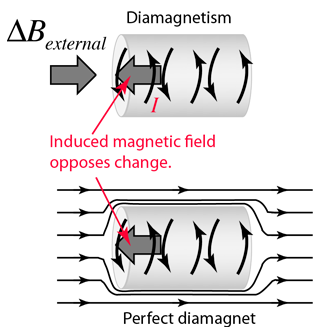
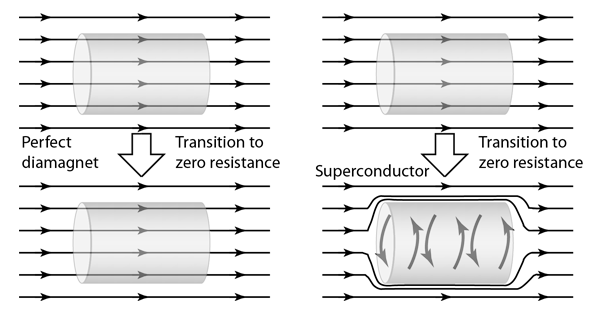
When a material makes the transition from the normal to superconducting state, it actively excludes magnetic fields from its interior; this is called the Meissner effect. 当材料从正常态过渡到超导态时,它会主动将磁场排斥出其内部;这种现象称为迈斯纳效应。
This constraint to zero magnetic field inside a superconductor is distinct from the perfect diamagnetism which would arise from its zero electrical resistance. Zero resistance would imply that if you tried to magnetize a superconductor, current loops would be generated to exactly cancel the imposed field (Lenz's law). But if the material already had a steady magnetic field through it when it was cooled trough the superconducting transition, the magnetic field would be expected to remain. If there were no change in the applied magnetic field, there would be no generated voltage (Faraday's law) to drive currents, even in a perfect conductor. Hence the active exclusion of magnetic field must be considered to be an effect distinct from just zero resistance. A mixed state Meissner effect occurs with Type II materials. 这种对超导体内部磁场为零的约束,与由于其零电阻而产生的完美抗磁性不同。零电阻意味着如果你试图对超导体磁化,电流环将生成以恰好抵消施加的磁场(法拉第定律)。但如果材料在冷却通过超导相变时已经存在稳定的磁场,该磁场预计会保持不变。如果施加的磁场没有变化,就不会产生电压(法拉第定律)来驱动电流,即使在完美导体中也是如此。因此,磁场的主动排除必须被视为与仅仅零电阻不同的效应。在II型材料中会发生混合态迈斯纳效应。
One of the theoretical explanations of the Meissner effect comes from the London equation. It shows that the magnetic field decays exponentially inside the superconductor over a distance of 20-40 nm. It is described in terms of a parameter called the London penetration depth. 梅斯纳效应的一个理论解释来自伦敦方程。它表明,在超导体内部,磁场以指数方式衰减,衰减距离为20-40纳米。这一现象用一个称为伦敦穿透深度的参数来描述。
|
Index Superconductivity concepts Reference Rohlf,Ch 15 索引 超导概念 参考 Rohlf,第15章 | ||
|
Go Back
返回 |
The Meissner Effect迈斯纳效应
|
Index Superconductivity concepts Reference Rohlf,Ch 15 索引 超导概念 参考 Rohlf,第15章 | ||||||
|
Go Back
返回 | ||||||
Perfect Diamagnetism完美抗磁性
|
Index Superconductivity concepts Reference Rohlf,Ch 15 索引 超导概念 参考 Rohlf,第15章 | |||
|
Go Back
返回 |
Mixed-State Meissner Effect混合态迈斯纳效应
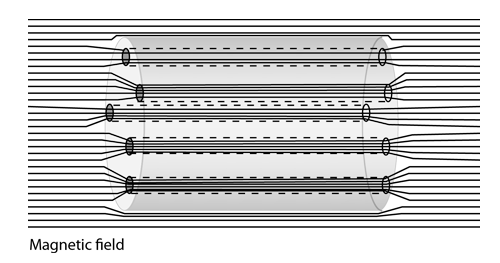
In Type II superconductors the magnetic field is not excluded completely, but is constrained in filaments within the material. These filaments are in the normal state, surrounded by supercurrents in what is called a vortex state. Such materials can be subjected to much higher external magnetic fields and remain superconducting. 在II型超导体中,磁场并不被完全排斥,而是被限制在材料内部的细丝状区域中。这些细丝处于正常态,周围被超电流环绕,这被称为涡旋态。这类材料可以承受更高的外部磁场而仍保持超导性。
![]() |
Index Superconductivity concepts Reference Rohlf,Ch 15 索引 超导概念 参考 Rohlf,第15章 | ||
|
Go Back
返回 |
Spin Alignment vs Electron Pairs自旋对齐 vs 电子对
The makers of superconducting magnets face a basic difficulty which Lindenfeld has put succinctly "magnetism and superconductivity are natural enemies". Macroscopic magnetization depends upon aligning the electron spins parallel to one another, while superconductivity depends upon pairs of electrons with their spins antiparallel. The Cooper pairs of electrons in the BCS theory have a very small binding energy, and external magnetic fields exert torques on the electron spins which tend to break up these pairs.
制造超导磁体的人员面临一个基本的困难,Lindenfeld曾简洁地表述为‘磁性与超导性是天然的敌人’。宏观磁化依赖于电子自旋相互平行排列,而超导性则依赖于自旋反平行的电子对。在BCS理论中,电子对(Cooper对)具有非常小的结合能,而外部磁场会对电子自旋施加力矩,这些力矩倾向于破坏这些对。 |
Index Superconductivity concepts Reference Rohlf,Ch 15 索引 超导概念 参考 Rohlf,第15章 | ||
|
Go Back
返回 |