Bilingual edition: English is preserved and Chinese follows each unit. Terminology uses the confirmed v20260916 glossary; automated semantic review remains traceable.
中英双语版:英文原文完整保留,中文紧随对应单元;术语采用 v20260916 确认表,自动语义审校结果可追溯。

Critical Magnetic Field

临界磁场

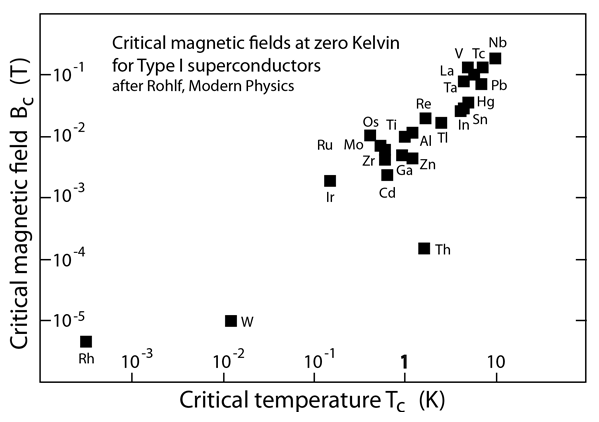
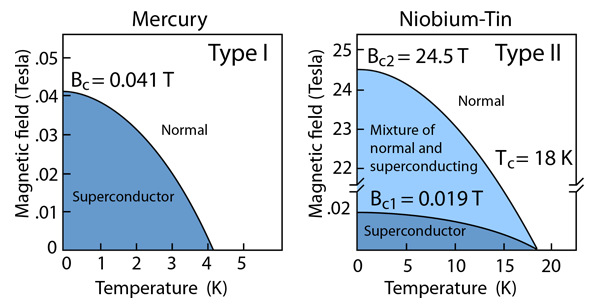
The superconducting state cannot exist in the presence of a magnetic field greater than a critical value, even at absolute zero. This critical magnetic field is strongly correlated with the critical temperature for the superconductor, which is in turn correlated with the bandgap. Type II superconductors show two critical magnetic field values, one at the onset of a mixed superconducting and normal state and one where superconductivity ceases.
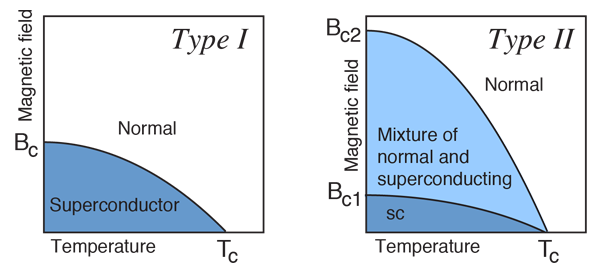
超导态在存在超过临界值的磁场时无法存在,即使在绝对零度下也是如此。这个临界磁场与超导体的临界温度密切相关,而临界温度又与能带隙相关。II型超导体显示出两个临界磁场值,一个是在超导态和正常态开始混合时的值,另一个是超导性消失时的值。

It is the nature of superconductors to exclude magnetic fields (Meissner effect) so long as the applied field does not exceed their critical magnetic field. This critical magnetic field is tabulated for 0K and decreases from that magnitude with increasing temperature, reaching zero at the critical temperature for superconductivity. The critical magnetic field at any temperature below the critical temperature is given by the relationship
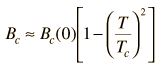
超导体的性质是排斥磁场(迈斯纳效应),只要外加磁场不超过其临界磁场。这个临界磁场在0K时被列出,并且随着温度升高而减小,直到临界温度时降为零。在临界温度以下的任何温度,临界磁场由以下关系式给出:
Illustrate mixed state
示例混合态
Examples
示例
Table of critical fields and temperatures
临界场和温度表
Calculation of critical field and critical current
临界磁场和临界电流的计算
Index

Superconductivity concepts

Reference Rohlf,Ch 15
索引 超导概念 参考 Rohlf,第15章
 
HyperPhysics***** Condensed Matter
HyperPhysics ***** 凝聚态物理
R Nave
Go Back
返回


Critical magnetic fields for superconductors

超导体的临界磁场
The critical magnetic field required to destroy the superconducting state is strongly correlated with the critical temperature for the superconductor. Each of these parameters can be viewed as representative of energy which can be supplied to the material in such a way that it interferes with the superconducting mechanism. This is consistent with the idea that there is a bandgap between the superconducting and normal states.

Type I
类型 I
Type II
类型II
Discussion
讨论
Dependence of critical field on temperature
临界场与温度的依赖关系
使超导态破坏所需的临界磁场与超导体的临界温度密切相关。这些参数可以被视为可以以某种方式供给材料的能,这种能会干扰超导机制。这与存在超导态与正常态之间的能隙这一想法是一致的。
Index

Superconductivity concepts

Reference Rohlf,Ch 15
索引 超导概念 参考 Rohlf,第15章
 
HyperPhysics***** Condensed Matter
HyperPhysics ***** 凝聚态物理
R Nave
Go Back
返回


Phase Diagram Examples

相图示例

The Type II superconductors have much higher critical magnetic fields than Type I, but for most of that field range they are mixtures of normal and superconducting.

II型超导体的临界磁场远高于I型,但在这大部分磁场范围内,它们都是正常态和超导态的混合物。
Illustrate mixed state
示例混合态
Index

Superconductivity concepts

Reference Rohlf,Ch 15
索引 超导概念 参考 Rohlf,第15章
 
HyperPhysics***** Condensed Matter
HyperPhysics ***** 凝聚态物理
R Nave
Go Back
返回


Vortex State for Superconductors

超导体的涡流态

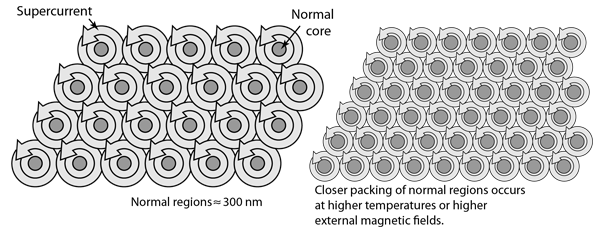
Type II superconductors usually exist in a vortex state with normal cores surrounded by superconducting regions. This allows magnetic field penetration. As their critical temperatures are approached, the normal cores are more closely packed and eventually overlap as the superconducting state is lost.

II型超导体通常处于一种漩涡态,其中正常区域被超导区域包围。这允许磁场穿透。当接近临界温度时,正常区域更加紧密排列,最终会重叠,当超导态消失时。
Further discussion of vortices
关于涡流的进一步讨论
Index

Superconductivity concepts

Reference Rohlf,Ch 15
索引 超导概念 参考 Rohlf,第15章
 
HyperPhysics***** Condensed Matter
HyperPhysics ***** 凝聚态物理
R Nave
Go Back
返回


Vortex State for Superconductors

超导体的涡流态
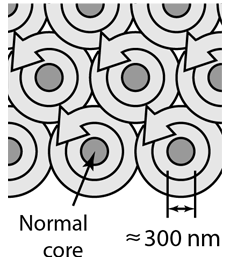
At the lower of the two critical magnetic fields in a Type II superconductor, magnetic fields begin to penetrate through cores of normal material surrounded by superconducting current vortices. As long as these vortices are stationary (pinned), the magnetic fields can penetrate while still maintaining zero electric resistivity paths through the material. A size of about 300 nm is typical for the normal cores. While the Meissner effect is modified to allow magnetic fields through the normal cores, magnetic fields are still excluded from the superconducting regions.
As the temperature or the external magnetic field is increased, the normal regions are packed closer together. The vortices feel a force when current flows, and if they move, the superconducting state is lost. Microscopic defects can act to pin the vortices and maintain the superconducting state to a higher temperature. So the microscopic structure and fabrication techniques influence their properties greatly.
当温度或外部磁场增加时,正常区域会更紧密地排列在一起。当电流流过时,涡流会感受到一个力,如果它们移动,超导态就会丧失。微观缺陷可以用来固定涡流,并将超导态维持到更高的温度。因此,微观结构和制造技术对其性质有重大影响。
在Type II超导体的两个临界磁场中较低的一个下,磁场均开始穿透正常材料的芯部,这些芯部被超导电流涡旋所包围。只要这些涡旋保持静止(被钉扎),磁场均可以在保持材料中零电阻路径的同时穿透正常材料的芯部。正常芯部的尺寸通常约为300 nm。虽然迈斯纳效应被修改以允许磁场均通过正常芯部,但磁场均仍被排除在超导区域之外。
Index

Superconductivity concepts

Reference Rohlf,Ch 15
索引 超导概念 参考 Rohlf,第15章
 
HyperPhysics***** Condensed Matter
HyperPhysics ***** 凝聚态物理
R Nave
Go Back
返回