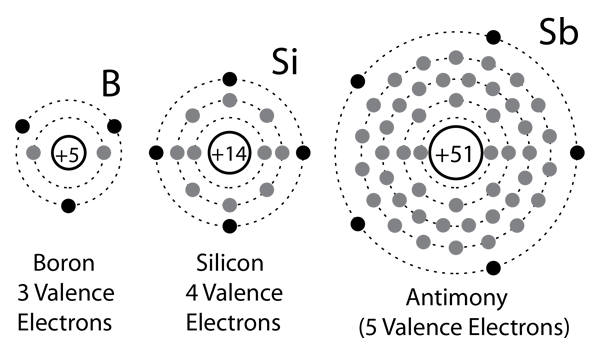
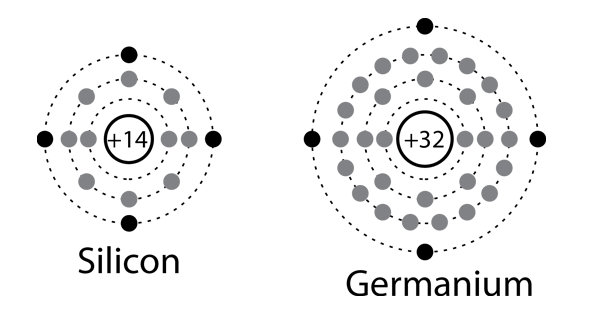
Silicon and Germanium硅和锗
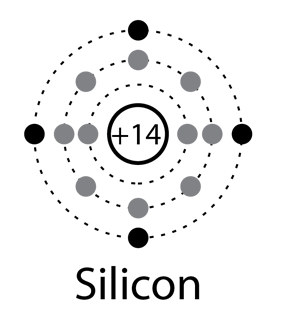
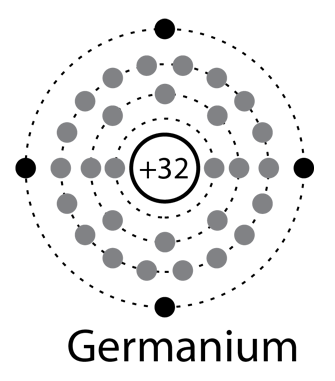
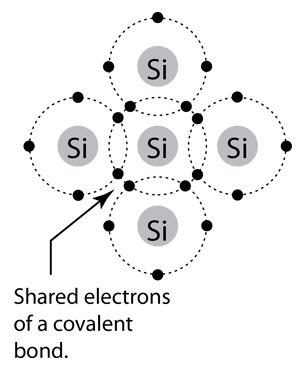
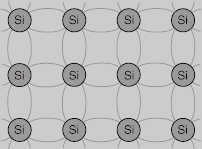
Solid state electronics arises from the unique properties of silicon and germanium, each of which has four valence electrons and which form crystal lattices in which substituted atoms (dopants) can dramatically change the electrical properties. 固体电子学起源于硅和锗的独特性质,这两种元素每个都有四个价电子,并且它们形成晶体晶格,在其中取代原子(掺杂剂)可以显著改变电学性质。
![]() 点击任一查看更多细节 |
Index Semiconductor concepts 索引 半导体概念 | ||
|
Go Back
返回 |
Silicon硅
|
Index Semiconductor concepts 索引 半导体概念 | ||||||
|
Go Back
返回 |
Germanium锗
|
Index Semiconductor concepts 索引 半导体概念 | ||
|
Go Back
返回 |
Silicon Lattice硅晶格
|
Index Semiconductor concepts Floyd, Electronic Devices, p6 索引 半导体概念 Floyd, 电子设备, 第6页 | |||
|
Go Back
返回 |
Valence Electrons价电子
The electrons in the outermost shell of an atom are called valence electrons; they dictate the nature of the chemical reactions of the atom and largely determine the electrical nature of solid matter. The electrical properties of matter are pictured in the band theory of solids in terms of how much energy it takes to free a valence electron. 原子最外层的电子称为价电子;它们决定了原子的化学反应性质,并在很大程度上决定了固体物质的电学性质。物质的电学性质可以通过固体的能带理论来描述,该理论以使价电子脱离所需的能量来阐述。
![]() |
Index Semiconductor concepts 索引 半导体概念 | ||
|
Go Back
返回 |