Solar Orbit
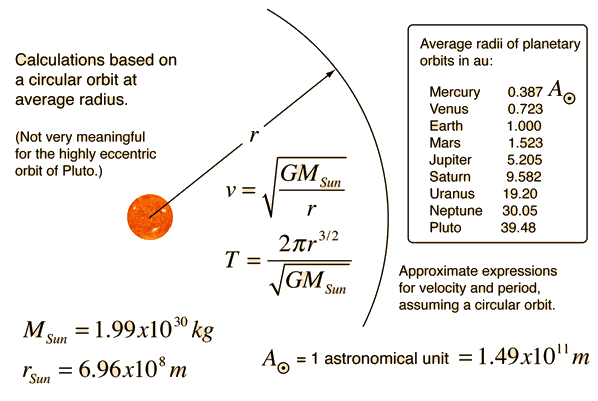
| Planetary data
行星数据 |
Note: The orbit radii in this table are from the NASA Solar System Data Table.
Accurate values for the periods of the planets can be calculated from Kepler's Law of Periods and the semimajor axes of the elliptical orbits. But it may be instructive to calculate approximate values for the periods and orbital velocities assuming a circular orbit at the average orbital radius.
Note that the accurate length of the Earth year is 365.256 days, so approximating the Earth's orbit with a circle gives an error of about 2 days or about 0.6%, so the Earth's orbit is very close to being a circle. The departure from circular orbit for the planets can be expressed in terms of the eccentricity of the orbits.
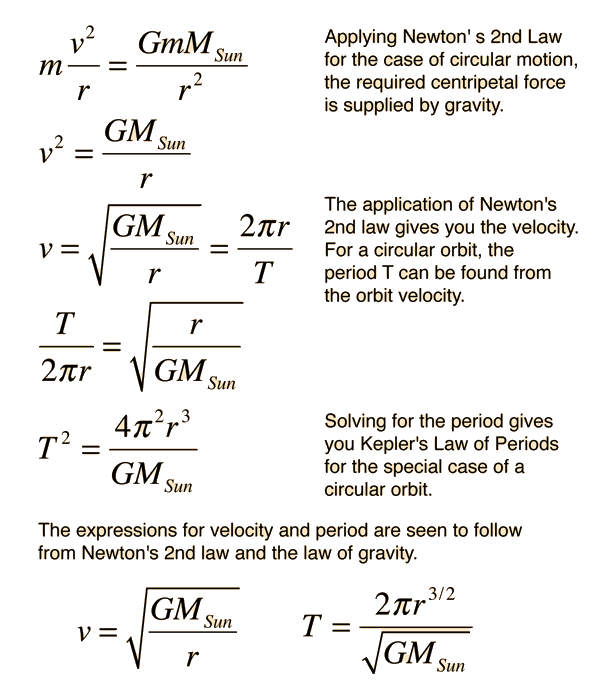
These approximations make use of Newton's second law, the law of universal gravitation and the concept of centripetal force. A perfectly circular orbit can be precisely described as follows:
Gravity concepts
Orbit concepts
| HyperPhysics***** Mechanics ***** Rotation
HyperPhysics ***** 力学 ***** 转动 | R Nave |