| Force from spherical shell of mass M
从质量为M的球壳产生的力 |
| Gravitational lens
引力透镜 |
索引
力学
返回
|
Index
索引 | ||
| HyperPhysics***** Mechanics
力学 |
Go Back
返回 |
Gravity重力
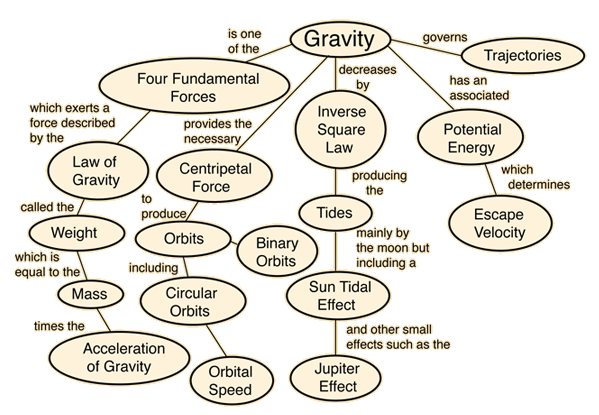
Gravity is the weakest of the four fundamental forces, yet it is the dominant force in the universe for shaping the large scale structure of galaxies, stars, etc. The gravitational force between two masses m1 and m2 is given by the relationship: 重力是四种基本力中最弱的一种,但却是塑造宇宙中星系、恒星等大尺度结构的主导力量。两个质量为 m₁ 和 m₂ 的物体之间的引力由以下关系式给出: 
This is often called the "universal law of gravitation" and G the universal gravitation constant. It is an example of an inverse square law force. The force is always attractive and acts along the line joining the centers of mass of the two masses. The forces on the two masses are equal in size but opposite in direction, obeying Newton's third law. Viewed as an exchange force, the massless exchange particle is called the graviton. From Einstein's treatment in general relativity, gravity is associated with a curvature of space-time and changes in mass configuration can produce gravitational waves. 这通常被称为‘万有引力定律’,G 是万有引力常量。这是一个反平方定律的力。力总是吸引力,并且沿着两个质量中心的连线作用。两个质量上的力大小相等但方向相反,遵守牛顿第三定律。作为交换力来看,无质量的交换粒子称为重力子。从爱因斯坦在广义相对论中的处理来看,引力与时空的弯曲有关,质量配置的变化可以产生引力波。
The gravity force has the same form as Coulomb's law for the forces between electric charges, i.e., it is an inverse square law force which depends upon the product of the two interacting sources. This led Einstein to start with the electromagnetic force and gravity as the first attempt to demonstrate the unification of the fundamental forces. It turns out that this was the wrong place to start, and that gravity will be the last of the forces to unify with the other three forces. Electroweak unification (unification of the electromagnetic and weak forces) was demonstrated in 1983, a result which could not be anticipated in the time of Einstein's search. It now appears that the common form of the gravity and electromagnetic forces arises from the fact that each of them involves an exchange particle of zero mass, not because of an inherent symmetry which would make them easy to unify. 重力力的形式与库仑定律对于电荷之间的力的形式相同,即它是一种平方反比定律的力,其依赖于两个相互作用源的乘积。这促使爱因斯坦从电磁力和重力开始,试图展示基本力的统一。事实证明,这是错误的起点,重力将是最后一种与其它三种力统一的力。电磁与弱力的统一(电磁力与弱力的统一)于1983年被证明,这一结果在爱因斯坦搜索时期无法预见。现在看来,重力和电磁力的共同形式源于它们都涉及零质量的交换粒子,而不是因为某种内在对称性使它们容易统一。
|
Index Gravity Concepts 索引重力概念 | ||
|
Go Back
返回 |
Examples of Trajectories轨迹示例
Common misconceptions about guns:关于枪的常见误解:
A dropped bullet will hit the ground before one which is fired from a gun.一颗下落的子弹会比从枪中射出的子弹先击中地面。
As shown in the illustration of a horizontal launch, gravity acts the same way on both bullets, giving them the same downward acceleration and making them strike the ground at the same time if the bullet is fired horizontally over level ground. Bullets fired from high-powered rifles drop only a few inches in hundreds of yards.从高射速步枪发射的子弹在数百码内仅下落几英寸。
Fired at twice the speed of sound, a bullet will drop over 3 inches in 100 yards, and at 300 yards downrange will have dropped about 30 inches. Plug in numbers into the bullet drop calculation to see for yourself. Ammunition manufacturers contribute to this misconception by stating the drop of their projectiles as just the extra drop caused by frictional drag compared to an ideal frictionless projectile.
如水平发射的示意图所示,重力对两颗子弹的作用相同,使它们具有相同的向下加速度,并且如果子弹在水平地面上发射,它们会同时击中地面。以两倍音速发射的子弹,在100码处会下落超过3英寸,在300码处下落约30英寸。将数值代入子弹下落计算,亲自验证一下。弹药制造商通过声称其弹丸的下落仅是由于摩擦阻力相对于理想无摩擦弹丸的额外下落,助长了这一误解。 |
Index Trajectory concepts 索引 轨道概念 | ||
|
Go Back
返回 |
Drop of a Bullet子弹下落

If air friction is neglected, then the drop of a bullet fired horizontally can be treated as an ordinary horizontal trajectory. The air friction is significant, so this is an idealization. 若忽略空气摩擦,则子弹水平发射时的下落可视为普通水平轨迹。空气摩擦显著,因此这是理想化的情形。
|
Index Trajectory concepts 索引 轨道概念 | ||
|
Go Back
返回 |