Cochlear Implant
As an alternative to a hearing aid for profound hearing loss, the cochlear implant is under continuing investigation. In order to understand speech we rely on the cochlea in the inner ear as the body's microphone, converting the information in the sound waves to a series of electrical impulses that travel to the brain. The analysis of speech sounds relies on the separation of frequency information in the sound to electrical impulses from different parts of the basilar membrane of the cochlea. According to the place theory of pitch perception, the hair cells at different locations along the basilar membrane send impulses to the brain that form a frequency spectrum of the incident sound so that information like vowel sounds can be distinguished. If in the absence of normal function of this cochlear structure, we can recreate a pattern of electrical stimulation that will be sent to the brain to be interpreted as sound, we have the possibility of providing some approximation to the normal hearing function.
 | Cochlear implants are currently accompanied by an implanted receiver stimulator and an external microphone and speech processor as illustrated at left. 目前,助听器通常配备有植入的接收刺激器和外部的麦克风和语音处理器,如图左所示。 This NIH image credited to Medical illustrations by NIH, Medical Arts & Photography Branch and is from the National Institute on Deafness and Other Communication Disorders (NIDCD). 这张NIH图片由NIH的医学插图、医学艺术与摄影分支提供,源自国家耳部疾病及其他通讯障碍研究所(NIDCD)。 |
As a conceptualization of the normal function the coclear implant would be called upon to supplant, consider the process of distinguishing two vowel sounds.
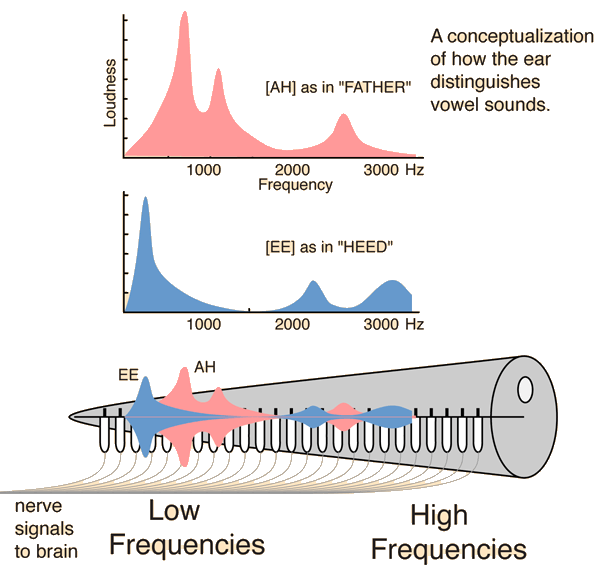
To distinguish the two sounds, the cochlea must send to the brain a profile of intensity vs frequency with sufficient resolution to be provide distinctive differences between these sounds in the relevant part of the brain.
 A coclear implant must provide a distributed electrical stimulation to simulate the natural function in the cochlea. 骨内植入物必须提供分布式电刺激,以模拟耳蜗的自然功能。 |  Cochlear Implant NIH image, Medical Arts and Photography Branch. Cochlear Implant NIH 图像,医学艺术与摄影分支。 |
The following description is drawn from the website of the National Institute of Deafness and other Communication Disorders. They describe the implant as a "device that can help to provide a sense of sound to a person who is profoundly deaf or severely hard of hearing." The implant is surgically placed under the skin behind the ear. An implant has four basic parts:
- A microphone, which picks up sound from the environment.
一种从环境中拾取声音的麦克风
- A speech processor, which selects and arranges sounds picked up by the microphone. A filter bank divides the signal into frequency bands and strategies utilizing the features of Fast Fourier Transforms extract and emphasize signals identified as being like speech sounds.
一种语音处理器,选择并排列由麦克风拾取的声音。滤波器组将信号分成频率带,利用快速傅里叶变换的特性提取并突出被识别为语音声音的信号。
- A transmitter and receiver/stimulator, which receives signals from the speech processor and converts them into electric impulses.
一个发射器和接收器/刺激器,它接收来自语音处理器的信号,并将它们转换为电信号。
- Electrodes, which provide stimulating electrical impulses to spcific electrodes inside the cochlea based on the analysis of the incoming sound that has been done. These impulses stimulate the nerves in a manner analogous to the place theory type excitation associated with normal hearing.
电极通过分析进入的声波,向耳蜗内的特定电极提供刺激性电信号。这些信号以类似于正常听力中与位置理论相关的方式刺激神经。
According to the NIDCD site, some 112,000 persons worldwide had received cochlear implants by the end of 2006. In the U.S. roughly 23,000 adults and 15,500 children had received them. Extensive training and therapy is necessary after the surgery, but with that therapy many develop the capability to communicate orally.
Current cochlear implants employ about 20 channels to stimulate the cochlea in a way that bears some resemblance to place theory stimulation. Incoming signals in the approximate range 200 - 7500 Hz are processed and used to generate stimulating electrical impulses on the channels of the cochlear implant.
The available cochlear transplants include a 22 channel unit, the Nucleus-22, and a 120 channel unit, the HiRes Fidelity 120.
(Kerry-Lea Glass is acknowledged for investigative work on this topic.)
| Assessment of hearing loss
听力损失评估 | Hearing Aids
助听器 |
Hearing concepts
Dangers of Loud Sounds
Reference

NIDCD of NIH
Balakany, et al.
| HyperPhysics***** Sound
HyperPhysics ***** 声音 | R Nave |