Diffraction of Sound声音的衍射
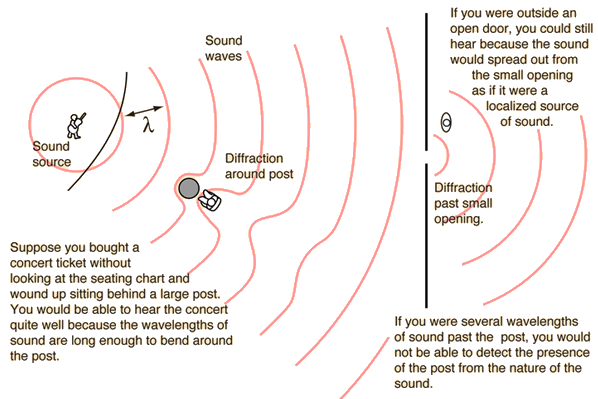
Diffraction: the bending of waves around small* obstacles and the spreading out of waves beyond small* openings. 衍射:波在小障碍物后方的弯曲以及通过小孔后的波的扩展。
* small compared to the wavelength
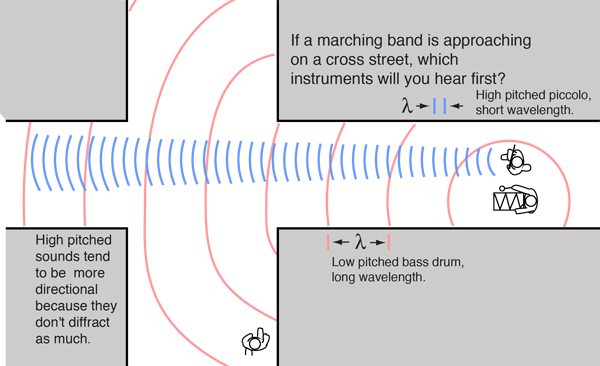
![]() Important parts of our experience with sound involve diffraction. The fact that you can hear sounds around corners and around barriers involves both diffraction and reflection of sound. Diffraction in such cases helps the sound to "bend around" the obstacles. The fact that diffraction is more pronounced with longer wavelengths implies that you can hear low frequencies around obstacles better than high frequencies, as illustrated by the example of a marching band on the street. Another common example of diffraction is the contrast in sound from a close lightning strike and a distant one. The thunder from a close bolt of lightning will be experienced as a sharp crack, indicating the presence of a lot of high frequency sound. The thunder from a distant strike will be experienced as a low rumble since it is the long wavelengths which can bend around obstacles to get to you. There are other factors such as the higher air absorption of high frequencies involved, but diffraction plays a part in the experience. 我们对声音的体验中涉及衍射现象。你能听到声音绕过角落和障碍物,这涉及到衍射和声波的反射。在这种情况下,衍射帮助声波“绕过”障碍物。衍射在长波长下更为明显,这意味着你比高频声波更容易绕过障碍物听到低频声音,这可以从行军乐队在街道上的情形中得到说明。衍射的另一个常见例子是雷声从近距离雷击和远处雷击的差异。近距离的雷击声会听起来像一声尖锐的爆裂声,表明有大量高频声音存在。而远处的雷击声则听起来像低沉的轰鸣声,因为长波长的声音能够绕过障碍物传播到你身边。其他因素如高频声在空气中的更高吸收也起作用,但衍射在体验中也扮演着角色。
You may perceive diffraction to have a dual nature, since the same phenomenon which causes waves to bend around obstacles causes them to spread out past small openings. This aspect of diffraction also has many implications. Besides being able to hear the sound when you are outside the door as in the illustration above, this spreading out of sound waves has consequences when you are trying to soundproof a room. Good soundproofing requires that a room be well sealed, because any openings will allow sound from the outside to spread out in the room - it is surprising how much sound can get in through a small opening. Good sealing of loudspeaker cabinets is required for similar reasons. 你可能觉得衍射具有双重性质,因为引起波绕过障碍物弯曲的同一现象,也导致波在小开口处扩散出去。衍射的这一特性也有许多影响。除了如上图所示,当你在门外时仍能听到声音外,声波的扩散也会在你试图隔音时产生影响。良好的隔音需要房间密封良好,因为任何开口都会让外界的声音在房间内扩散——令人惊讶的是,通过一个小开口可以进入大量声音。对于扬声器箱体的密封也需类似的原因。
Another implication of diffraction is the fact that a wave which is much longer than the size of an obstacle, like the post in the auditorium above, cannot give you information about that obstacle. A fundamental principle of imaging is that you cannot see an object which is smaller than the wavelength of the wave with which you view it. You cannot see a virus with a light microscope because the virus is smaller than the wavelength of visible light. The reason for that limitation can be visualized with the auditorium example: the sound waves bend in and reconstruct the wavefront past the post. When you are several sound wavelengths past the post, nothing about the wave gives you information about the post. So your experience with sound can give you insights into the limitations of all kinds of imaging processes. 衍射的另一个含义是,如果波的波长远大于障碍物的尺寸,比如上面礼堂中的柱子,这种波就无法给你关于该障碍物的任何信息。成像的一个基本原理是,你无法用某种波来观察比该波波长更小的物体。你无法用光学显微镜观察病毒,因为病毒的尺寸比可见光的波长要小。这种限制的原因可以用礼堂的例子来形象化:声波会绕过柱子并重建波前。当你离柱子有多个声波波长的距离时,波中没有任何信息能告诉你关于柱子的存在。因此,你对声音的体验可以为你提供关于所有种类成像过程限制的见解。
* 小于波长的其他例子: |
Index Traveling wave concepts Sound propagation concepts 索引 旅行波概念 声波传播概念 | |||
|
Go Back
返回 |
![]() The long wavelength sounds of the bass drum will diffract around the corner more efficiently than the more directional, short wavelength sounds of the higher pitched instruments. 低音鼓的长波长声音会比更高音调乐器更高效地绕过角落。
|
Index Traveling wave concepts Sound propagation concepts 索引 旅行波概念 声波传播概念 | ||
|
Go Back
返回 |
Loudspeaker Sound Contours扬声器声音轮廓
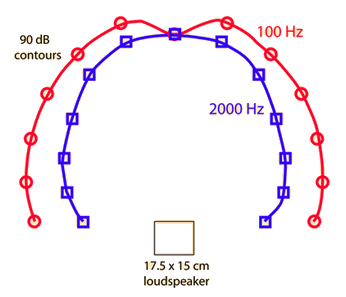
Note that the wavelength of the 100 Hz sound is about 3.45 meters, much larger than the speaker, while that of the 2000 Hz sound is about 18 cm, about the size of the speaker. 注意,100 Hz声音的波长约为3.45米,远大于扬声器的尺寸,而2000 Hz声音的波长约为18厘米,大约与扬声器的尺寸相当。
The realities of diffraction may affect your choice of loudspeakers for your personal listening. Very small loudspeakers are often promoted as having sound just as good as a large loudspeaker. There is reason to be skeptical about such claims on physical grounds. Large speakers are inherently more efficient in producing bass frequencies into a room just because their size compares more favorably with the wavelengths of those sounds. Even if that basic problem is overcome by electronic equalization of the sound input to the speakers and the design of the crossover networks which provide the signal to the different components of the loudspeaker, there is no escaping the implications of diffraction. Small loudspeakers will spread the bass frequencies considerably more than the high frequencies. This difference between the equal-loudness patterns of highs and lows becomes more and more pronounced as you produce smaller and smaller speakers. So you might conceivably get equivalent sound directly on-axis with the speaker, but as you move away from the axis, the high frequencies will drop off more rapidly than the lows. Practically, this limits the audience region for optimal listening. It might be fairly said that if the speakers are just for you, you might be satisfied with the small speakers because you can position yourself at the ideal-listener location. But if you have guests, they will not be as satisfied because of the greater off-axis variations from the small speakers. 衍射的现实可能会影响你为个人聆听选择扬声器的决定。非常小的扬声器常常被宣传为声音质量与大扬声器一样好。从物理角度来看,对这种说法持怀疑态度是有道理的。大扬声器在产生低频声音时固有地更有效率,因为它们的尺寸与这些声音的波长相比更为匹配。即使通过电子均衡放大器对声音输入进行调整,并且通过交叉扬声器网络将信号分配到不同部件,这种基本问题仍然存在。衍射的影响无法避免。小扬声器会比高频声音扩散得更广。高频和低频的等响度曲线之间的差异随着扬声器尺寸的减小而变得更加明显。因此,你可能可以得到与扬声器正前方等响的音质,但当你远离轴线时,高频会比低频衰减得更快。实际上,这限制了最佳聆听区域。可以说,如果扬声器只是为你自己使用,你可能会对小扬声器感到满意,因为你可以定位在理想听众位置。但如果有人来访,他们将不会那么满意,因为小扬声器会产生更大的偏离轴线的差异。
|
Index Traveling wave concepts Sound propagation concepts 索引 旅行波概念 声波传播概念 | ||
|
Go Back
返回 |