Bilingual edition: English is preserved and Chinese follows each unit. Terminology uses the confirmed v20260916 glossary; automated semantic review remains traceable.
中英双语版:英文原文完整保留,中文紧随对应单元;术语采用 v20260916 确认表,自动语义审校结果可追溯。

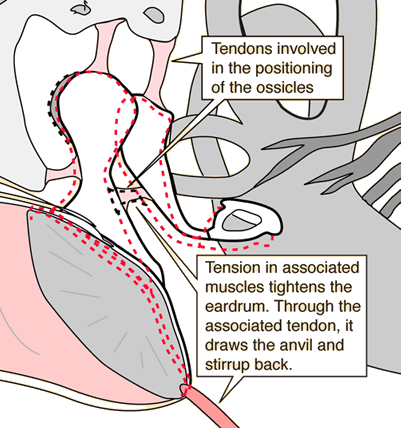
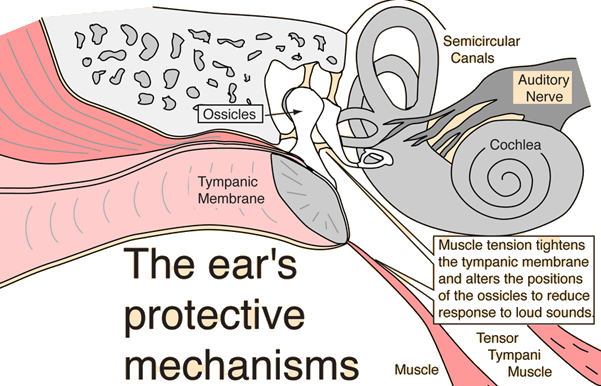
In response to sustained loud sounds, muscle tension tightens the tympanic membrane and, acting through the tendon connecting the hammer and anvil, repositions the ossicles to pull the stirrup back, lessening the transfer of force to the oval window of the inner ear. This contributes to the ear's wide dynamic range.

对持续的 loud 声音的响应,肌肉紧张会收紧鼓膜,并通过连接锤骨和砧骨的肌腱将听小骨重新定位,将砧骨拉回,从而减少力量传递到内耳的卵圆窗。这有助于耳朵拥有宽广的动态范围。

The stapedius muscle and the tensor tympani muscle act in response to loud sounds.(DeBonis & Donohue)

当听到响亮的声音时,镫骨肌和鼓膜张肌会作出反应。(DeBonis & Donohue)
More detail
更多内容
Index

Hearing concepts

Reference
Stevens & Warshofsky

DeBonis & Donohue
索引听力概念参考Stevens & Warshofsky DeBonis & Donohue
  HyperPhysics***** Sound
HyperPhysics ***** 声音
Go Back
返回


Loud Sound Response

Loud Sound Response(专名或术语)

In response to loud sounds, the tensor tympani muscle tightens the eardrum and through the tendon between the hammer and anvil and shifts the stirrup backward from the oval window of the inner ear. This shifting of the ossicles reduces the transmitted force to the inner ear, protecting it. However, it is a relatively slow action and cannot protect the ear from sudden loud sounds like a gunshot. The process is less effective in older ears.

对响亮的声音作出反应时,紧张的 tensor tympani 肌肉会收紧鼓膜,并通过锤骨和砧骨之间的肌腱将砧骨向内耳的卵圆窗后方推移。这种 ossicles 的移动会减少传入内耳的力,从而保护内耳。然而,这一过程相对缓慢,无法保护耳朵免受突然的响亮声音(如枪声)的伤害。这一过程在年长者中效果较差。
Dynamic levels of music
音乐的动态层次
Index

Hearing concepts

Reference
Stevens & Warshofsky
索引 声学概念 参考 Stevens & Warshofsky
  HyperPhysics***** Sound
HyperPhysics ***** 声音
Go Back
返回


Young and Old Ears

年轻与年长的耳朵

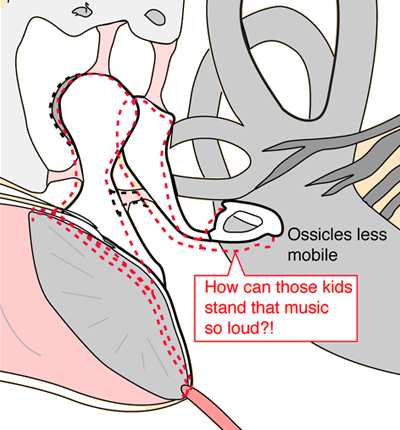
A young person's ear can provide a limited amount of protection from sustained loud sounds by shifting the stirrup backward so that it doesn't exert as much force on the oval window. In the very young, the stirrup is thought to be capable of actually breaking contact with the oval window, breaking the direct link to the inner ear. In an older ear, the structures become stiffer and cannot adjust backward as much. Older persons are generally less tolerant of loud sounds.

年轻人的耳朵可以对持续的 loud sounds 提供一定保护,通过将锤骨向后移动,使其对卵圆窗施加的力减少。在非常年轻的人中,认为锤骨实际上可以与卵圆窗断开接触,从而切断与内耳的直接联系。在年长的耳朵中,结构变得更僵硬,无法向后移动那么多。老年人通常对 loud sounds 的耐受性较低。
Index

Hearing concepts

Reference
Stevens & Warshofsky
索引 声学概念 参考 Stevens & Warshofsky
  HyperPhysics***** Sound
HyperPhysics ***** 声音
Go Back
返回