Eta Carinae
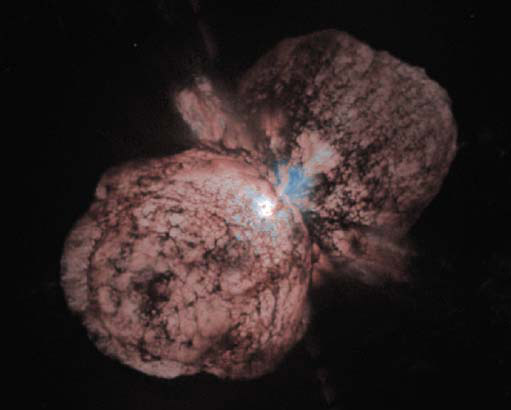
Credit: J. Morse (U. Colorado), K. Davidson (U. Minnesota) et al., WFPC2, HST, NASA
Eta Carinae may be about to explode. But no one knows when - it may be next year, it may be one million years from now. Eta Carinae's mass - about 100 times greater than our Sun - makes it an excellent candidate for a full blown supernova. Historical records do show that about 150 years ago Eta Carinae underwent an unusual outburst that made it one of the brightest stars in the southern sky. Eta Carinae, in the Keyhole Nebula, is the only star currently thought to emit natural LASER light. This image, taken in 1996, resulted from sophisticated image-processing procedures designed to bring out new details in the unusual nebula that surrounds this rogue star. Now clearly visible are two distinct lobes, a hot central region, and strange radial streaks. The lobes are filled with lanes of gas and dust which absorb the blue and ultraviolet light emitted near the center. The streaks remain unexplained. (Text adapted from NASA.)
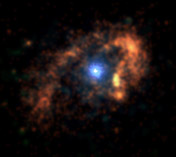 | Eta Carinae is the one of the most luminous star systems in our Galaxy, radiating millions of times more power than our Sun. Eta Carinae is also one of the strangest star systems known, brightening and fading greatly since the early 1800s. This is an X-ray image from the Chandra Observatory. A horseshoe-shaped outer ring about two light-years across has been discovered surrounding a hot core measuring three light-months across. One thing appears likely: these structures were caused by collisions involving matter expelled from the center at supersonic speeds. Speculation continues that Eta Carinae will be seen to undergo a supernova explosion sometime in the next thousand years. (Text adapted from NASA.)
Eta Carinae 是银河系中最明亮的恒星系统之一,其辐射的功率比太阳大数百万倍。Eta Carinae 也是已知最奇特的恒星系统之一,自19世纪初以来,它的亮度曾大幅变化。这是一张来自钱德勒望远镜的X射线图像。一个跨度约两光年的 horseshoe 形外环已被发现,环绕着一个直径约三光月的炽热核心。一个明显的情况是:这些结构可能是由从中心区域以超音速喷射出的物质碰撞形成的。人们仍在推测,Eta Carinae 在未来千年内可能会发生超新星爆发。(文本改编自NASA。) |
"This star was first cataloged by Edmond Halley in 1677, as a star of fourth magnitude. Since, its brightness has varied in a most remarkable way: In 1730, its brightness reached mag 2, and again fell to mag 4 in about 1782. It brightened again about 1801 and faded back to 4th magnitude in 1811. In 1820, Eta began to brighten steadily, reaching 2nd magnitude in 1822 and 1st mag in 1827. After this first preliminary maximum, the star faded back to mag 2 for about 5 years, then rose again to about mag 0. After a further slight decline, Eta's brightness increased once more and reached its maximal brilliance of nearly -1.0 in April 1843, when it outshone all stars in the sky but Sirius. After this brilliant show, the star slowly faded continuously, and became invisible in 1868. Interrupted by two minor outbursts around 1870 and 1889, Eta Carinae faded to about 8th magnitude around 1900, where it remained until 1941. At that time, the star began to brighten again, and reached 7th magnitude about 1953. Slowly and steadily, Eta Carinae became brighter until about 6th magnitude in the early 1990s - the star reached naked-eye visibility again at that time. Then in 1998-99, the star suddenly brightened by about a factor two."(SEDS)
Eta Carinae is about 7500 light years from the Earth. NASA's Far Ultraviolet Spectroscopic Explorer detected a partner of Eta Carinae in 2005. The companion was detected by the eclipsing of Eta Carinae's X-rays with a period of 5.5 years.
Sources
- Astronomy picture of the day Apr 28, 2002
每日天文学图片 2002年4月28日
- Astronomy picture of the day Oct 11. 1999
天文每日图片 1999年10月11日
- Eta Carinae (SEDS)
Eta Carinae (SEDS)(专名或术语)
- Partner to Eta Carinae
Eta Carinae的伙伴
- GSFC's Eta Carinae site
GSFC的参宿四地点
Star Concepts
Star Classification
| HyperPhysics***** Astrophysics
HyperPhysics ***** 天体物理学 | R Nave |