Temperature Regulation of the Human Body
 |
The human body has the remarkable capacity for regulating its core temperature somewhere between 98°F and 100°F when the ambient temperature is between approximately 68°F and 130°F according to Guyton. This presumes a nude body and dry air. 根据Guyton的说法,当环境温度在约68°F到130°F之间时,人体具有调节核心温度的 remarkable capacity,该温度在98°F到100°F之间。这假设人体是裸体且空气干燥的。
|
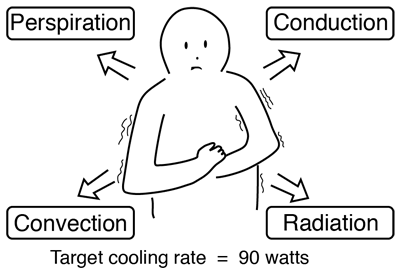
The external heat transfer mechanisms are radiation, conduction and convection and evaporation of perspiration. The process is far more than the passive operation of these heat transfer mechanisms, however. The body takes a very active role in temperature regulation.
The temperature of the body is regulated by neural feedback mechanisms which operate primarily through the hypothalamus. The hypothalamus contains not only the control mechanisms, but also the key temperature sensors. Under control of these mechanisms, sweating begins almost precisely at a skin temperature of 37°C and increases rapidly as the skin temperature rises above this value. The heat production of the body under these conditions remains almost constant as the skin temperature rises. If the skin temperature drops below 37°C a variety of responses are initiated to conserve the heat in the body and to increase heat production. These include
- Vasoconstriction to decrease the flow of heat to the skin.
血管收缩以减少热量向皮肤的流动。
- Cessation of sweating.
出汗停止。
- Shivering to increase heat production in the muscles.
战栗以增加肌肉中的热量产生。
- Secretion of norepinephrine, epinephrine, and thyroxine to increase heat production
分泌肾上腺素、去甲肾上腺素和甲状腺素以增加产热
- In lower animals, the erection of the hairs and fur to increase insulation.
在低等动物中,毛发和毛皮的竖起以增强保温性。
| Modeling the cooling of the human body
人体冷却的建模 |
References
Guyton
Ch. 47
Benzinger
Hardy
| HyperPhysics***** Thermodynamics
HyperPhysics ***** 热力学 | R Nave |