Bilingual edition: English is preserved and Chinese follows each unit. Terminology uses the confirmed v20260916 glossary; automated semantic review remains traceable.
中英双语版:英文原文完整保留,中文紧随对应单元;术语采用 v20260916 确认表,自动语义审校结果可追溯。
Note: This is a large HTML document. Wait until it finishes loading for full functionality.
注意:这是一个大型的HTML文档。请等待它加载完成以获得完整功能。
Index

Motion concepts
索引运动概念
 
HyperPhysics***** Mechanics
力学
R Nave
Go Back
返回


Freefall

自由下落

In the absence of frictional drag, an object near the surface of the earth will fall with the constant acceleration of gravity g. Position and speed at any time can be calculated from the motion equations.

在没有摩擦阻力的情况下,接近地球表面的物体将以恒定的重力加速度g下落。任意时刻的位置和速率可以通过运动方程计算。

Illustrated here is the situation where an object is released from rest. Its position and speed can be predicted for any time after that. Since all the quantities are directed downward, that direction is chosen as the positive direction in this case.

这里展示的是一个物体从静止释放的情况。其位置和速率可以在释放后任何时间被预测。由于所有量都是向下的,因此在此情况下选择向下为正方向。
At time t = s after being dropped,
the speed is vy = m/s = ft/s ,

The distance from the starting point will be
y = m= ft
Enter data in any box and click outside the box.
在时间 t = s 后被释放,速度为 v_y = m/s = ft/s,从起点的距离为 y = m = ft,任选一个框输入数据并点击框外。
中文译文中的待填/计算数值依次对应:1:t 2:v 3:vc 4:y 5:yc。实际数值以上方原输入框为准。

Note that you can enter a distance (height) and click outside the box to calculate the freefall time and impact velocity in the absence of air friction. But the calculation assumes that the gravity acceleration is the surface value g = 9.8 m/s2, so if the height is great enough for gravity to have changed significantly the results will be incorrect.

请注意,您可以输入一个距离(高度),并点击框外以计算在无空气阻力情况下的自由下落时间及撞击速度。但该计算假设重力加速度为表面值g = 9.8 m/s²,因此如果高度足够大,使重力发生显著变化,结果将不准确。
Free fall with air friction
有空气摩擦的自由下落
Free fall from great height
从高处自由下落
Free fall experiment with spark timer
使用火花计时器的自由落体实验
Index

Trajectory concepts
索引 轨道概念
 
HyperPhysics***** Mechanics
力学
R Nave
Go Back
返回


Peak at m at
t= s
在 t= s 时,m 处出现峰值
中文译文中的待填/计算数值依次对应:1:p 2:tp。实际数值以上方原输入框为准。

Vertical Trajectory

竖直轨迹

Vertical motion under the influence of gravity can be described by the basic motion equations. Given the constant acceleration of gravity g, the position and speed at any time can be calculated from the motion equations:

在重力影响下的竖直运动可以用基本运动方程来描述。已知重力加速度为 g,可以在任一时刻通过运动方程计算出位置和速率:

You may enter values for launch velocity and time in the boxes below and click outside the box to perform the calculation.

您可以将在下方框中输入发射速度和时间的值,并点击框外以执行计算。
For launch speed v0y = m/s =ft/s
and time t = s ,

The values below are output values; those boxes will not accept input for calculation. The velocity will be
vy = m/s = ft/s
and the height will be y = m = ft
对于发射速度 v₀y = m/s = ft/s 和时间 t = s,下面的值是输出值;这些框不接受输入进行计算。速度将是 v_y = m/s = ft/s,高度将是 y = m = ft
中文译文中的待填/计算数值依次对应:1:v0 2:v0c 3:t 4:vv 5:vc 6:y 7:yc。实际数值以上方原输入框为准。
Index

Trajectory concepts
索引 轨道概念
 
HyperPhysics***** Mechanics
力学
R Nave
Go Back
返回


Index

Trajectory concepts

Calculation
索引轨迹概念计算
 
HyperPhysics***** Mechanics
力学
R Nave
Go Back
返回


Horizontal Launch

水平发射

All the parameters of a horizontal launch can be calculated with the motion equations, assuming a downward acceleration of gravity of 9.8 m/s2.

水平发射的各个参数都可以用运动方程计算,假设重力加速度为9.8 m/s²。
Time of flight
t = s
Vertical impact velocity
vy = m/s
Launch velocity
v0 = m/s
Height of launch
h = m
Horizontal range
R = m

Calculation is initiated by clicking on the formula in the illustration for the quantity you wish to calculate.

通过点击示意图中你希望计算的量的公式来启动计算。
飞行时间 t = s 垂直撞击速度 v_y = m/s 发射速度 v_0 = m/s 发射高度 h = m 水平射程 R = m
中文译文中的待填/计算数值依次对应:1:t11 2:vy11 3:v011 4:h11 5:r11。实际数值以上方原输入框为准。
Include demonstration apparatus
包含演示装置
Index

Trajectory concepts
索引 轨道概念
 
HyperPhysics***** Mechanics
力学
R Nave
Go Back
返回


General Ballistic Trajectory

一般弹道轨迹
The motion of an object under the influence of gravity is determined completely by the acceleration of gravity, its launch speed, and launch angle provided air friction is negligible. The horizontal and vertical motions may be separated and described by the general motion equations for constant acceleration. The initial vector components of the velocity are used in the equations. The diagram shows trajectories with the same launch speed but different launch angles. Note that the 60 and 30 degree trajectories have the same range, as do any pair of launches at complementary angles. The launch at 45 degrees gives the maximum range.
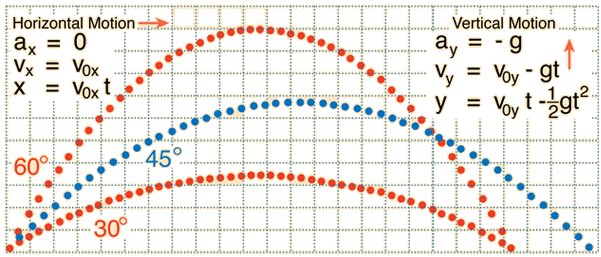
在重力作用下物体的运动完全由重力加速度、初速度和发射角决定(假设空气摩擦可以忽略)。水平和垂直运动可以分开,并通过恒定加速度的一般运动方程进行描述。方程中使用了初速度的矢量分量。图中显示了相同初速度但不同发射角的轨迹。注意,60度和30度的轨迹具有相同的射程,任何一对互补角度的发射也具有相同的射程。45度的发射给出最大射程。
Index

Trajectory concepts

Calculation
索引轨迹概念计算
 
HyperPhysics***** Mechanics
力学
R Nave
Go Back
返回


For launch velocity v0 = m/s, launch angle θ = degrees:
对于初速度 v₀ = m/s,发射角 θ = 度:
中文译文中的待填/计算数值依次对应:1:v0 2:a。实际数值以上方原输入框为准。
At time t = sec:

Horizontal velocity
vx =m/s.
Horizontal distance
x = m.
Vertical velocity
vy = m/s.
Vertical position
y = m.
在时间 t = 秒时:水平速度 v_x = 米/秒。水平距离 x = 米。垂直速度 v_y = 米/秒。垂直位置 y = 米。
中文译文中的待填/计算数值依次对应:1:t 2:vx 3:x 4:vy 5:y。实际数值以上方原输入框为准。
Index

Trajectory concepts
索引 轨道概念
 
HyperPhysics***** Mechanics
力学
R Nave
Go Back
返回


Index

Trajectory concepts
索引 轨道概念
 
HyperPhysics***** Mechanics
力学
R Nave
Go Back
返回


Index

Trajectory concepts
索引 轨道概念
 
HyperPhysics***** Mechanics
力学
R Nave
Go Back
返回


Index

Trajectory concepts
索引 轨道概念
 
HyperPhysics***** Mechanics
力学
R Nave
Go Back
返回


For launch velocity
v0 = m/s,
launch angle
θ = degrees,
The horizontal range is
R = m.
The total time of flight is
t = s.
The peak height is
h = m.
对于初速度 v₀ = m/s,发射角 θ = 度,水平射程是 R = m。飞行总时间是 t = s。最高高度是 h = m。
中文译文中的待填/计算数值依次对应:1:v0 2:a 3:r 4:t 5:h。实际数值以上方原输入框为准。
Index

Trajectory concepts
索引 轨道概念
 
HyperPhysics***** Mechanics
力学
R Nave
Go Back
返回


Will it clear the fence?

它会清过栏杆吗?

The basic motion equations can be solved simultaneously to express y in terms of x.

For launch velocity
v0 = m/s = ft/s, launch angle
θ = degrees,
and horizontal range
x = m = ft,


the calculated height is
y = m = ft.
The time of flight is
t = s.

对于初速度 v₀ = m/s = ft/s,发射角 θ = 度,水平射程 x = m = ft,计算出的最高高度为 y = m = ft。飞行时间是 t = 秒。
中文译文中的待填/计算数值依次对应:1:v0 2:v0c 3:a 4:x 5:xc 6:y 7:yc 8:t。实际数值以上方原输入框为准。
基本运动方程可以联立求解,以用x表示y。
中文译文中的待填/计算数值依次对应:1:a。实际数值以上方原输入框为准。
Index

Trajectory concepts
索引 轨道概念
 
HyperPhysics***** Mechanics
力学
R Nave
Go Back
返回


Where will it land?

它会落在哪里?
The basic motion equations give the position components x and y in terms of the time. Solving for the horizontal distance in terms of the height y is useful for calculating ranges in situations where the launch point is not at the same level as the landing point.
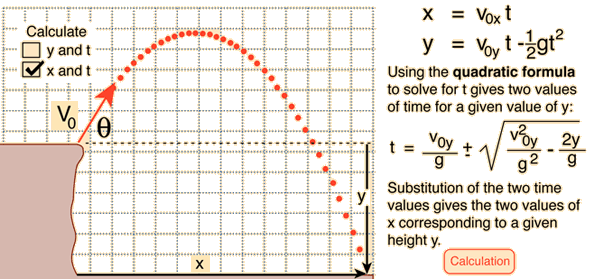
基本运动方程给出了位置分量x和y与时间的关系。用高度y来表示水平距离对于计算在发射点和着陆点不在同一电平情况下的射程是有用的。
Index

Trajectory concepts
索引 轨道概念
 
HyperPhysics***** Mechanics
力学
R Nave
Go Back
返回


Where will it land?

它会落在哪里?

The basic motion equations give the position components x and y in terms of the time. Solving for the horizontal distance in terms of the height y is useful for calculating ranges in situations where the launch point is not at the same level as the landing point.

基本运动方程给出了位置分量x和y与时间的关系。用高度y来表示水平距离对于计算在发射点和着陆点不在同一电平情况下的射程是有用的。
Launch velocity
v0 = m/s = ft/s,
launch angle
θ = degrees,
and trajectory height
y = m = ft,
发射速度 v₀ = m/s = ft/s,发射角 θ = 度,轨迹高度 y = m = ft,
中文译文中的待填/计算数值依次对应:1:v0 2:v0c 3:a 4:y 5:yc。实际数值以上方原输入框为准。
The two calculated times are
t1 = s and
t2 = s.
The corresponding ranges are
x1 = m =ft
and
x2 = m =ft.
计算出的两个时间分别是 t₁ = s 和 t₂ = s。对应的射程分别是 x₁ = m = ft 和 x₂ = m = ft。
中文译文中的待填/计算数值依次对应:1:t1 2:t2 3:x1 4:x1c 5:x2 6:x2c。实际数值以上方原输入框为准。
Note that the value y in the illustration is downward and it is presumed that upward is positive. To reproduce the scenario in the diagram, the input value of y should be negative.

请注意,图中示例中的y值向下,且假设向上为正方向。要重现图中的情景,输入的y值应为负数。
Index

Trajectory concepts
索引 轨道概念
 
HyperPhysics***** Mechanics
力学
R Nave
Go Back
返回


Launch Velocity

发射速度

The launch velocity of a projectile can be calculated from the range if the angle of launch is known. It can also be calculated if the maximum height and range are known, because the angle can be determined.

若已知发射角,可由射程计算出 projectile 的发射速度。如果已知最大高度和射程,也可计算出发射速度,因为可以确定发射角。
From the range relationship, the launch velocity can be calculated. For range
R = m = ft,
and launch angle
θ = degrees,

the launch velocity is
v0 = m/s = ft/s.


从射程关系可以计算出发射速度。对于射程 R = m = ft,发射角 θ = degrees,发射速度为 v₀ = m/s = ft/s。
中文译文中的待填/计算数值依次对应:1:R 2:Rc 3:a 4:v 5:vc。实际数值以上方原输入框为准。
Index

Trajectory concepts
索引 轨道概念
 
HyperPhysics***** Mechanics
力学
R Nave
Go Back
返回


Launch Velocity

发射速度

The launch velocity of a projectile can be calculated from the range if the angle of launch is known. It can also be calculated if the maximum height and range are known, because the angle can be determined.

若已知发射角,可由射程计算出 projectile 的发射速度。如果已知最大高度和射程,也可计算出发射速度,因为可以确定发射角。
For range
R = m = ft,
and peak height
h = m = ft,

the launch velocity is
v0m/s = ft/s.

The required launch angle is
θ = degrees.
对于射程 R = m = ft,和最大高度 h = m = ft,发射速度是 v₀ m/s = ft/s。所需的发射角是 θ = 度。
中文译文中的待填/计算数值依次对应:1:R 2:Rc 3:h 4:hc 5:v 6:vc。实际数值以上方原输入框为准。
Index

Trajectory concepts
索引 轨道概念
 
HyperPhysics***** Mechanics
力学
R Nave
Go Back
返回


Angle of Launch

发射角

Variation of the launch angle of a projectile will change the range. If the launch velocity is known, the required angle of launch for a desired range can be calculated from the motion equations.

弹道的发射角变化会改变射程。如果已知发射速度,可以根据运动方程计算出实现所需射程的发射角。
From the range relationship, the angle of launch can be determined. For range
R = m = ft,
and launch velocity
v0 = m/s = ft/s.
there are two solutions for the launch angle.

θ1 = degrees,

θ2 = degrees,


从射程关系可以确定发射角。对于射程 R = m = ft,发射速度 v₀ = m/s = ft/s,存在两个解的发射角。θ₁ = 度,θ₂ = 度,
中文译文中的待填/计算数值依次对应:1:R 2:Rc 3:v 4:vc 5:a1 6:a2。实际数值以上方原输入框为准。
Index

Trajectory concepts
索引 轨道概念
 
HyperPhysics***** Mechanics
力学
R Nave
 Go Back
返回


Index

Trajectory concepts
索引 轨道概念
 
HyperPhysics***** Mechanics
力学
R Nave
Go Back
返回