Bilingual edition: English is preserved and Chinese follows each unit. Terminology uses the confirmed v20260916 glossary; automated semantic review remains traceable.
中英双语版:英文原文完整保留,中文紧随对应单元;术语采用 v20260916 确认表,自动语义审校结果可追溯。

Perceived Brightness

感知亮度

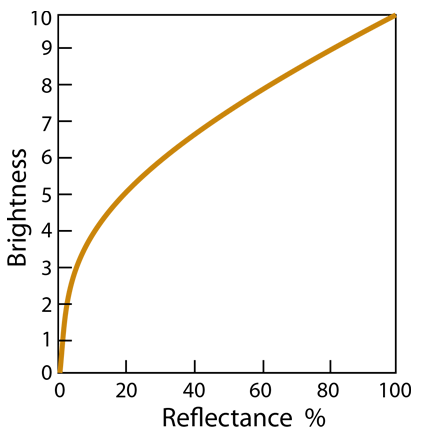
The perceived

光从表面漫反射后的感知亮度并不是实际反射光的线性函数。心理物理实验表明,感知亮度大致与光通量的对数成正比。光通量加倍会导致在任意亮度刻度上增加约1.5个单位。
brightness of light diffusely reflected from a surface is not a linear function of the actual reflected light. Psychophysical experiments indicate that the perceived brightness increases approximately as the logarithm of the luminous flux. A doubling of the flux leads to an increase of about 1.5 units on the arbitrary brightness scale at left.
Index

Vision concepts

Reference
Williamson & Cummins
p177-178
索引 视觉概念 参考 Williamson & Cummins p177-178
 
HyperPhysics***** Light and Vision
HyperPhysics ***** 光与视觉
R Nave
Go Back
返回


Efficacy Tables
效率表

Luminous Efficacy

发光效率

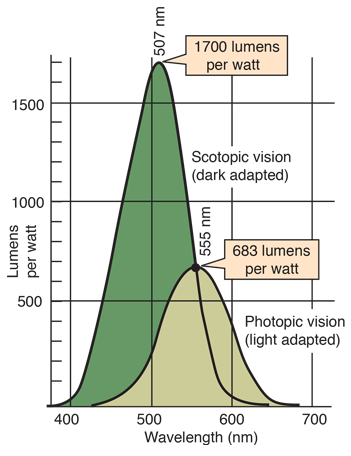
The curves represent the spectral luminous efficacy for human vision. The lumen is defined such that the peak of the photopic vision curve has a luminous efficacy of 683 lumens/watt. This value for the photopic peak makes the efficacy the same as the scotopic value at 555 nm.

这些曲线表示人类视觉的光谱光效。单位制定义为:视黄视觉曲线的峰值光效为683流明/瓦。这个视黄峰值使光效与555纳米处的视敏光效相同。

The scotopic vision is primarily rod vision, and the photopic vision includes the cones.

视觉的 Scotopic 部分主要依赖杆细胞,而 photopic 部分则涉及锥细胞。

The response curve of the eye along with the spectral power distribution of a luminous object determine the perceived color of the object.

眼睛的响应曲线与发光物体的光谱功率分布共同决定了该物体的感知颜色。
Examples
示例
Why is a candle flame yellow?
为什么蜡烛火焰是黄色的?
Index

Vision concepts

Reference
Williamson & Cummins
p173
索引 视觉概念 参考 Williamson & Cummins p173
 
HyperPhysics***** Light and Vision
HyperPhysics ***** 光与视觉
R Nave
Go Back
返回


Photopic Vision

视网膜视觉
The Photopic efficacy curve was extrapolated from testing done on 'Standard Observers'. This was done by taking a person with normal vision, and having them compare the brightness of monochromatic light at 555 nm, where the eye is most sensitive, with the brightness of another monochromatic source of differing wavelength. To achieve a balance, the brightness of the 555 nm source was reduced until the observer felt that the two sources were equal in brightness. The fraction by which the 555 nm source is reduced measures the observer's sensitivity to the second wavelength. This exercise is repeated through many wavelengths and many observers. The average of the results gives us the relative sensitivity of the eye at various wavelengths. In 1924, the International Commission on Illumination adopted the "relative sensitivity curve for the C.I.E. Standard Observer".

视黄素效度曲线是基于对‘标准观察者’的测试进行外推得到的。这一过程是通过让一个视力正常的人比较555纳米波长的单色光(这是眼睛最敏感的波长)与另一种波长不同的单色光源的亮度。为了达到平衡,555纳米光源的亮度被逐渐降低,直到观察者感觉两个光源的亮度相等。555纳米光源被降低的幅度反映了观察者对第二种波长的敏感度。这一实验在许多波长和许多观察者中重复进行。结果的平均值给出了眼睛在不同波长下的相对敏感度。1924年,国际照明委员会采用了‘C.I.E.标准观察者相对敏感度曲线’。

Each wavelength has a relative value for the Standard Observer's sensitivity, the luminous efficacy at that wavelength, Vλ. The value of Vλ is designated as unity at 555 nm and decreases to zero at the ends of the visible spectrum. This is associated with the daylight vision of the human eye, also known as photopic vision. In lowlight conditions, the efficacy curve shifts toward the blue end of the spectrum due to the sensitivity of the eye. Chemical changes in the eye at night shift our vision to the scotopic range. This differentiation between light and dark vision is caused by the activity of the rods and cones in the retina, and their sensitivity to light.

每个波长都有一个相对于标准观察者灵敏度的相对值,即该波长的光通量效率 Vλ。Vλ 在 555 nm 处被指定为 1,而在可见光谱的两端降至零。这与人眼的日间视觉有关,也称为光视型视觉。在低光条件下,由于眼睛的敏感性,效率曲线会向光谱的蓝色端移动。夜间眼睛的化学变化使我们的视觉转向视锥型视觉。这种明暗视觉之间的区别是由视网膜中的杆细胞和视锥细胞的活动及其对光的敏感性所引起的。

At 555 nm, this efficacy translates to a luminous flux of 683 lumens/W, and thus a fraction of that value at wavelengths to either side of the visible spectrum. This value is derived from the definition of the candela directly.

在555纳米处,这种效能相当于683流明/瓦的光通量,因此在可见光谱两侧的波长处,该值会降低。这个值直接来源于坎德拉的定义。
Index

Vision concepts

Reference
Williamson & Cummins
p173
索引 视觉概念 参考 Williamson & Cummins p173
 
HyperPhysics***** Light and Vision
HyperPhysics ***** 光与视觉
T Beaulieu, R Nave
T Beaulieu, R Nave(专名或术语)
Go Back
返回


Scotopic Vision

视网膜视觉

The Scotopic Efficacy curve was established in the same manner as the photopic curve. It's sensitivity is shifted however to peak at 507 nm, and decreases in proportionally the same manner as the photopic curve. This results in the scotopic curve reaching a relative value of zero sooner in the visible spectrum than the daylight curve. As a consequence of this fact, our nighttime vision does not see red!

视觉适应曲线是按照与光适应曲线相同的方式建立的。然而,其灵敏度却在507纳米处达到峰值,并以与光适应曲线相同的比例下降。这导致视觉适应曲线比日光曲线更早在可见光谱中达到相对值为零。因此,我们的夜间视觉无法看到红色!

The scotopic efficacy curve is assigned a value of unity at 507 nm, and is represented by the symbol Vλ. To determine spectral Luminous Efficacy, the scotopic efficacy value, Vλ , must be multiplied by 1700 lumens per Watt. This value was adjusted from 1754 to allow both curves to obtain the same value of 683 lumens/W at 555 nm. So, a source we see with our dark adapted vision at 507 nm produces 1700 lumens for every Watt radiated, and any other wavelength produces a fraction of that value based on the efficacy curve.

视黄效曲线在507 nm处被赋予单位值,并用符号Vλ表示。为了确定光谱光效,必须将视黄值Vλ乘以1700流明/瓦。该值从1754调整而来,以使两条曲线在555 nm处都得到683流明/瓦的相同值。因此,我们在暗适应视觉下看到507 nm的光源,每瓦辐射会产生1700流明,而其他波长则根据效曲线产生相应比例的值。
Rods do not see red!
杆子看不到红色!
Index

Vision concepts

Reference
Williamson & Cummins
p173
索引 视觉概念 参考 Williamson & Cummins p173
 
HyperPhysics***** Light and Vision
HyperPhysics ***** 光与视觉
T Beaulieu, R Nave
T Beaulieu, R Nave(专名或术语)
Go Back
返回