A Cavity Resonator as a Hearing Aid?
The fact that a cavity resonator will respond strongly to a single frequency reportedly led Helmholtz to experiment with it as a hearing aid.
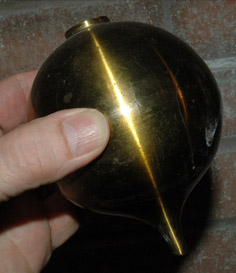 |
The loss of sensitivity to high frequencies with age (presbycusis) leads to difficulty in understanding speech for older persons. Low frequencies tend to mask the frequencies in the normal maximum sensitivity range (2000-5000 Hz) that you depend upon for clear understanding. If you boost a frequency in that range while discriminating against the direct sounds, you might be able to understand better. The Helmholtz resonator acts as a band-pass filter at the resonant frequency. 随着年龄增长,对高频的敏感度下降(耳老年性听力损失)会导致老年人在理解言语时遇到困难。低频声倾向于掩盖你在2000-5000 Hz正常最大敏感度范围内依赖的频率,这些频率对于清晰理解至关重要。如果你在该范围内增强某一频率,同时抑制直接声音,你可能能更好地理解言语。亥姆霍兹共振器在共振频率处起到带通滤波器的作用。 |
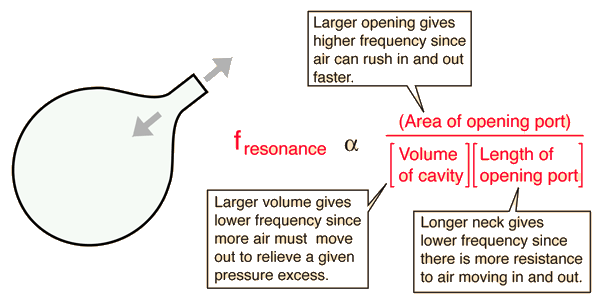
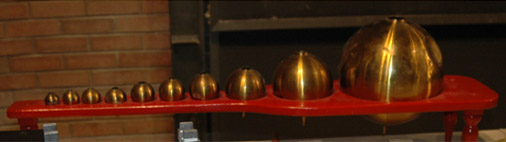
This is a set of brass Helmholtz resonators tuned to a scale of frequencies. This set is part of the sound demonstration equipment at the University of Utah in Salt Lake City.
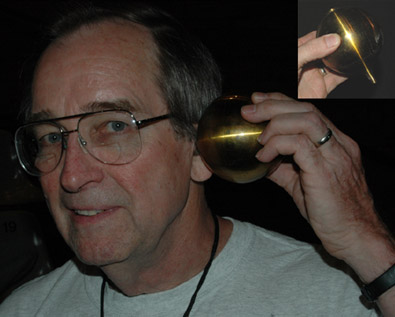
Today's miniature hearing aids are quite a contrast to the Helmholtz resonator type devices which had to be held to the ear. 今天的微型助听器与必须贴在耳畔的亥姆霍兹共振器类型设备形成了鲜明对比。 |
 |
| Applications
应用 | Calculation
计算 |
Wave concepts
Resonance concepts
| HyperPhysics***** Sound
HyperPhysics ***** 声音 | R Nave |